
What an Android Pokies App Actually Promises Australians in 2026
The proposition arrives by way of an APK download, a paid search result, a banner, or a Telegram channel. An Android pokies app will offer a real-money account, a library of slot games dressed to look like the machines on a pub floor in Sydney or Melbourne, and a withdrawal path back to a debit card, an e-wallet, or a crypto wallet. None of it is licensed in Australia. The Interactive Gambling Act 2001 makes the product category a prohibited interactive gambling service, and the brand that takes the deposit is breaking Australian law, not bending it. That is the deal on offer before a cent moves: a transaction with an operator the local regulator has no jurisdiction over, no Australian complaint body behind it, and a real chance the site gets blocked while a balance is still on the account.
Current as of 29 October 2026 against the Australian Communications and Media Authority’s register of blocking requests and formal warnings.
Table of Contents
- The Fundamentals of Real-Money Pokies Apps on Android in Australia
- The Prohibition Governing Every Offshore Pokies App for Australians
- What Offshore Pokies Apps Cost the Australian Player
- Touchscreen Mechanics: What Changes When Pokies Move to a Phone
- Comparison: Eleven Operators the ACMA Has Formally Warned
- Common Questions About Real Money Pokies Apps on Android in Australia
The Fundamentals of Real-Money Pokies Apps on Android in Australia
A real-money Android pokies app, in the form most commonly advertised to Australian players, is an Android Package Kit sideloaded from outside the Google Play Store and run as a standalone application on the phone. It opens to a login or a sign-up form, asks for a deposit method, and serves up games built on the same random-number-generator mathematics as their land-based counterparts. The visual language borrows from Australian pokies culture — fruit symbols, hold-and-spin bonus rounds, “free games” features, the Asian-themed and Egyptian-themed slots that line the floors of clubs in NSW and Queensland — but the casino operating the software is registered in Curaçao, Cyprus, or another permissive jurisdiction, and the game studio behind the visuals is usually Bgaming, Pragmatic Play, or one of the other white-label suppliers that rents its catalogue to dozens of operators at once.

What sits behind that storefront is a market Australians have helped build into one of the world’s heaviest gambling economies. In 2020–21 Australians bet almost A$150 billion through gaming machines and lost A$12.18 billion on them. The country holds roughly 3 percent of the world’s pub and club poker machines with about 0.3 percent of the global population. The figures are not new, and they cover legal venues, but they sketch the pool the offshore apps are fishing in: a population that knows the product, plays it at scale, and lives in a country where the legal version is regulated venue by venue.
That legal version is heavily present on the ground. New South Wales had 87,298 gaming machines outside casinos across 2,195 venues as of June 2023, with player losses of A$8.18 billion in 2022–23. Queensland reported 21,122 gaming machines operating in 351 venues in October 2023. Victoria had 26,380 machines outside Crown Casino spread across 488 venues in 2021–22, operating under a 30,000-machine statewide limit. Western Australia has banned poker machines in pubs and clubs since Crown Perth opened in 1985; that casino alone has grown from about 200 machines at opening to roughly 2,500 today, all approved by the state’s Gaming and Wagering Commission. Electronic gaming machines — pokies, in the Australian vocabulary — operate in every state and territory, with each jurisdiction writing its own rules.
Registered clubs operated Australia’s first legal poker machines from 1956 in New South Wales. Tasmania awarded the Federal Group a monopoly licence over all of the state’s machines in 1968, and legislation passed in November 2021 ended that monopoly, moving oversight to the Tasmanian Liquor and Gaming Commission. The same state planned nation-leading mandatory pre-commitment cards for its machines, with implementation delayed until late 2025. The history matters because it explains why the legal version looks the way it does: a venue product, regulated state by state, with a return-to-player floor written into law.
That floor varies by jurisdiction: 85 percent in NSW, the Northern Territory, Queensland, and (generally) Victoria (87 percent at Crown Melbourne), 87 percent in the ACT and Tasmania, 87.5 percent in South Australia, and 90 percent in Western Australia. The minimum is the floor, not the actual return — venues and machines operate above it where competition and regulation push them — but it defines the legal product an Australian can sit down and play in a venue. The Android pokies app that arrives via sideload makes no such commitment to its customers; it advertises return-to-player percentages for individual games, but those figures sit inside terms of service drafted in another country, enforced by another country’s regulator, with no Australian body checking the maths.
The legal minimum is also what makes the offshore product feel familiar to Australian players. The same icons, the same five-reel layouts, the same hold-and-spin bonus mechanics, the same Australian slang in the paytable. A punter who knows Crown Perth’s baccarat or a Sydney club’s Dragon Train has seen the bones of an offshore pokies app already. What they have not seen is the licensing envelope around it, and the absence of that envelope is what the rest of this reading covers: the legal frame, the enforcement record, the mobile mechanics, and the eleven offshore operators the ACMA has chosen to name in writing.
See also Real Money Pokies Apps in Australia.
The Prohibition Governing Every Offshore Pokies App for Australians
The prohibition is statutory, and it predates the smartphone. The Interactive Gambling Act 2001 makes it an offence to provide certain interactive gambling services to customers physically present in Australia. The Interactive Gambling Amendment Act 2017 tightened the law, expanded what counts as a prohibited service, and gave the Australian Communications and Media Authority sharper enforcement tools. What is captured is online casino games, online pokies, and in-play betting — the live wagering that lets a punter back the next ball, the next point, or the next goal after the event has started.
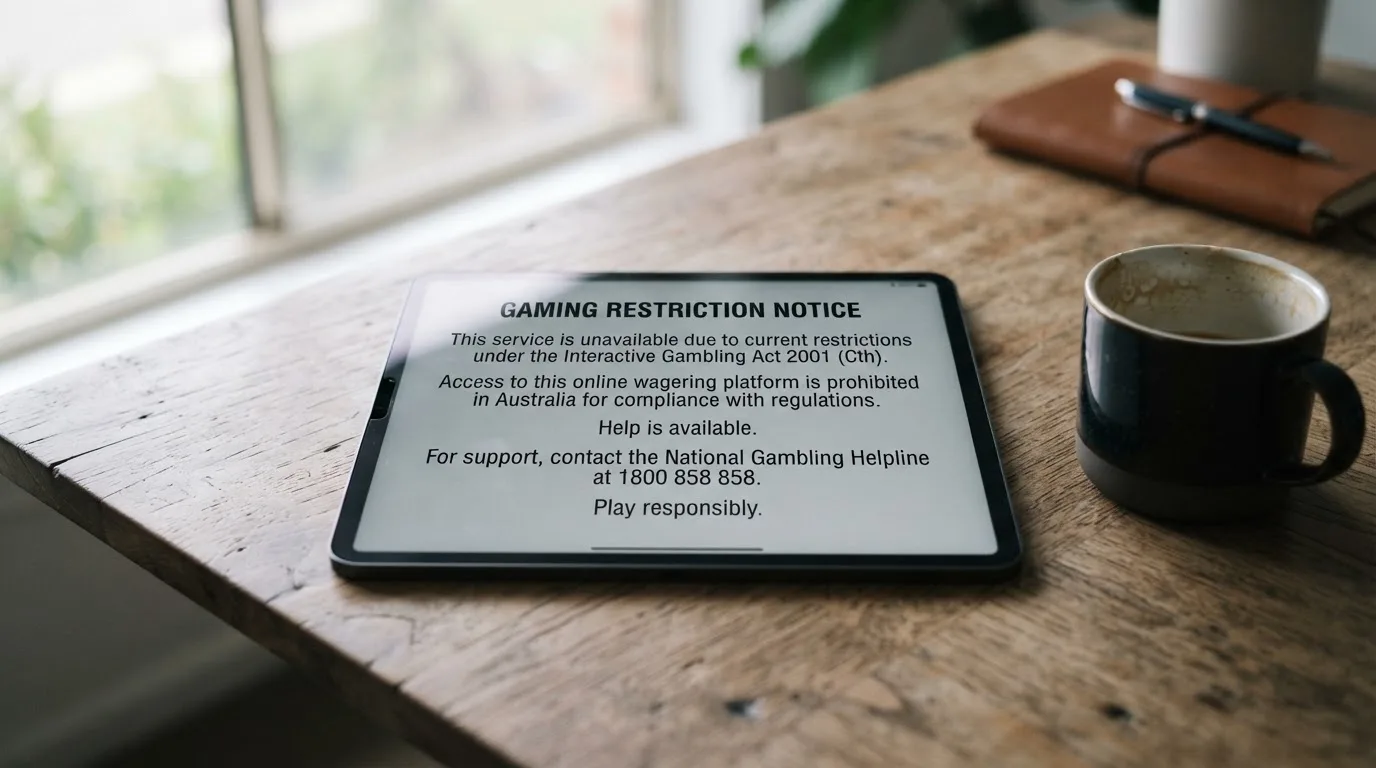
What remains licensable is narrower than the marketing suggests. Wagering on races and sporting events placed before the event begins is licensed. Lotteries and keno are licensed. In practice, most online bookmakers Australians use — Sportsbet, Bet365, Ladbrokes — operate under licences issued by the Northern Territory Racing and Wagering Commission, a body that regulates 52 of Australia’s online bookmakers for tax reasons. That commission has no full-time staff and meets once a month in Darwin. The licensee pays its territory tax, the wagering product is offered to Australians under IGA exemptions, and the regulator’s role is administrative rather than consumer-facing.
Online casino games and online pokies sit outside any licence an Australian state or territory can issue. No jurisdiction here licences an offshore-facing Android pokies app. The claim that one is licensed — usually to Curaçao, Anjouan, or the Kahnawake Gaming Commission — does not translate into any Australian consumer protection. The IGA targets the provider, not the individual player: nobody has been prosecuted for downloading and playing. The cost of that asymmetry is paid by the player when something goes wrong.
What “going wrong” looks like in practice is concrete. An offshore casino gives no Australian consumer protection. There is no Australian complaints body to escalate to. If a withdrawal is refused, the bonus terms are read in a way the player did not expect, or the account is closed with funds inside, the practical recourse is the operator’s own dispute process — typically answered by the same staff that made the original decision — followed by a complaint to a regulator with no jurisdiction over an Australian resident. If the ACMA later adds the site to a blocking request, the URL stops resolving in Australia while a balance may still be sitting on the account.
The enforcement record shows what that risk has looked like over time. By 26 June 2026 the ACMA had asked Australian internet service providers to block 1,751 illegal gambling and affiliate marketing websites since the first such request was filed in November 2019, and more than 230 unlicensed gambling services had left the Australian market since enforcement was strengthened in 2017. A single enforcement round reported on 26 June 2026 directed ISPs to block a further twelve names: 7Signs, ChromaBet, Donbet, Duospin, Freshbet, Slots Gem, Jacks Club, Lucky Start, Pointsbetz, Spinrise, Vinyl Casino and Wildsino. The list of names is what changes; the underlying pattern does not.
What that record translates to in volume is worth stating directly. The ACMA’s blocking request pace, averaged over the roughly six-and-a-half years from November 2019 to the June 2026 total of 1,751, runs somewhere in the order of 22 requests a month — or roughly 260 a year — with the actual monthly figure swinging well above or below that average in concentrated rounds, the June 2026 batch alone accounting for twelve of them. Treating any single year as representative misreads the curve. The honest reading is the band: roughly 20 to 25 blocking requests a month, or 240 to 300 a year, with single-round spikes the average smooths out. A reader who treats the ACMA’s pace as constant undercounts it during enforcement rounds and overcounts it in quiet months.
The economic case for staying outside that enforcement is large. H2 Gambling Capital’s 2025 report estimates that Australians lose about A$3.9 billion a year to illegal gambling sites, and that the share of gambling going through legal channels fell from 74 percent in 2021 to 64 percent. The decline is not from licensed operators losing ground to each other — the licensed wagering market is roughly flat — but from licensed wagering losing ground to illegal casino and pokies products. The market the offshore pokies apps serve is, by these figures, the largest segment of Australian gambling that is not legal to supply.
One further piece of the legal frame took effect on the publication year of this page. The Interactive Gambling Amendment (Gambling Reform) Bill 2026 passed Parliament on 19 August 2026; its advertising and inducement measures commence on 1 January 2027. It is law with a start date, not yet in force, and it reaches the marketing around the apps more than the apps themselves. The IGA itself remains the prohibition that governs the supply side; the 2026 amendment tightens the inducements that draw Australians toward prohibited services in the first place.
What Offshore Pokies Apps Cost the Australian Player
The cost is not theoretical. A licensed Australian wagering account sits inside a framework that gives the consumer somewhere to go when something goes wrong. An offshore account does not, and the absence of that framework shows up in places a player usually meets only when the account is already in trouble.
The most concrete example is withdrawal. A licensed Australian operator is bound by Australian transaction rules, anti-money-laundering obligations, and complaint pathways through state and territory regulators. An offshore operator is bound by the rules of whatever jurisdiction issued its licence, and the customer is in neither. When a withdrawal stalls, a bonus term is read in a way the player did not expect, or a verification process becomes a tool for delay, the practical recourse is the operator’s own dispute process — typically answered by the same staff that made the original decision — followed by a complaint to a regulator with no jurisdiction over an Australian consumer. That regulator is in another country, on another continent, with no obligation to respond in a useful timeframe.
The self-exclusion framework tells the same story. BetStop, the National Self-Exclusion Register, has been live since August 2023 and binds every Australian-licensed online and phone wagering service. A person on BetStop cannot open a new account with a licensed bookmaker, and existing accounts are closed. The register does not bind offshore casinos. Self-excluding through BetStop is the right step for an Australian who has decided to stop, but it does not touch the offshore Android pokies app installed on the phone, and it does not prevent that app from accepting a deposit from the same person.
Where to go instead, when the decision is to stop, is uncontested. The National Gambling Helpline on 1800 858 858 is free, operates 24/7, and routes callers to state and territory counselling services. Gambling Help Online runs the live text-based chat counterpart. Both are Australian, both are free, both are funded to work with the person rather than the operator. The point of mentioning them in a piece on offshore apps is not to suggest they can recover a lost balance; it is to confirm that the support system in Australia is intact even where the product is not.
The payment side of the prohibition also reaches the player’s wallet. Credit cards, credit-related products, and digital currency have been banned as payment methods for licensed online wagering since 11 June 2024, with penalties up to A$247,500 for operators that breach the rule. The legal deposit routes for a licensed Australian wagering account are debit card, bank transfer, PayID, Osko, and BPAY. An offshore app asking for a credit card or a crypto deposit is by that request alone operating outside the Australian rule set, and the player has no Australian chargeback or transaction-dispute mechanism if the funds disappear.
The tax side of the question sits on the other end of the ledger. Gambling winnings of a recreational Australian player are not assessable income under section 6-5 of the Income Tax Assessment Act 1997, and losses are not deductible, unless the person carries on a business of gambling. That model answer is the cleanest the Australian Taxation Office offers; the practical advice, where the position is unclear, is to check with the ATO.
The IGA targets the provider, not the individual. The 1,751 blocking requests, the 230-odd services pushed out of the market, and the formal warnings to specific operators are the ACMA acting against the supply side. The Australian who downloaded the app is not who the regulator is coming for. The cost is paid in the lack of recourse, the lack of a self-exclusion bite, and the lack of a payment system that protects the customer when something goes wrong. That is the player-side reality of the prohibition: the regulator acts against the operator, and the player is left to act for themselves.
Touchscreen Mechanics: What Changes When Pokies Move to a Phone
The mechanics of an offshore Android pokies app are the mechanics of any sideloaded application that wants to behave like native software on the phone. It installs as its own package, draws its own launcher icon, asks for the permissions its developer wants, and on launch fills the screen with the game catalogue or the login form. The differences from a browser-based casino are practical ones — and they explain why operators invest in an APK at all when a mobile website would technically do the same job.
The Google Play Store does not host real-money gambling apps for the Australian market. Google’s policy restricts real-money gambling apps to certified operators in jurisdictions where the activity is licensed, and Australia is not among them for casino and pokies products. The app a player installs is therefore almost always an APK downloaded from the operator’s own site or from a third-party mirror, with a setting in the phone’s security menu allowing installation from unknown sources. That single change is the most consequential one in the install process, because it disables a protection layer Google puts around the operating system. From that point the app is free to ask for whatever permissions it wants, and the phone’s only remaining line of defence is what the user chooses to grant.
Permissions are the next concrete difference. A real-money pokies app typically asks for storage access (to cache game assets and to read media files), phone state (to detect calls and pause play), full network access (to reach the operator’s servers and payment processors), and on older versions of Android the ability to read SMS messages — the last one is sometimes used to auto-read verification codes, sometimes for less benign purposes. Some apps also request accessibility services, which would let them read screen content and automate gestures, and a meaningful minority request overlay permission, which lets them draw on top of other apps. None of these requests is unique to gambling apps; the same permissions are asked by other categories of sideloaded software. What is unique is the combination: an app outside Google’s review process, holding payment credentials and personal identity information, asking for deep access to the device.
Why operators bother with the APK at all is a question of habit and persuasion rather than technology. A downloaded app sits on the home screen with a logo; a bookmarked URL does not. Push notifications reach the player without the player opening a browser. Animations and sound run with less of the browser’s overhead, which matters on cheaper phones and on weaker networks. The “download for Android” framing is itself part of the pitch — the operator is selling weight, presence, an experience closer to a venue than to a website — and the player who installs from a sideload is signalling the same thing back.
The free Aristocrat-style pokies apps available through the Play Store illustrate the contrast. They carry the same visual vocabulary — the same five-reel layouts, the same hold-and-spin bonuses, the same Australian slang in the paytable (“feature,” “big win,” “hold”) — but they pay out in play money only, with no deposit mechanism and no withdrawal path. The mathematics underneath is the same kind of RNG output, and the games are built to feel similar, but the money flow stops at the spin. The transition from a free Aristocrat-style app to a real-money sideloaded APK is a transition from a closed system to an open one with all the consumer risk that implies.
The screen itself reshapes the experience. Pokies are designed to be played in long sessions, often in portrait orientation on a phone, with one thumb doing the work. The animations are tuned for a five- to ten-centimetre-wide display, and the touch zones for spin, max bet, and autoplay are calibrated to thumbs rather than mice. A hand-held session feels faster than a desktop session, partly because the controls are closer together and partly because the phone’s accelerometer, haptics, and notification discipline push the player to keep going. None of this changes the mathematics of the games underneath. The house edge on a banker bet in baccarat is 1.06 percent, on the player bet 1.24 percent, on the tie 14.36 percent; blackjack under Las Vegas Strip rules with optimal play holds an edge of about 0.28 percent. Punto banco, the variant most played today, banks both hands by fixed drawing rules out of a six- or eight-deck shoe. The touch interface changes the rhythm at which that edge is collected, not the edge itself.
What an Android Pokies App Actually Promises Australians in 2026 — More on this topic at casino providers.
Comparison: Eleven Operators the ACMA Has Formally Warned
The eleven brands named here are not a ranking, and they are not a recommendation. Each is an offshore casino the ACMA itself named in a formal warning for offering prohibited interactive gambling services to Australians. The table reads the public record side by side — the warning, the date, the operator entity behind it, any earlier ACMA action on the same brand, and what the brand’s own marketing footprint looks like — without taking a position on which operator a reader should choose, because no reader should choose any of them under Australian law.
The ACMA issues formal warnings under the Interactive Gambling Act 2001 as a precursor to further action. A warning is not a blocking order, but a brand that has been warned and continues to accept Australian customers is advertising its own disregard for the warning. Two of the eleven brands here have been warned twice under different operator names — a pattern that points to the underlying operator shell game rather than to any change in conduct.
| Brand | ACMA action and date | Operator named by the ACMA | Earlier ACMA action on this brand | Subject support in available listings |
|---|---|---|---|---|
| RocketPlay | Formal warning, March 2026 | Pulsup Ltd | Dama N.V., May 2022 | — |
| Level Up Casino | Formal warning, May 2022 | Dama N.V. | — | bgaming directory listing |
| Woo Casino | Formal warning, March 2025 | Dama N.V. | — | — |
| Spirit Casino | Formal warning, May 2025 | Dama N.V. | — | — |
| National Casino | Formal warning, July 2025 | Consolutetish S.R.L. | — | en.wikipedia.org passing mention |
| Bizzo Casino | Formal warning, July 2025 | Consolutetish S.R.L. | TechSolutions Group, 2022 | — |
| Ignition Casino | Formal warning, July 2025 | Bamboo Media | — | — |
| Instant Casino | Formal warning, February 2025 | EOD Code SRL | — | — |
| Jackbit | Formal warning, April 2026 | Ryker B.V. | — | — |
| Casino Intense | Formal warning, April 2025 | Sterplay Holding Ltd | — | Abc.net.au, acma.gov.au, Crownmelbourne.com.au references |
| Sky Crown | Formal warning, September 2022 | Hollycorn N.V. | — | — |
The “subject support” column reads the way the listings themselves read. A brand listed in a game studio’s catalogue is being marketed, not licensed; a brand mentioned in passing on Wikipedia is being catalogued, not endorsed; the references on the ABC News and ACMA websites, where they appear, are themselves the warnings. None of the listings carry any weight as Australian consumer protection, and none convert into a right of recourse for an Australian player.
RocketPlay — a paper trail of two operator shells in four years
RocketPlay was warned in May 2022 under Dama N.V. and again in March 2026 under Pulsup Ltd. The brand survived the change of operator entity and kept accepting Australian customers in between. That is the whole story the dual warning tells: a brand that has now been told twice, by two different registered owners, that its product is prohibited, and that continues to advertise to Australians regardless. The two operator shells — Dama N.V. and Pulsup Ltd — are the visible evidence; the conduct underneath is the same.
Level Up Casino — one of seven Dama N.V. brands named in a single 2022 letter
Level Up Casino was one of seven casino brands the ACMA named when it warned Dama N.V. in May 2022; the others were Bambet, Dazard, RocketPlay, Wild Tornado, and Cobra Casinos. Bgaming’s own game directory lists Level Up among the casinos using its content, which is the practical meaning of the “subject support” figure in the table: a game studio’s catalogue is a marketing channel, not a licence. The Dama N.V. cluster is the largest single operator footprint in the ACMA’s enforcement record against casino brands, and Level Up is one of seven examples of what that footprint looks like.
Woo Casino — Dama N.V.’s March 2025 warning, three years after the cluster
Woo Casino drew a fresh Dama N.V. warning in March 2025, three years after the ACMA had already told the same operator about six of its brands. Woo and Spirit share an operator, a parent group, and a warning year, and the gap between them is two months. Reading the two together is the cleanest way to see the warning’s pattern: an operator group the ACMA has now engaged with across two separate enforcement cycles, with the second cycle not producing any different conduct from the first.
Spirit Casino — Dama N.V.’s May 2025 warning, two months after Woo
Spirit Casino is the second half of the Dama N.V. pair for 2025. The May 2025 warning arrived two months after Woo’s, on the same legal grounds, against the same operator. Treating the two as separate cases understates the underlying structure; treating them as one case oversells the regulator’s bandwidth. The truth is in the middle, and the ACMA’s own publication list is the source that places them adjacent in its register.
National Casino — a Consolutetish warning, with a Wikipedia mention in passing
National Casino drew its formal warning in July 2025 under Consolutetish S.R.L., one of two brands the operator group was warned on in that cycle. The Wikipedia entry on gambling in Australia mentions the brand in passing alongside other offshore names, which is the limit of the listing-level evidence here. A Wikipedia mention does not constitute a licence, an endorsement, or an Australian footprint — it is a citation that the brand exists in the offshore category, nothing more.
Bizzo Casino — warned twice like RocketPlay, three years apart
Bizzo Casino was first warned in 2022 under TechSolutions Group, then again in July 2025 under Consolutetish S.R.L. The pattern is the one RocketPlay shows: the same brand, the same product category, two operator entities, two warnings, no change in conduct. The earlier warning was addressed to TechSolutions (CY) Group Limited and TechSolutions Group N.V., both Cyprus-registered, both wrapping the same underlying offer. A third operator shell wrapped around Bizzo has not produced a third shift in behaviour.
Ignition Casino — a US-poker-themed brand, warned under Bamboo Media
Ignition Casino carries the branding of an American poker room, and the ACMA’s July 2025 warning was issued to Bamboo Media, the operator behind it. An American-sounding name is not a defence against an Australian prohibition, and the warning was published with the same effect as any other. The brand’s design language targets a North American audience that the ACMA’s jurisdiction does not reach, which is part of what makes the Australian player a different kind of customer to the operator than a US one — and a customer with none of the US consumer protections either.
Instant Casino — the earliest 2025 warning in the ACMA’s cycle
Instant Casino was warned in February 2025 under EOD Code SRL, making it the earliest 2025 entry in this list. The warning predates Woo, Spirit, Ignition, National, Bizzo, and Casino Intense, and it sits at the front of a year in which the ACMA issued enough formal warnings to fill the rest of 2025 and roll into 2026. The pattern is what the year is; the brand is one example of it.
Jackbit — fresh on the ACMA register, April 2026
Jackbit was warned in April 2026 under Ryker B.V., alongside sister casino CasinOK. The April 2026 letter is one of the most recent on the register, and it tells the same story as the others: a brand registered through a Curaçao entity, offering a prohibited product, accepting Australian customers. Nothing about a recent warning makes the operator less likely to keep doing so, and the absence of any earlier ACMA action on Jackbit does not distinguish it from the rest of the list.
Casino Intense — three Australian sources, all of them the warning itself
Casino Intense’s only footprint in Australian sources is the warning itself. ABC News reported on the April 2025 action, the ACMA’s own page published the formal warning, and Crown Melbourne’s site appears in the same source set as a reference to the broader Australian casino market the offshore brand is competing with. None of the three listings carries Casino Intense as an Australian-licensed operator; all three treat the brand as a foreign operator in breach of the IGA. The lesson the Australian sources teach about Casino Intense is the lesson the warning itself teaches: there is no other angle on this brand in the Australian record.
Sky Crown — paired with sister casino Blue Leo in one 2022 letter
Sky Crown was warned in September 2022 under Hollycorn N.V., in the same letter that named sister casino Blue Leo. The Hollycorn letter is the oldest formal warning on this list, and it shows the same pattern the 2025 cluster shows: one operator group, multiple brand names, one warning covering several of them at once. Sky Crown has continued to advertise to Australian players since, on the same terms the warning named, and the four years between that warning and the ACMA’s 2026 enforcement cycle have not produced any change in that posture.
Common Questions About Real Money Pokies Apps on Android in Australia
Does the Google Play Store host any real-money pokies app an Australian could install?
No. Google’s policy restricts real-money gambling apps to certified operators in jurisdictions where the activity is licensed, and Australia is not on that list for casino or pokies. Apps an Australian installs come from outside the Play Store, with installation-from-unknown-sources enabled on the phone.
Does sideloading an offshore pokies APK leave an Australian player open to prosecution?
No. The Interactive Gambling Act 2001 targets the provider, not the customer, and no Australian player is known to have been prosecuted for downloading or playing. The cost is consumer-side: no complaints body, no recourse on a stalled withdrawal, no BetStop bite, no payment-dispute mechanism.
What is the actual difference between a free Aristocrat-style pokies app and a real-money one?
Free Aristocrat-style apps on the Play Store use the same look and RNG maths as pub machines but pay out in play money only. A real-money app takes a deposit, runs the same kinds of games, and is supposed to pay withdrawals back — outside any Australian licence or recourse.
What Android permissions does a real-money pokies app typically request?
Storage access (for game assets), phone-state (to pause on calls), full network, and on older Android the ability to read SMS — sometimes for verification codes, sometimes for purposes the player cannot see. Some also request accessibility services or overlay permission, granting deep reach into other software on the phone.
Why does the marketing emphasise an Android download rather than a browser-based casino?
A downloaded app sits on the home screen with a logo, can send push notifications without a browser, and runs animations with less overhead than a mobile site. The ‘download for Android’ framing sells weight and presence, producing a customer one tap from a session rather than one URL away.