
Instant payout online casinos in Australia: what the claim is worth, what the law allows
An “instant payout” casino is a site that promises a withdrawal will land in the customer’s account within minutes rather than days. The phrase sells the gap between two pains: the wait for a bank transfer, and the bank transfer that never arrives at all. For Australian readers, that gap has another dimension that no marketing page acknowledges. Online casino games and online pokies cannot be licensed anywhere in Australia under the Interactive Gambling Act 2001. Every site advertising instant payouts to an Australian reader is offering a prohibited service. The figure research pins on this market — about A$3.9 billion a year flowing to unlicensed offshore sites — is what enforcement has so far failed to redirect.
This page works through the gap between what instant payout marketing promises and what an Australian reader can lawfully do with it. It covers the rail that actually moves money fast in Australia (PayID and Osko), the ACMA’s enforcement record, the bank-side blocks that intercept gambling transactions before they leave the account, the responsible gambling tools that work inside Australian law, and the eleven brands the ACMA itself has acted against in the last two years. Each one carries a verdict on what the reader actually has in front of them — because a list of names is not a recommendation, and a name that appears here has been placed here because the regulator put it here.
As of 1 November 2026, every operator and enforcement claim on this page was checked against the ACMA register of formal warnings and against the Reserve Bank of Australia’s published materials on card payments and surcharging.
Table of Contents
- The Australian legal frame for any online casino offer
- How the ACMA has enforced that frame
- Settlements: the blocking rate as a measure of enforcement reach
- Responsible gambling tools that work inside Australian law
- Crypto and the false promise of anonymous instant payout
- PayID, Osko and the rail that actually moves money fast
- Bank-side gambling blocks in detail
- What is licensed, and where an Australian reader can play lawfully
- The eleven brands the ACMA has acted against
- The brand landscape at a glance
- What an Australian reader can actually do
- What the marketing word “instant” is worth
- On choosing not to play
- On tax and winnings
- Frequently asked questions
The Australian legal frame for any online casino offer
The Interactive Gambling Act 2001 makes it an offence to provide online casino games, online pokies or in-play betting to a person physically in Australia. The 2017 amendments gave the ACMA real teeth: the authority can investigate, issue formal warnings, and direct Australian internet service providers to block offending sites. None of the eight Australian states and territories licenses online casino products. What is licensed is wagering on sport and racing placed before the event, lotteries, and keno — in practice, licensed through the Northern Territory Racing and Wagering Commission (NTRWC), a body with no full-time staff that meets once a month in Darwin and oversees 52 online bookmakers including Sportsbet, Bet365 and Ladbrokes. The NTRWC’s role is tax-driven, not consumer-protection-driven.

The player is not the target of the Act. Enforcement falls on the provider. An offshore operator that takes an Australian deposit is not prosecuted in Australia, but it gives the customer nothing an Australian consumer would recognise as protection: no complaints body, no dispute resolution, no recourse if a withdrawal is refused or a balance sits on a blocked domain. The ACMA can block the site while real money is still in it.
A second reform layer is on the books. The Interactive Gambling Amendment (Gambling Reform) Bill 2026 passed Parliament on 19 August 2026, and its advertising and inducement measures commence 1 January 2027. The law exists; it has not yet started. For a reader reading this in 2026, the active frame is the 2001 Act as amended in 2017, the 2023 credit-card ban on licensed wagering services, and the ACMA’s blocking list.
How the ACMA has enforced that frame
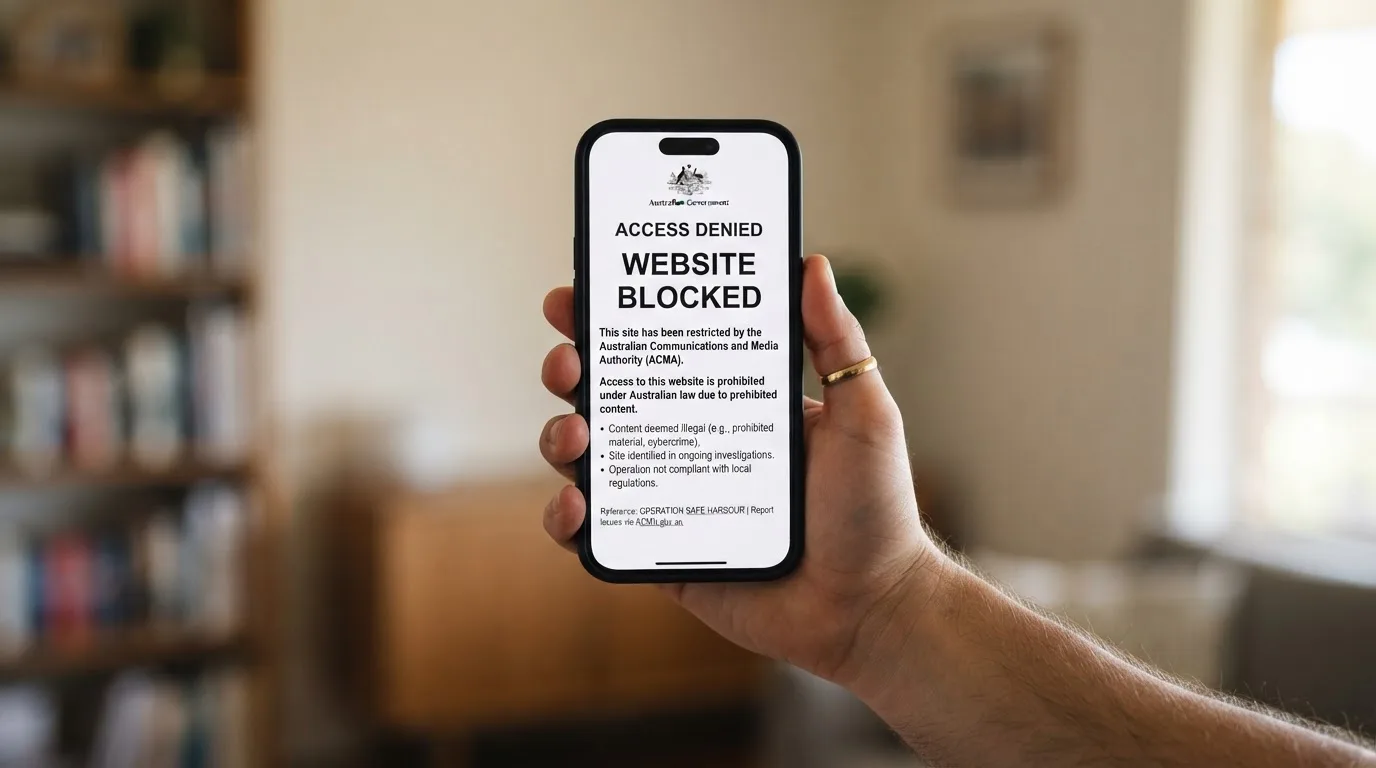
The ACMA publishes every formal warning it issues and every blocking request it sends to Australian ISPs. Two figures anchor the picture. As of June 2026 the ACMA reported a cumulative 1,751 illegal gambling and affiliate marketing websites blocked since the first blocking request in November 2019, and more than 230 unlicensed gambling services had exited the Australian market since enforcement was strengthened in 2017. In the most recent published round, on 26 June 2026, the ACMA asked ISPs to block 12 more sites in one batch: 7Signs, ChromaBet, Donbet, Duospin, Freshbet, Slots Gem, Jacks Club, Lucky Start, Pointsbetz.com, Spinrise, Vinyl Casino and Wildsino.
The formal warnings tell a related story. They are issued to the corporate entity behind the brand rather than to the brand name itself, which is why the same operator name keeps recurring across multiple brands: Dama N.V. has been warned over Bambet, Dazard, Level Up, Rocketplay, Wild Tornado and Cobra Casinos (May 2022), then again over Woo Casino (March 2025) and Spirit Casino (May 2025). Consolutetish S.R.L. was warned in July 2025 over National Casino and Bizzo Casino, with Bizzo also caught up in an earlier 2022 warning to TechSolutions. Pulsup Ltd was warned over Rocketplay.com.au in March 2026. Bamboo Media was warned over Ignition Casino in July 2025. EOD Code SRL was warned over Instant Casino in February 2025. Ryker B.V. was warned over Jackbit and CasinOK in April 2026. Sterplay Holding Ltd was warned over Casino Intense in April 2025. Hollycorn N.V. was warned over Sky Crown and Blue Leo in 2022.
The pattern is the point. Offshore operators do not exit the Australian market on receipt of a warning — they rename the brand, swap the corporate shell, or relaunch. The enforcement record is long because the product is illegal and the demand is real; nothing else explains why the ACMA is still writing to Dama N.V. in 2025 about a brand it warned in 2022.
Settlements: the blocking rate as a measure of enforcement reach
Understanding the pace at which the ACMA clears the queue provides a clearer picture of enforcement reach. The first blocking request went out in November 2019. The cumulative count reached 1,751 by the round reported on 26 June 2026 — a span of roughly six and a half years. That is a band, not a single figure: between roughly 250 and 280 sites blocked per year on average, with the year-to-year spread wider than the average suggests, because the early years were slow (the regime’s first blocking request had to wait until late 2019) and the most recent rounds batched a dozen sites at a time. The condition that makes the band honest is that this is the ACMA’s published cumulative count of blocking requests carried out by ISPs, not a count of unique operators and not a count of brands — one warning can name several sites, and one operator can run several warnings’ worth of brands across several shells. Treating the 1,751 as “1,751 distinct casinos shut” is the misread the figure invites.
The takeaway is not the rate. It is what the rate does not capture: the brands that have been warned and continue to operate under a new name, the affiliate marketing pages that send traffic to those brands, and the share of Australians — H2 Gambling Capital’s 2025 estimate puts illegal gambling losses at about A$3.9 billion a year — who reach the offshore site before the ACMA does.
Responsible gambling tools that work inside Australian law
Two things are true at once. Australians lose real money to illegal offshore sites, and the responsible gambling tools built for Australians do not reach those sites. BetStop, the National Self-Exclusion Register, has been live since August 2023 and is the country’s single self-exclusion mechanism for online gambling. Its reach is limited to Australian-licensed online and phone wagering services — sports bookmakers, racing operators, the licensed keno and lottery products. An offshore casino running on a Curaçao or Anjouan shell is not connected to BetStop, and an exclusion registered there has no effect on what a player can do at an unlicensed site.
The help lines are a different layer, and they do not require the site to be licensed. The National Gambling Helpline at 1800 858 858 is free, runs 24/7 and offers chat through Gambling Help Online. A reader who has been playing at an offshore site and wants to step back can use the helpline regardless of where the gambling happened. A reader who wants the site itself to be unable to take their money needs the bank-side blocks, not the regulator.
The major Australian banks now offer card-level gambling blocks that intercept the transaction before it leaves the account. Westpac’s gambling block refuses authorisation of any transaction registered under the merchant category code for betting and casino gambling, on eligible personal credit and debit cards. ANZ’s gambling block, activated in the ANZ app, blocks gambling transactions on eligible cards — and also blocks them when they pass through a digital wallet such as Apple Pay on the same card. Commonwealth Bank’s gambling lock in the CommBank app works similarly and explicitly states that it cannot guarantee every gambling transaction will be stopped. ANZ adds a 48-hour cooling-off period before its block can be removed, and warns that some non-gambling transactions may be blocked in error. None of these blocks is a substitute for BetStop, and none of them reaches a site that has not yet been added to the merchant code registers — but for the licensed wagering services they cover, they make it materially harder for the next deposit to go out.
A reader who wants both layers — exclusion from licensed wagering and a card that refuses the transaction — should register with BetStop first, then turn on the bank’s block. A reader who only wants the card-level block can do it without registering, and the bank will do it within minutes.
Crypto and the false promise of anonymous instant payout
A reader searching for “instant payout crypto casino” or “instant payout bitcoin casino” is usually chasing two things at once: a fast settlement and the absence of an identity check at the receiving end. Both are real properties of a Bitcoin or Ethereum transfer, and neither is what an offshore casino instant payout delivers.
The crypto leg can be fast. A Bitcoin transaction on the base layer settles in roughly ten minutes on average; on the Lightning Network it is closer to seconds. The casino’s own side of the transfer — crediting the player account after the deposit has been confirmed on-chain — is where “instant” actually means instant. What the marketing does not surface is the second leg: converting crypto to Australian dollars and getting them into an Australian bank account. Australian-licensed online wagering services cannot accept payment by digital currency as of 11 June 2024, so any Australian-facing crypto deposit is going to an unlicensed operator. AUSTRAC’s threshold-transaction-report rule applies only to physical cash; ordinary electronic bank transfers are not subject to that per-transaction reporting requirement, regardless of the amount sent. The crypto exchange a reader uses to cash out is, however, subject to AUSTRAC’s own reporting and identity rules — the anonymity the marketing sold is consumed at the on-ramp and the off-ramp and does not exist between them.
There is a second issue the marketing never names: the same Interactive Gambling Act provision that bans credit cards and credit-related products as a payment method for licensed wagering was extended to digital currency for the same set of operators. A licensed Australian wagering service cannot offer a crypto deposit. An unlicensed one has no obligation to refuse one, and no obligation to convert it cleanly. The bitcoin casino instant payout that lands in a wallet is not the same product as a PayID transfer that lands in a transactional account in under a minute.
PayID, Osko and the rail that actually moves money fast
The fastest lawful transfer rail in Australia is the New Payments Platform, which became accessible to the public on 13 February 2018. Osko, the NPP’s real-time payment service, lets a bank transfer between participating Australian banks arrive in under a minute, 24/7 including weekends. The transfer is addressed either to a BSB and account number or to a PayID — a phone number, email address or ABN linked to a bank account.
More than 25 million PayIDs had been registered on the platform as of April 2025, with over 100 Australian financial institutions offering PayID-based instant transfers. Participants are required to keep monthly outages to no more than two minutes. The platform’s owner is New Payments Platform Australia Ltd, a non-profit whose 13 shareholders include the Reserve Bank of Australia and the country’s major banks; in 2021 the ACCC authorised the merger of NPP Australia with BPAY and eftpos into a single company, Australian Payments Plus (AP+).
For a reader at a licensed wagering service — a sports bookmaker, a racing operator, licensed keno — PayID is the closest thing to instant withdrawal that exists inside Australian law. The transfer goes out in seconds; it lands in under a minute; it works on a Saturday night. The catch is that the licensed wagering services that offer instant withdrawal are not the same businesses that the search term “instant payout casino” was reaching for, because what is licensed is wagering on sport and racing, not casino games.
A second catch is worth naming in full. Paying to a PayID shows the name of the account holder before the transfer is sent; AP+ warns that being asked to transfer money to a PayID on an illegal gambling site almost certainly means a scam site. A reader who is asked to PayID money to an offshore casino brand is being asked to send it to a name the platform itself flags. The instant leg is real; the destination is what makes the offer what it is.
Payment methods at a glance
| Method | Speed | Notes |
|---|---|---|
| PayID/Osko | Under 1 minute | Instant transfer 24/7 |
| BPAY | Next business day | For licensed wagering |
| Debit Card | Variable | Settlement set by bank |
A reader comparing payment methods needs to know what each rail costs them and what each rail can actually do.
PayID and Osko. Free for the consumer at the sending bank. Lands in under a minute. Available 24/7. Cannot be used to pay a licensed Australian wagering service for credit — that is a separate ban — but is the standard rail for ordinary withdrawals.
BPAY. A bill-payment service in online banking, launched on 18 November 1997, owned equally via parent company Cardlink Services Limited by ANZ, Commonwealth Bank, National Australia Bank and Westpac. BPAY has been available since 1997 in the online banking of over 140 banks and financial institutions and is offered by over 95,000 businesses. It is run by Australian Payments Plus (AP+), the same operator as PayID and Osko. A payer enters the Biller Code and the Customer Reference Number (CRN) printed on the bill. BPAY is not an instant rail — payments are usually processed overnight or next business day — but it is built for the licensed wagering services that use it.
Debit card. The default method on licensed wagering services. The settlement speed depends on the card network and the merchant’s processing setup; “instant” on a debit card is a settlement speed the casino can advertise but the customer bank controls. Surcharging on debit cards is the subject of an RBA proposal: the Reserve Bank of Australia’s July 2025 review proposes removing surcharges only on eftpos, Mastercard and Visa transactions, explicitly leaving American Express outside the scope of the proposed surcharge ban. American Express itself operates as a three-party scheme rather than the four-party model Visa and Mastercard run — it issues cards and processes transactions itself — and a surcharge on Amex, where it is charged, comes from the merchant’s processing relationship with Amex rather than from a Visa or Mastercard-style interchange fee.
Credit card and digital wallets linked to credit. Banned as a payment method for Australian-licensed online wagering services since the 2023 amendments took effect, with a commencement date of 11 June 2024 and penalties of up to A$247,500 for operators. The ban reaches digital wallets such as Apple Pay when the underlying card is a credit card. Apple Pay itself does not charge fees to consumers for using it in stores, online or in apps, and transaction limits and PIN requirements are set by the card issuer or merchant rather than by Apple. By the end of 2025 Apple Pay, Google Pay and Samsung Pay transactions collectively accounted for around 45% of all card payments in Australia by number. A reader whose default wallet is Apple Pay on a credit card cannot use that wallet at a licensed wagering service.
Crypto. Banned as a payment method for licensed wagering since 11 June 2024. Available at offshore sites, where the on-chain leg can be fast and the on-ramp and off-ramp are slow, regulated and identity-checked.
Bank-side gambling blocks in detail
The bank-side blocks are the single most useful Australian-law tool for stopping the next deposit. They are also uneven. Westpac’s gambling block works at card level: it refuses authorisation of transactions registered under the merchant category code ‘Betting/Casino Gambling’ on eligible personal credit and debit cards. ANZ’s gambling block, activated in the ANZ app, blocks gambling transactions on eligible cards and also blocks them through a digital wallet such as Apple Pay on the same card. Commonwealth Bank’s gambling lock in the CommBank app automatically blocks most gambling transactions on eligible cards, with the same caveat that not all gambling transactions can be guaranteed to be stopped. ANZ adds a 48-hour cooling-off period before its block can be removed, and warns that not all gambling transactions will be blocked and some non-gambling transactions might be blocked in error.
What the bank-side blocks cannot do is reach an offshore operator that has not been added to the merchant code registers. They work on licensed Australian wagering services. They are not a substitute for self-exclusion, and they are not a substitute for not opening the site in the first place. They are a useful friction layer for a reader who has set a boundary and wants the bank to enforce it on the licensed side.
What is licensed, and where an Australian reader can play lawfully
Three product categories are licensed somewhere in Australia: wagering on sport and racing placed before the event, lotteries, and keno. Wagering on racing and sport is licensed in practice through the Northern Territory, with the NTRWC overseeing 52 online bookmakers including Sportsbet, Bet365 and Ladbrokes. Lotteries are run by state and territory operators under their own regimes. Keno is licensed at venue level. Land-based casinos and licensed pokies venues are licensed at state and territory level and offer casino-style games within their physical premises. Online casino games and online pokies — the products the search term was reaching for — are not.
The practical reading is that a reader who wants to play a casino game lawfully in Australia goes to a licensed pokies venue or a land-based casino. A reader who wants to bet on a horse race or a sporting event goes to a licensed wagering service and uses PayID or Osko for the deposit and the withdrawal. The licensed wagering services are the only set of operators at which an instant payout claim is also a lawful claim.
The eleven brands the ACMA has acted against
The list below is not a recommendation. Each brand appears because the ACMA itself issued a formal warning over it for offering prohibited services to Australians. The list is closed, in the order the ACMA record opens it. The verdict on each is the page’s own.
RocketPlay — formally warned twice in four years
The ACMA issued a formal warning to Pulsup Ltd over Rocketplay.com.au in March 2026; an earlier warning to Dama N.V. over the Rocketplay brand had already gone out in May 2022. The operator behind the brand changed; the offering did not. What the reader has is a casino brand that has been told twice that offering online casino games to Australians is prohibited, and is offering them anyway. Subject support is described in third-party listings rather than on the operator’s own terms, which is consistent with what those listings report and not the operator’s own confirmation.
The verdict is that the second warning is itself the clearest signal. The ACMA does not warn an operator twice over the same product category unless the operator has continued to offer it. A reader who reaches this brand has reached a brand that has been told, in writing, what it is doing.
Level Up Casino — warned once, still listed
Dama N.V. was warned over Level Up Casino in May 2022 as part of a six-brand batch. The ACMA’s May 2022 warning covered Bambet, Dazard, Level Up, Rocketplay, Wild Tornado and Cobra Casinos. Subject support is described in third-party listings only. The brand is named here because the warning is on the record. The warning date and the operator name are the only facts the page can carry without crossing into marketing.
The verdict is the same shape as RocketPlay, with one fewer data point: a single ACMA action rather than two, but the same pattern of a Curaçao-registered operator offering prohibited services to Australians without an Australian licence to do so.
Woo Casino — the second Dama N.V. warning
The ACMA issued a further formal warning to Dama N.V. over Woo Casino in March 2025. This is the warning that marked Dama N.V.’s return to the ACMA’s correspondence after the 2022 batch. No subject support is recorded. The brand has been named in the ACMA’s record and is here for that reason.
The verdict is structural rather than brand-specific. A reader who reaches Woo Casino is reaching a brand whose operator has now received two separate rounds of ACMA correspondence — May 2022 and March 2025 — over multiple brand names. The brand changes; the operator does not.
Spirit Casino — the third Dama N.V. warning
Dama N.V. was warned again over Spirit Casino in May 2025, two months after the Woo Casino warning. No subject support is recorded. Three Dama N.V. warnings in four years is not a coincidence and not an enforcement failure of the same operator. It is the record of one operator continuing to do what it has been told twice not to do.
The verdict is the same as Woo Casino’s, applied to a brand that is newer in the ACMA’s file. The reader’s situation is unchanged.
National Casino — a Consolutetish warning
The ACMA issued a formal warning to Consolutetish S.R.L. over National Casino in July 2025. Subject support is described in third-party listings only, drawing on ACMA, AUSTRAC and BetStop materials. A reader who reaches National Casino is reaching a brand named on three separate Australian regulatory surfaces, none of them licensing.
The verdict is that the third-party listings confirm the brand exists where the listings say it does, and the ACMA’s warning confirms the offering is what the Act prohibits. Neither finding is on the operator’s own terms.
Bizzo Casino — warned twice under two different operators
Bizzo Casino has been the subject of two ACMA actions: an earlier 2022 formal warning to TechSolutions (CY) Group Limited and TechSolutions Group N.V., and a July 2025 formal warning to Consolutetish S.R.L. over both National Casino and Bizzo Casino. The 2022 warning is on the record; the operator changed; the brand continued. Subject support is described in third-party listings only.
The verdict is sharper than for the brands that have been warned once. Bizzo is a brand whose offering to Australians has been ruled on twice, by two different operators, across three years. The brand is not the unit of analysis; the offering is.
Ignition Casino — Bamboo Media’s Australian entry
The ACMA issued a formal warning to Bamboo Media over Ignition Casino in July 2025. No subject support is recorded. The brand is one of several Australian-facing offshore casino brands the ACMA named in the same general period of 2025.
The verdict is that the warning is the page’s evidence; the absence of a second warning is not. The reader’s situation is the same as for any other brand on this list: an unlicensed offshore operator, a prohibited product, no Australian consumer protection.
Instant Casino — EOD Code SRL
The ACMA issued a formal warning to EOD Code SRL over Instant Casino in February 2025. Subject support is described in third-party listings drawing on the ecoPayz and PayID materials. The brand name is the kind that sells the “instant” property directly — and the ACMA has named the operator behind it.
The verdict is that the brand name is the marketing, and the ACMA’s warning is the regulation. The reader has both, and they say opposite things about what the offer is.
Jackbit — Ryker B.V. in 2026
The ACMA issued a formal warning to Ryker B.V. over Jackbit and CasinOK in April 2026. No subject support is recorded. CasinOK was named in the same warning, which is a reminder that one ACMA action often covers several brands under one operator.
The verdict is the same shape as the other 2026 warnings on this list. A reader reaching Jackbit is reaching a brand whose operator has been told in writing what the offering is, and the offering continues.
Casino Intense — Sterplay Holding Ltd
The ACMA issued a formal warning to Sterplay Holding Ltd over Casino Intense in April 2025. Subject support is described in third-party listings drawing on AUSTRAC, BetStop and Gambling Insider materials. The brand has been named across three Australian regulatory surfaces; none of them is licensing.
The verdict is that the third-party listings confirm the brand’s existence on the surfaces they cover. The reader’s situation is unchanged.
Sky Crown — Hollycorn N.V. in 2022
The ACMA issued a formal warning to Hollycorn N.V. over Sky Crown and Blue Leo casino services, published in September 2022. No subject support is recorded. Sky Crown is the longest-standing entry on this list — the ACMA’s 2022 file is the older end of the warnings the page covers.
The verdict is that a 2022 warning and a 2025 warning are not the same evidence. Sky Crown’s warning is older than the others on this list, and the page records it as such rather than implying it is current.
The brand landscape at a glance
The table below reads down the eleven ACMA-warned brands and across the columns that matter to an Australian reader: the brand, the ACMA action and date, the operator named by the ACMA, and what the third-party listings actually report.
| Brand | ACMA action and date | Operator named by the ACMA | Subject support |
|---|---|---|---|
| RocketPlay | Formal warning — March 2026 (Pulsup Ltd); earlier May 2022 (Dama N.V.) | Pulsup Ltd / Dama N.V. | Listings report the brand on the surfaces they cover |
| Level Up Casino | Formal warning — May 2022 | Dama N.V. | Listings report the brand on the surfaces they cover |
| Woo Casino | Formal warning — March 2025 | Dama N.V. | No data |
| Spirit Casino | Formal warning — May 2025 | Dama N.V. | No data |
| National Casino | Formal warning — July 2025 | Consolutetish S.R.L. | Listings report the brand across ACMA, AUSTRAC and BetStop materials |
| Bizzo Casino | Formal warning — July 2025 (Consolutetish); earlier 2022 (TechSolutions) | Consolutetish S.R.L. / TechSolutions | Listings report the brand on the surfaces they cover |
| Ignition Casino | Formal warning — July 2025 | Bamboo Media | No data |
| Instant Casino | Formal warning — February 2025 | EOD Code SRL | Listings report the brand across ecoPayz and PayID materials |
| Jackbit | Formal warning — April 2026 | Ryker B.V. | No data |
| Casino Intense | Formal warning — April 2025 | Sterplay Holding Ltd | Listings report the brand across AUSTRAC, BetStop and Gambling Insider materials |
| Sky Crown | Formal warning — September 2022 | Hollycorn N.V. | No data |
What the table is for is to put the eleven brands on one surface so the patterns are visible. Dama N.V. appears four times across four years. Consolutetish S.R.L. appears twice in one round, with one of those brands also caught up in a 2022 warning under a different operator. The single warning on a brand is not the same evidence as the second warning on the same operator, and the table lets the reader see that without the page having to argue it in prose.
What an Australian reader can actually do
A reader who arrived at this page from a search for instant payout casinos has three options, and each costs them differently.
The first is to recognise the search as a request for a product that is prohibited and not pursue it. The reader’s budget is preserved; the wait is gone. The cost is whatever the reader was looking to get out of the offer, which by definition the offer was not going to deliver lawfully.
The second is to play at a licensed wagering service on sport, racing, lotteries or keno, using PayID or Osko for instant deposits and withdrawals where the operator supports them. The settlement is fast because PayID is fast; the operator is licensed because wagering is licensed; the offer is not the offer the search was reaching for. The cost is the mismatch between the search and the product.
The third is to play at a land-based casino or a licensed pokies venue. The product is the same product the search was reaching for; the venue is licensed; the payout is in cash and immediate. The cost is the trip.
The responsible-gambling layer applies to all three. BetStop excludes the reader from Australian-licensed wagering services for a chosen period. The bank-side gambling blocks at Westpac, ANZ and Commonwealth Bank block most gambling transactions on eligible cards. The National Gambling Helpline at 1800 858 858 is free, runs 24/7 and offers chat through Gambling Help Online. None of those tools reaches an offshore casino. The card-level block and the self-exclusion register are the two most useful Australian-law instruments a reader can turn on in the next hour.
What the marketing word “instant” is worth
The marketing word, in quotes because that is what it is, is “instant”. It is worth the speed of the underlying rail, the speed of the operator’s own crediting process, and the speed of the customer’s own identity and source-of-funds checks. Where the rail is PayID and Osko, the speed is real and measured in seconds. Where the rail is Bitcoin and the operator credits on first confirmation, the speed is real and measured in tens of minutes. Where the operator requires source-of-funds documentation before the first withdrawal, the speed is whatever the documentation takes, and that is the part the marketing does not name.
The “instant” claim also presumes that the rest of the offer is sound. It presumes the operator will pay out at all. It presumes the operator is not on a blocking list that takes the site down with money still on it. It presumes the operator’s terms have not changed between deposit and withdrawal. Each of those presumptions is the kind of thing an offshore operator can fail at without any Australian consumer recourse. The instant leg is the smallest part of the offer, and it is the part the marketing spends the page on.
On choosing not to play
A reader who has been playing at an offshore casino and wants to stop has the same set of tools as a reader who has never played: BetStop, the bank-side blocks, the helpline. A reader who wants the bank to make it harder for the next deposit to leave can turn on the gambling block at Westpac, ANZ or Commonwealth Bank within minutes. A reader who wants the wagering-side exclusion can register with BetStop. A reader who wants to talk to someone first can call 1800 858 858 or use the chat at Gambling Help Online.
The set of tools is not a substitute for not opening the site, and it does not reach an offshore site. It is what Australian law offers to readers who want to use it.
On tax and winnings
Gambling winnings of a recreational player are not assessable income under section 6-5 of the ITAA 1997, and losses are not deductible. A person who carries on a business of gambling is treated differently. The rule is general; a reader with a specific situation should check with the ATO.
Frequently asked questions
Does “instant payout” mean the money is truly available immediately?
The “instant” part of an instant payout claim is the settlement speed of the underlying rail. PayID and Osko settle between Australian banks in under a minute, 24/7. Bitcoin on the base layer settles in roughly ten minutes; on the Lightning Network it is closer to seconds. What the marketing does not surface is the operator’s own crediting time, which can be minutes or hours, and the customer’s identity and source-of-funds checks, which can be days on a first withdrawal. “Instant” describes the rail, not the whole journey.
Which Australian payment rail is built for near-instant transfers?
Osko, the New Payments Platform’s real-time payment service, settles between participating Australian banks in under a minute, 24/7, addressed either to a BSB and account number or to a PayID. Over 100 Australian financial institutions offer PayID-based instant transfers, and more than 25 million PayIDs had been registered as of April 2025. The platform’s monthly outages are capped at two minutes per participant, and the platform became publicly accessible on 13 February 2018. PayID is the closest thing to an instant withdrawal rail inside Australian law for licensed wagering services.
Is it legal for an online casino to advertise instant payouts to Australians?
Online casino games and online pokies are prohibited interactive gambling services under the Interactive Gambling Act 2001. No state or territory licenses them. An offshore operator advertising instant payouts to an Australian reader is offering a prohibited service. The ACMA enforces the prohibition by issuing formal warnings, directing ISPs to block offending sites, and publishing the action. The advertising is the offence the ACMA’s record is built on.
Can a cryptocurrency withdrawal really be instant?
The on-chain leg can be fast. A Bitcoin transaction on the base layer settles in roughly ten minutes on average; on the Lightning Network it is closer to seconds. The off-ramp — converting crypto to Australian dollars and getting them into an Australian bank account — is regulated and identity-checked, and Australian-licensed wagering services cannot accept crypto as a deposit as of 11 June 2024. The crypto leg is instant; the rest of the journey is not.
What verification steps can delay an otherwise instant payout?
First-withdrawal verification is the usual delay. Operators commonly require identity documents, proof of address and source-of-funds documentation before the first withdrawal is processed. Some operators run the checks only when a withdrawal crosses a threshold. The verification can take days, and it is the part of the journey the marketing does not name. A reader who plans to withdraw within the first session should assume the first withdrawal is not the one that will be instant.
Should a claimed instant payout change how much someone trusts a site?
The instant claim is the rail’s property. The trust is the operator’s property. An offshore operator with no Australian consumer protection can advertise instant payouts and still refuse a withdrawal, block a player’s account, or have its site blocked by the ACMA with a balance still on it. The instant leg is the smallest part of the offer. A reader who trusts the operator because the rail is fast is trusting the rail, not the operator.