Best 3 Reel Slots Australia 2026: A Real Look at the Format, the Law, and the Offshore Sites Named by the ACMA
 Available in US
The phrase “best 3 reel slots Australia” pulls together two questions that pull in opposite directions. A reader who types it wants a feel for the format: three reels, classic symbols, the stripped-back mechanics of a one-armed bandit. The Australian legal frame says the only places they can actually play that format for money are pubs, clubs and casinos inside the country, and the only places they can find it online are offshore sites that operate against the Interactive Gambling Act 2001. This page works through both sides. It sets out what a 3-reel game is and how it pays, then walks through the prohibition, the ACMA’s enforcement record, and what offshore play really costs a player in 2026. The reading time is the price of being honest with yourself before you deposit anywhere.
Current as of 24 September 2026. Operator and licence claims checked against the Australian Communications and Media Authority’s register of formal warnings and blocking actions.
Table of Contents
What a 3-Reel Slot Actually Is
A 3-reel slot is a slot machine built around three spinning columns of symbols, with one payline (or a small handful) running across the middle. Three matching symbols in a line pays out; the rarer the symbol, the bigger the prize. The format is the original one. Charles Fey of San Francisco developed the first automatic slot mechanism in the late 19th century: a three-reel machine with five symbols — horseshoes, diamonds, spades, hearts and the Liberty Bell — and three bells in a row paid the top prize of ten nickels. The Liberty Bell cabinet is the parent of every slot you have ever played.

Bally’s Money Honey, released in 1963, was the first slot with a bottomless hopper that could pay out up to 500 coins without an attendant. The first video slot arrived in 1976, made by Fortune Coin Co. in Kearny Mesa, California. Each step added complexity: more reels, more symbols, more paylines, eventually dozens of “ways to win” patterns that have very little in common with the Fey cabinet. A modern video slot can run five or more reels with fifty or more symbols per reel, producing odds as high as 300 million to one against a top combination. A classic mechanical three-reel machine with about ten symbols per reel has roughly one thousand possible combinations. That is the structural gap the word “classic” describes.
A 3-reel slot is not a worse version of a modern game. It is a different instrument. Three reels and one payline means there are fewer outcomes to learn, fewer features to track, and a clearer relationship between what you bet and what you can win. The top prize on a mechanical machine sits around a hundred to a few hundred coins, not the multi-thousand-coin jackpots a five-reel video slot advertises on its splash screen. The trade is simple: simpler maths, smaller top prizes, longer stretches of small wins and losses.
Reading a 3-Reel Paytable
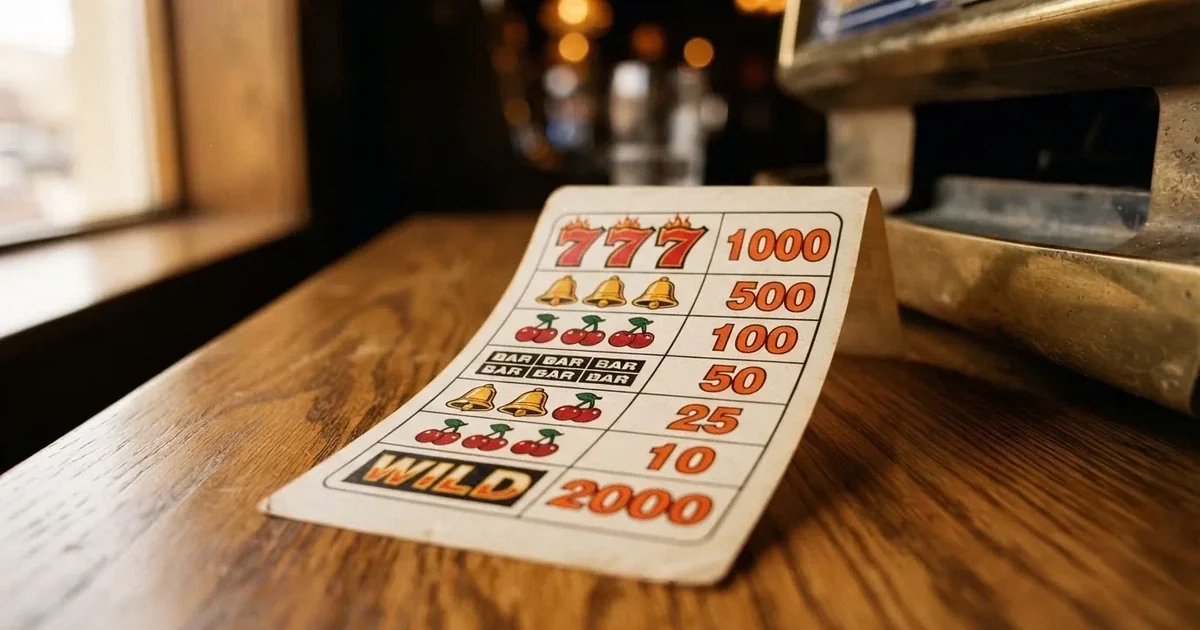
A paytable is the printed or on-screen chart that lists every symbol, the payouts for matching combinations, and the rules that govern them. On a 3-reel game it usually covers one page. The top line is the jackpot: three of the rarest symbol. Beneath it come three-of-a-kind payouts for the next-rarity symbols, then three of any, then two-of-a-kind on certain symbols, then any combination of special symbols that triggers a feature. A wild symbol, if the game has one, will say so in its own line.
The number that matters most on a paytable is not the jackpot figure. It is whether the listed payouts scale with your bet. Most 3-reel games price the payout by coin: three bells at one coin per line pays ten, at two coins pays twenty, at three coins pays the top progressive jackpot. Drop a coin and you are playing for a tenth of the headline prize. Read the coin-multiplier rule before you read the symbol list; it is the one detail that decides whether the advertised top prize is one you can actually win.
Paylines and Bet Structure
A 3-reel slot has either one payline (the centre row) or a small handful (the centre row plus the diagonals, sometimes the V-shapes). A one-coin bet on a one-payline game is the simplest wager a slot accepts. A multi-coin bet on a multi-payline game costs you coin-times-paylines per spin and lets you pick up combinations across more lines. The advertised jackpot figure assumes the maximum coin bet on every active payline, which is the only configuration that triggers the top tier on a progressive.
On modern 3-reel variants, the bet selector usually lets you pick the number of paylines, the number of coins per line and the coin value separately. A 0.01 coin at one coin on one line is the floor bet. The ceiling on the same screen is whatever the operator sets. The combination you choose changes the return profile of every spin, which is the practical consequence of a multi-line 3-reel: it costs more per spin, but it collects combinations you would otherwise miss.
Symbols and Feature Triggers
Classic 3-reel games keep the symbol set short: bars (single, double, triple), sevens, cherries, sometimes a Liberty Bell or a fruit icon. The rarer the symbol, the larger its three-of-a-kind payout. Cherries or a single BAR often pay out on one or two matches as well, which keeps the small-win cadence going. Some 3-reel titles borrow a feature from the five-reel format — a wild, a scatter, a free-spin round — and graft it onto the three-reel structure. The slot still reads as a 3-reel game (three columns, a payline, a coin bet), but the bonus round behaves like a video slot.
If a 3-reel slot offers a “bonus” landing pattern, the paytable describes what it pays and what triggers it. The trigger is usually three scatter symbols anywhere on the reels, regardless of payline. The bonus round itself is what separates a feature-light classic from a feature-heavy 3-reel video slot, and the distinction is worth checking before you start: a “3-reel bonus slot” can mean either game, and the payout profile differs.
The Legal Landscape Around 3-Reel Slots in Australia
Online casino games and online pokies are prohibited in Australia. The Interactive Gambling Act 2001 (IGA), tightened by the Interactive Gambling Amendment Act 2017, makes it an offence to provide online casino games, online pokies or in-play betting to a person in Australia. No state or territory issues a licence for them. What is licensable is wagering on races and sport placed before the event, lotteries and keno. In practice that wagering is licensed by the Northern Territory Racing and Wagering Commission (NTRWC), which regulates 52 of Australia’s online bookmakers — including Sportsbet, Bet365 and Ladbrokes — for tax reasons. The commission has no full-time staff and meets once a month in Darwin. The shape is unusual, but the rule is plain: if it spins without a sporting or racing event behind it, it is not a licensable product.
The IGA targets the provider, not the player. An individual Australian who opens an offshore casino account is not prosecuted. What they give up is consumer protection: there is no Australian complaints body for a Curaçao or Anjouan-licensed site, no recourse if a withdrawal is refused, no guarantee the site stays reachable. The Australian Communications and Media Authority (ACMA) investigates, issues formal warnings and directs Australian internet service providers to block illegal sites. A site blocked in this way can vanish with a balance still on it. The cost of “no Australian licence” is not theoretical.
H2 Gambling Capital’s 2025 report estimates Australians lose about A$3.9 billion a year to illegal gambling sites, and that the share of gambling going through legal channels fell from 74% in 2021 to 64%. Both numbers are about the offshore trade. The legal channel is not losing share because Australians are gambling less; it is losing share because illegal sites are catching more of what Australians spend.
What the Prohibition Actually Covers
The IGA prohibits “prohibited interactive gambling services”: online casino games (roulette, blackjack, baccarat, slots, craps and the rest), online pokies and in-play betting. Lotteries and keno run online under state and territory arrangements. Sports and race wagering online are licensed, but only when the bet is placed before the event starts. The shape of the law is what you can already feel at the edge of the market: poker machines in a pub are fine, the same machine in an app on your phone is not.
| Feature | Licensed Australian Venue | Offshore Online Casino |
|---|---|---|
| Regulatory Body | State/Territory Regulator | None (Offshore/None) |
| Consumer Protection | Yes (State-based) | None |
| Legality | Legal | Prohibited (IGA 2001) |
| Complaint Path | Yes | None |
| Self-Exclusion | Yes (BetStop/State) | None |

The 3-reel format does not get a carve-out. An online 3-reel slot is an online casino game under the IGA. There is no legal pathway through which a Curaçao-, Anjouan- or Malta-licensed site can offer 3-reel slots to a person physically in Australia. The licences those sites display are licences to operate in their own jurisdictions. None of them is an Australian licence, because no Australian licence exists for the product.
What the ACMA Has Done
The ACMA’s enforcement runs on a published record. As of June 2026, the authority had asked Australian ISPs to block 1,751 illegal gambling and affiliate marketing websites since the first blocking request in November 2019, and more than 230 unlicensed gambling services had left the Australian market since enforcement was strengthened in 2017. The blocking work is incremental: in a single round reported on 26 June 2026, the ACMA asked ISPs to block 12 more sites, including 7Signs, ChromaBet, Donbet, Duospin, Freshbet, Slots Gem, Jacks Club, Lucky Start, Pointsbetz, Spinrise, Vinyl Casino and Wildsino. The list rotates; the work does not.
A formal warning is the step before a blocking request. The ACMA publishes each warning with the operator name and the date. A warning does not always lead to a block; a site that ignores it does. The brands covered in the operator section later in this page are all brands the ACMA has warned by name. The full published list runs much longer than the eleven covered here.
Where 3-Reel Slots Actually Exist in Australia
They exist in licensed venues. Pokies-style slot machines outside casinos numbered 87,298 in New South Wales as of June 2023, 26,380 in Victoria in 2021–22, 21,122 in Queensland in October 2023, 11,672 in South Australia in September 2023 and 3,587 in the ACT in November 2023. These are predominantly five-reel video machines now, but the 3-reel format is part of the venue floor. New South Wales legalised slot machines in 1956; by 2010 Australia operated an estimated 97,103 gaming machines outside casinos, a per-capita rate about five times that of the United States. A punter walking into a pub in Sydney or a club in Melbourne is sitting inside the legal market. A punter opening a casino app is not.
The legal-venue market has its own protections. Each state runs its own pre-commitment, self-exclusion and clock- or card-based play-monitoring system. The Australian venue market is one of the most heavily regulated slot markets in the world; that is part of why so much play has moved offshore.
Responsible Gambling and Player Protection
If thinking about 3-reel online slot play ever starts to feel compulsive or stressful, free confidential help is available around the clock. The National Gambling Helpline is 1800 858 858, free, 24/7, with chat at Gambling Help Online. Both services are run by qualified counsellors and are not connected to any operator.
BetStop, the National Self-Exclusion Register, has been live since August 2023 and binds Australian-licensed online and phone wagering services. An offshore casino is not connected to it. Excluding yourself from BetStop stops licensed Australian wagering operators from letting you open new accounts or deposit, but it does not stop an offshore casino from accepting your deposit. The protections BetStop offers are real for the licensed market, and absent for the offshore market that is the only place online 3-reel slots exist.
The ACMA’s role in player protection is upstream of any individual player. By blocking sites and warning operators, it shrinks the offshore supply. It does not refund losses. The refund-and-recourse pathway for an Australian player who has a problem with an offshore site runs through the operator directly, and is unreliable in practice.
Bonuses and Free Spins on 3-Reel Slots
A “3-reel bonus slot” is a real category in the offshore market. The shape of the offer is consistent across the sites the ACMA has acted against. A welcome package stacks a deposit match with a batch of free spins, often capped at a per-spin value and tied to a specific 3-reel title. The headline looks generous: 100% up to a four-figure amount plus two hundred free spins on a named 3-reel game. The conditions attached are where the cost lives.
A wagering requirement is a multiplier applied to the bonus (and sometimes to the deposit too) that says how many times you must play through the bonus before you can withdraw any winnings. A 40x requirement on a A$500 bonus means A$20,000 of turnover before withdrawal is permitted. Free-spin winnings are almost always credited as bonus funds, not cash, which means the wagering requirement applies to them as well. A max-cashout cap on free-spin winnings is standard: anything above the cap is voided when you withdraw.
A “free 3 reel bonus slot” is a marketing phrase that almost never means a no-cost game. It means a 3-reel slot that is part of a bonus promotion, often the free-spin tranche of a welcome package. The “no download” line attached to some listings is a browser-play claim, not a money claim; it says the game runs in HTML5 rather than as an install, and tells you nothing about the wagering conditions attached to the bonus. A 3-reel slot in a bonus promotion is a paid slot, dressed in the word “free”.
The arithmetic on a bonus is straightforward to do and worth doing. Required turnover is the bonus times the wagering multiplier. The number of spins that turnover represents depends on the stake-per-spin and the return-to-player of the game. A higher wagering multiplier and a lower RTP both push the time and the expected loss upward; the headline figure on the offer does not move.
The reader who types “best 3 reel slots Australia” with a bonus question in mind has two honest answers. The legal one is: Australian-licensed venues do not run online sign-up bonuses, because they do not run online casino games. The offshore one is: the bonus exists, the wagering requirement is steep, the max-cashout cap will clip any big free-spin win, and the site is operating against the IGA.
Specific Games, Providers and the Online Format
A “3 reel online slot” is, structurally, a digital version of a 3-reel mechanical slot: three columns of symbols, a payline or two, a coin bet, a paytable. The digital format adds a return-to-player (RTP) setting, which is the long-run percentage of stakes the game returns to players; a higher RTP means a smaller house edge. The RTP for a 3-reel online slot is typically a little lower than a 5-reel video slot — the larger top prizes on a 5-reel game are funded by a higher base-game RTP — but the gap is not always large. Always check the published RTP in the game’s help screen before you commit; the number is a long-run estimate, not a session guarantee.
A “3 reel classic slot” is the conservative end of the same format: no feature rounds, no scatters, just a paytable and a spin button. The format is sometimes called a “stepper” in the US trade press, because the reels visibly click into position one stop at a time. A “3 reel bonus slot” is a 3-reel game with a bonus round grafted on. A “3 reel pokie” is the Australian-English phrasing for the same game and reflects the venue-market vocabulary; outside Australia, the same game is a “slot”.
Volatility on a 3-reel slot behaves a little differently from a 5-reel video slot. The paytable is shallower, the top prize is lower as a multiple of the bet, and the variance is concentrated in a smaller number of high-payout symbols. A 3-reel classic slot tends to read as low-to-medium volatility: smaller swings, smaller peaks. A 3-reel bonus slot, with a feature round attached, behaves more like a video slot: longer dry stretches, larger peaks when the feature lands. The reel count alone does not tell you the volatility; the paytable and the feature set do.
Paytable Structure and Volatility
A 3-reel slot’s paytable has fewer lines than a 5-reel game’s. The payout for three of a kind on the top symbol is the highest single line. The payout for three of a kind on the most common symbol is the lowest. The gap between the two is the paytable spread. A narrow spread (small gap between top and bottom symbols) means more consistent payouts; a wide spread (large gap) means longer dry stretches with occasional large hits.
The number of paylines changes the analysis. A one-payline 3-reel slot concentrates the variance on a single line: you either hit the combination on the centre row or you do not. A multi-payline 3-reel slot spreads the variance across two or three lines, which smooths the small-win cadence but does not change the top payout structure. The trade-off is between clarity (one line, one outcome) and cadence (more lines, more small wins).
The feature round, where one exists, is the largest single source of variance on a 3-reel bonus slot. The base game pays the small wins; the feature round pays the occasional large one. A reader comparing two 3-reel bonus slots should compare the feature-round payout profile, not just the base-game paytable.
How Reel Count Affects Outcomes
Three reels with ten symbols each produce one thousand possible combinations per spin, before symbol weighting. Five reels with the same symbol count produce one hundred thousand. The combination count is not the same as the outcome count (symbol weighting and payline structure change the picture), but the order of magnitude is right: a 3-reel slot has fewer outcomes to learn and a smaller pool of combinations for the RNG to draw from. The top payout odds on a 3-reel mechanical slot are around one in a thousand; on a 5-reel video slot, the top combination can sit around one in tens of millions.
That is the structural reason a 3-reel slot feels calmer. It is not that the house edge is dramatically smaller; in many cases it is a touch larger. It is that the game has fewer extreme outcomes in either direction, so a session on a 3-reel slot looks more like a slow grind than a roller-coaster.
Eleven Operators Named by the ACMA
The following list is not a ranking. Each brand is included because the ACMA has issued a formal warning under the Interactive Gambling Act 2001 over that brand or its operator. No licence on any of these sites authorises it to offer online casino games to a person in Australia; the only licence any of them holds is a licence to operate from somewhere else.
| Brand | ACMA action and date | Operator named by the ACMA | Subject support |
|---|---|---|---|
| RocketPlay | Formal warning, March 2026; earlier Dama N.V. warning, May 2022 | Pulsup Ltd; Dama N.V. | — |
| Level Up Casino | Formal warning, May 2022 | Dama N.V. | listings only (Bgaming) |
| Woo Casino | Formal warning, March 2025 | Dama N.V. | — |
| Spirit Casino | Formal warning, May 2025 | Dama N.V. | — |
| National Casino | Formal warning, July 2025 | Consolutetish S.R.L. | listings only (Wikipedia) |
| Bizzo Casino | Formal warning, July 2025; earlier 2022 warning | Consolutetish S.R.L.; TechSolutions | — |
| Ignition Casino | Formal warning, July 2025 | Bamboo Media | — |
| Instant Casino | Formal warning, February 2025 | EOD Code SRL | — |
| Jackbit | Formal warning, April 2026 | Ryker B.V. | — |
| Casino Intense | Formal warning, April 2025 | Sterplay Holding Ltd | listings only (ABC News, ACMA, Crown Melbourne) |
| Sky Crown | Formal warning, September 2022 | Hollycorn N.V. | — |
The “subject support” column is what each site does or does not show about its 3-reel catalogue in third-party listings. Most of the brands carry no entry at all, which means no third-party listing I could find identifies a 3-reel game catalogue attached to that brand by name. The handful that do carry a listings-only marker — Level Up, National Casino, Casino Intense — appear in third-party game-provider or news listings, but the listings do not establish a 3-reel-specific offering.
Reading the ACMA’s Blocking Record as a Reader
The blocking work has a measurable shape. From November 2019 (the first blocking request) through to the snapshot reported in June 2026, the ACMA has directed ISPs to block 1,751 illegal gambling and affiliate marketing websites. That is a running total, not a per-year figure. Spread over roughly six and a half years, the long-run blocking rate sits in a band of roughly 200 to 320 sites per year, with the per-year figure varying as new waves are identified and existing waves complete. The block rate is not a steady-state process; it accelerates when new illegal sites are identified and slows between waves, but it has not stopped since the first request.
Working that out as a band rather than a single figure is the honest read. The first blocking request was in November 2019; the snapshot total was reported in June 2026. That span covers roughly 80 months. At the 1,751 total over 80 months, the monthly blocking rate sits at roughly 22 sites per month, or about 262 per year. The actual annual figure in any given year depends on how many new waves the ACMA identifies, and that depends on how many new offshore sites come into existence. The band the reader can use is: the ACMA has blocked an average of roughly 250 illegal gambling sites per year since the first blocking request, with year-to-year variation. The number is large because the illegal market is large.
The blocking rate is the ACMA’s enforcement throughput. It does not tell a reader how many individual Australians are playing on offshore sites; H2 Gambling Capital’s A$3.9 billion estimate is the closest available proxy. It does tell a reader that the legal status of the offshore sites has not changed in six and a half years of enforcement. The supply side of the market responds to blocking by spawning new sites; the ACMA responds by blocking those in turn. The dynamic is ongoing.
1. RocketPlay
The ACMA issued a formal warning to Pulsup Ltd over Rocketplay in March 2026. An earlier warning covered Dama N.V. over Rocketplay in May 2022, so the brand has appeared in the ACMA’s published register twice in four years. The operator behind the brand has changed at least once in that window. None of that changes the legal status: the site offers online casino games, including 3-reel slots, to Australians without an Australian licence. The site is not a ranking candidate.
A reader looking at RocketPlay for 3-reel slots is looking at a brand the ACMA has named twice. The site displays an offshore licence; the licence does not authorise Australian play. The risk a reader is taking on is the same risk any other offshore casino carries: a blocked site with a balance still on it, no Australian complaints body, no recourse if a withdrawal is refused. The RocketPlay entry in the table is the ACMA’s own data, and the ACMA is the authority whose record the rest of this page leans on.
2. Level Up Casino
Level Up Casino carries a single formal warning, issued in May 2022 to Dama N.V. The brand surfaces in Bgaming’s third-party listings as a casino carrying Bgaming content; that is the listings-only marker in the table, and it tells a reader the brand is named on a provider’s distribution list without telling them which 3-reel games are available. Dama N.V. is the operator named on the warning; the operator is the entity the ACMA holds responsible, not the brand alone.
A reader comparing Level Up against the rest of the Dama N.V. set is comparing four brands on the table (RocketPlay, Level Up, Woo Casino, Spirit Casino) that share an operator. Dama N.V.’s name appearing four times in the ACMA’s register is a data point on the operator, not a recommendation on any of its brands.
3. Woo Casino
Woo Casino carries a formal warning issued in March 2025 to Dama N.V. Woo Casino is the second of the four Dama N.V. brands on the table. The warning is recent; the brand has had four years between the broader 2022 Dama N.V. action and its own 2025 warning. The site displays an offshore licence; the licence does not authorise Australian play. The reader looking for a 3-reel format at Woo Casino will find a game library structured around video slots, with 3-reel titles present in the catalogue but not the centre of the offering.
The honest read on Woo Casino is the same honest read on every brand in this section: the ACMA’s warning is a published fact about the operator, the site is operating against the IGA, and the cost of that is borne by the reader.
4. Spirit Casino
Spirit Casino carries a formal warning issued in May 2025 to Dama N.V. Spirit Casino is the third of the four Dama N.V. brands. The warning is two months after Woo Casino’s, and the operator name is the same. The pattern is what the data shows: one operator, four warnings, multiple brands.
A reader who has been rejected by one Dama N.V. brand has, on the ACMA’s record, been rejected by three others. The site-rotation tactic is well-known in the offshore market: when a domain is blocked, the operator re-emerges under a new brand name and a new URL. The ACMA’s record is the reader’s defence against the rotation: the operator name is the through-line.
5. National Casino
National Casino carries a formal warning issued in July 2025 to Consolutetish S.R.L. The brand surfaces in third-party listings (Wikipedia’s coverage of Australian-facing casinos names it). Consolutetish S.R.L. is also the operator named in the ACMA’s warning over Bizzo Casino in the same month, so the two brands share an operator. The pattern is the same as Dama N.V.: one operator, two or more brands, multiple warnings.
The listings-only marker on National Casino reflects the limit of what third-party data carries. A reader can confirm National Casino is named on a Wikipedia entry; the entry does not establish which 3-reel games the brand offers.
6. Bizzo Casino
Bizzo Casino carries two formal warnings. The first was issued in 2022 to TechSolutions (CY) Group Limited and TechSolutions Group N.V.; the second in July 2025 to Consolutetish S.R.L. The operator has changed across the two warnings. A reader who checked the brand in 2022 and found it on the ACMA’s register, then checked again in 2025 and found it still on the register, has watched a brand cycle through two operators and remain on the enforcement list.
The honest read on Bizzo Casino is: the operator behind the brand is not stable, and the brand’s presence on the ACMA’s register is.
7. Ignition Casino
Ignition Casino carries a formal warning issued in July 2025 to Bamboo Media. The brand name is shared with a US-facing site of the same name, but the operator behind the Australian-facing offering is Bamboo Media, which is the name on the ACMA’s register. A reader who has used the US-facing Ignition Casino is not, on the ACMA’s record, dealing with the same operator as the Australian-facing site.
The site is not a ranking candidate. The warning is a published fact, and the reader looking at the brand should weigh it as such.
8. Instant Casino
Instant Casino carries a formal warning issued in February 2025 to EOD Code SRL. The warning is one of the more recent on the table. EOD Code SRL is the operator name on the ACMA’s register; the brand is the consumer-facing label. The site offers a 3-reel catalogue alongside its broader slot library. The reader weighing Instant Casino is weighing an offshore site that the ACMA has named by operator.
The site may be reachable from Australia today, or it may already be blocked. The block status is not carried by the warning itself; the ACMA’s blocking rounds are reported separately. The reader should treat any individual site as potentially blocked and the balance on it as potentially stranded.
9. Jackbit
Jackbit carries a formal warning issued in April 2026 to Ryker B.V. The same operator is named over CasinOK in the same month, so Jackbit and CasinOK share an operator. The pattern repeats: one operator, two or more brands, a recent ACMA action. Jackbit is the most recent warning on the table, and the brand has had less time to age than the older entries.
The reader looking at Jackbit should know that the brand is on the ACMA’s register within the past 12 months. The site’s offshore licence is not an Australian licence. The legal status is unchanged.
10. Casino Intense
Casino Intense carries a formal warning issued in April 2025 to Sterplay Holding Ltd. The brand surfaces across multiple third-party listings (ABC News, ACMA, Crown Melbourne coverage), which is what the listings-only marker in the table reflects: third-party sources name the brand, but the listings do not establish a 3-reel-specific offering.
A reader who has encountered Casino Intense through news coverage has encountered a brand the ACMA has warned. The warning is what the ACMA publishes; the news coverage is what other outlets have added around it. The reader’s job is to weigh both.
11. Sky Crown
Sky Crown carries a formal warning issued in September 2022 to Hollycorn N.V. The same operator is named over Blue Leo casino in the same warning, so Sky Crown and Blue Leo share an operator and a date. Sky Crown is the oldest warning on the table. Hollycorn N.V. has been on the ACMA’s register for nearly four years at the time of writing. A brand that has stayed on the register that long has either been blocked, re-emerged under a new URL, or been left in place because the operator complied with the warning. The reader cannot tell from the warning alone.
The honest read on Sky Crown is: the ACMA’s record is the only authoritative source for the brand’s status, and the reader should treat any individual site as potentially blocked.
What Offshore 3-Reel Play Costs a Reader in 2026
The cost of offshore 3-reel play has three layers. The first is the legal exposure, which for the player is nil (the IGA targets the provider, not the player). The second is the access risk: a blocked site, a stranded balance, no Australian complaints body. The third is the arithmetic cost: the bonus terms, the wagering requirement, the game RTP.
The arithmetic cost is the one a reader can estimate. A typical 3-reel slot at an offshore casino carries an RTP somewhere in the 94% to 96% band, with the exact figure published in the game’s help screen. A 40x wagering requirement on a A$500 bonus means A$20,000 of turnover before withdrawal is permitted. At a 0.20 coin bet on a multi-line 3-reel slot, that is roughly 100,000 spins; at a 5-second interval per spin, that is roughly 140 hours of continuous play, or about a month of full-time grinding on a single game. The expected loss over that turnover at a 95% RTP is 5% of A$20,000, which is A$1,000. That is the cost of clearing the bonus if every assumption holds.
The conditions attached to the bonus move every number in that estimate. A max-cashout cap on free-spin winnings clips the upside. A contribution percentage (slots at 100%, table games at 10% or 0%) limits what counts toward the wagering requirement. A time limit on the bonus (often seven days from issue) limits how long the reader has to clear it. A reader who has not read all three conditions has not yet priced the offer.
The access risk is harder to estimate. A blocked site can lose its balance without warning. A site that refuses a withdrawal has no Australian complaints body the reader can take the case to. A site that pays out promptly today may stop paying out tomorrow. The H2 Gambling Capital estimate of A$3.9 billion a year in losses to illegal sites is the macro number; the micro number for any individual player is whatever their session costs them, with the structural risk that the operator may not be reachable when they try to withdraw.
The legal exposure is nil, but the legal status is real. Every dollar an Australian spends on an offshore casino is a dollar outside the Australian consumer protection frame. The BetStop register does not bind an offshore casino. The National Gambling Helpline does not have a referral path back to an offshore operator’s complaint process, because there is no Australian complaint process to refer to. The state-based pre-commitment and venue-monitoring systems do not apply. The reader is on their own.
FAQ
What makes a 3-reel slot different from a standard five-reel video slot?
A 3-reel slot has three columns of symbols and typically one payline (sometimes a small handful), with a paytable built around three-of-a-kind combinations. A five-reel video slot has five columns, many paylines and feature rounds. The 3-reel format has fewer outcomes to learn, smaller top prizes as a multiple of the bet and a smoother session-to-session cadence; the five-reel format has bigger top prizes, more features and a wider variance profile.
Can 3-reel slot machines be found in licensed Australian pubs and clubs?
Yes. The Australian venue market outside casinos held over 97,000 gaming machines in 2010 and remains the largest per-capita slot market in the developed world. The 3-reel format is part of the venue floor, alongside the more common five-reel video machines. New South Wales alone had 87,298 pokies-style machines outside casinos as of June 2023.
Do 3-reel slots typically pay out differently than newer five-reel formats?
The base-game RTP on a 3-reel slot is often slightly lower than on a five-reel video slot, because the larger top prizes on a five-reel game are funded by a higher base-game return. The variance profile is narrower on a 3-reel classic slot (smaller top prizes, smaller swings) and wider on a 3-reel bonus slot with a feature round. Always check the published RTP in the game’s help screen before committing.
Is a 3-reel slot online the same game as a 3-reel machine on a casino floor?
Structurally, yes: three reels, a payline, a paytable. Mechanically, no: a venue machine is a physical cabinet with a stepper mechanism (the reels click into position one stop at a time), while an online 3-reel slot is a digital game with a random number generator and a published RTP. The format reads the same; the underlying mechanics and the payout structure are not identical.
Are 3-reel slots for real money available legally from an Australian-based site?
No. The Interactive Gambling Act 2001 prohibits online casino games, including online pokies of any reel count, from being offered to a person in Australia. No state or territory issues a licence for them. The only legal Australian venues for 3-reel slots are licensed pubs, clubs and casinos inside the country. Offshore sites offering 3-reel slots to Australians operate against the IGA.
Written by the editors at Casino Providers Info.