
Online pokies for Australian players in 2026: the prohibition, the warnings and the cost
A search for the best aus pokies online australia in 2026 lands on a market that doesn’t really exist in the form the wording implies. Australia has no licensed online pokies. What it has is a comprehensive prohibition under the Interactive Gambling Act 2001, a flourishing offshore market the ACMA keeps warning and blocking, and a licensed land-based machine population that runs into six figures across pubs, clubs and casinos. The ranked list the search implies is a comparison the regulator has refused to allow.

Current as of 7 November 2026 against the ACMA’s register of formal warnings and the June 2026 blocking round.
Table of Contents
- What an Australian punter is actually searching through
- Fundamentals of prohibition: what the Interactive Gambling Act 2001 actually says
- Where the player can turn if play stops being a choice
- PayID, deposits and the money side — without any bank to bank into
- What a sign-up bonus credit or free-spins offer actually involves
- Paytable reading: what an online pokie’s payout table actually tells a player — and what it doesn’t
- Prohibition at the offshore edge: what a fair comparison of warned brands weighs
- RocketPlay: a second formal warning, to a new operator
- Level Up Casino: one of six brands in the ACMA’s May 2022 sweep
- Woo Casino: a Dama N.V. follow-up warning three years after the original
- Spirit Casino: the second of two follow-up Dama N.V. warnings in 2025
- National Casino: a Consolutetish S.R.L. brand alongside Bizzo
- Bizzo Casino: a brand warned twice under two different operators
- Ignition Casino: a single 2025 warning to a single operator
- Instant Casino: a single 2025 warning to EOD Code SRL
- Jackbit: a brand alongside CasinOK in the most recent ACMA action
- Casino Intense: a 2025 warning to a holding company, named across multiple Australian sources
- Sky Crown: the oldest ACMA formal warning on this page
- The blocking rate: the arithmetic behind the cumulative count
- Frequently asked questions
What an Australian punter is actually searching through
The word “pokies” is Australian English for what an international casino operator would call a slot machine or a fruit machine. The machine itself — a spinning-reel game with symbol combinations paying out against a fixed table — hasn’t changed much since registered clubs installed the country’s first legal units in New South Wales in 1956. What has changed is the surrounding market.
Three things now occupy the space a reader is searching. The first is the legal land-based market. Across every state and territory, electronic gaming machines sit in pubs, clubs and casinos. New South Wales alone had 87,298 of those machines outside casinos across 2,195 venues as of June 2023, with player losses running to A$8.18 billion in the 2022-23 financial year. Queensland had 21,122 machines in 351 venues by October 2023. Victoria operated 26,380 machines outside Crown Casino across 488 venues in 2021-22, sitting beneath a statewide cap of 30,000. The country high for the minimum return-to-player on a licensed land-based pokie is Western Australia at 90%; New South Wales, the Northern Territory and Queensland set theirs at 85%; the ACT, Tasmania and Crown Melbourne at 87%; South Australia at 87.5%.
The second is the prohibited offshore market. Online pokies are illegal to provide to a person in Australia under the Interactive Gambling Act 2001. Operators that take Australian customers anyway run from outside the country, usually under a Curaçao or Costa Rica corporate wrapper, with whatever licence an offshore regulator issues. The product they sell is the same spinning-reel game, delivered over a web browser instead of a coin slot.
The third is the enforcement line between them. The ACMA, the Australian Communications and Media Authority, is the agency that investigates and acts against the offshore market. Its tools are formal warnings to operators, warnings that name the directors behind shell companies, and directions to Australian internet service providers to block illegal sites at the network layer. The cumulative count of those blocks now sits past 1,750 since the first blocking request in November 2019.
Fundamentals of prohibition: what the Interactive Gambling Act 2001 actually says
The Interactive Gambling Act 2001 — the IGA — is the federal statute. It was tightened significantly by the Interactive Gambling Amendment Act 2017 and adjusted further in the years that followed. The core provision is straightforward: it is an offence for a person or a corporation to provide online casino games to a customer who is physically present in Australia, and online pokies are the central example of what that provision covers. The legal minimum age for any Australian-licensed gambling activity, online or otherwise, is 18.

The prohibition runs in one direction. The provider is the target. The player sitting in Perth, Sydney or Cairns is not the subject of a criminal offence for opening an account. That distinction is what makes the offshore market resilient: the IGA does not stop offshore sites from advertising into Australia, only from being paid for doing so by Australians, and enforcement happens at the network edge rather than the wallet edge.
What the IGA does not prohibit is the part of the gambling market that Australians do legally use online. Wagering on horse races, harness races, greyhound races and sporting events placed before the event is licensable. Lotteries and keno are licensable. In-play betting — wagering on a sporting event after it has started — is treated like online casino games and is not licensable. The distinction matters because it explains why the Northern Territory Racing and Wagering Commission licences more than 50 online bookmakers (Sportsbet, Bet365 and Ladbrokes among them) and licences none of the offshore online casinos Australians are most likely to have heard of.
The Northern Territory regulator itself is small. Reporting published in April 2026 sets out that the commission has no full-time staff and meets once a month in Darwin. Why does it licence the country’s online wagering market? Tax. The Northern Territory takes a point-of-consumption tax on wagering revenue that other states declined to collect, and the corporate economics of an Australian-licensed bookmaker make Darwin a cheaper headquarters than Sydney or Melbourne. The regulatory thinness is not accidental; it is the cost of being the smallest jurisdiction willing to take the licence money.
No state or territory issues a licence for online pokies. The land-based pokies Australians use are licensed state by state. Tasmania ended Federal Group’s monopoly licence over its poker machines in November 2021 and moved oversight of the machines to the Tasmanian Liquor and Gaming Commission; its mandatory pre-commitment cards (the scheme that ties a player’s session to a pre-set spending limit at the machine) were legislated for implementation in late 2025. Western Australia went the opposite way in 1985, banning poker machines in pubs and clubs entirely when Crown Perth opened; Crown Perth’s own machine count has since grown from about 200 in 1985 to roughly 2,500, all approved by the state’s Gaming and Wagering Commission. None of that local licensing extends to a website that streams the same game to an Australian IP address.
So the prohibition has a gap that is not a licensing gap but an enforcement gap. Offshore operators break Australian law from outside Australian law. The Australian response is the ACMA — formal warnings, blocking directions to ISPs, and an escalating pace of action. H2 Gambling Capital’s 2025 industry estimate put annual Australian losses to illegal sites at about A$3.9 billion and the share of gambling going through legal channels falling from 74% in 2021 to 64% by 2025. The legal market is shrinking as a share of the total; the offshore market is taking the rest.
Where the player can turn if play stops being a choice
The help available to an Australian player whose gambling is slipping beyond their control is free, confidential and operates around the clock. The National Gambling Helpline is 1800 858 858. The web counterpart is Gambling Help Online, which provides live chat. Both services are funded by state and territory governments under an intergovernmental agreement and staffed by counsellors trained in problem-gambling intervention. Neither service asks the caller to identify the site they have been playing on before they will talk.
In August 2023 Australia also went live with BetStop, the National Self-Exclusion Register. BetStop is a centralised list that a person can join to bar themselves from every Australian-licensed online and phone wagering provider for a period they choose (three months, up to a lifetime, with the option to extend). BetStop binding makes new account creation difficult at licensed operators, and the bar applies across every Australian wagering licence at once, not one site at a time.
The catch is the catch. BetStop binds only Australian-licensed wagering services. An offshore online casino is not connected to the register and is not required to honour any self-exclusion BetStop records. The offshore sites offer their own self-exclusion tools, sometimes, and a player who has set up an exclusion with BetStop has no automatic protection past the Australian edge of the network. The 24-hour helpline and Gambling Help Online do reach players regardless of which site they have been using — the help isn’t gated on the site’s status, just on the player making the call.
For a player whose account is offshore and whose balance is offshore, the answer to “what recourse do I have if I can’t withdraw” is the uncomfortable one. Not BetStop, because the offshore site isn’t bound by it. Not the ACMA, because the regulator’s jurisdiction is at the edge of the Australian network, not the balance. Not a state regulator, because no state licensed the site. Not an Australian consumer-protection body, because no Australian consumer-protection law reaches it. The recourse, when the answer to those four is “no”, is the helpline, the chat line, and the practical step of leaving the offshore system behind. The help isn’t a transaction; it’s a conversation.
PayID, deposits and the money side — without any bank to bank into
The reader-friendly payment systems Australian banked players are used to — debit card, BPAY, direct bank transfer, and PayID or Osko for instant transfers — are routed through the financial system for licensed Australian wagering. PayID itself is a service of the New Payments Platform that links a phone number, an email address or an ABN to a bank account; it isn’t a bank, it’s an addressing system, and it doesn’t change the legality of what it pays for. A PayID deposit into an offshore casino account is still a deposit into an offshore casino account.
A payment reform reached into Australian-licensed online wagering on 11 June 2024. Since that date, the IGA has banned credit cards, credit-related products and digital currency (i.e., cryptocurrency) as a means of paying a licensed Australian wagering provider. The penalty for an operator who accepts them is up to A$247,500. A licensed Australian bookmaker may therefore lawfully take a PayID deposit from a debit-account-linked PayID. What it may not lawfully take is a credit card deposit or a Bitcoin deposit.
A site that asks an Australian player for a credit card or a crypto deposit is, by definition, operating outside the Australian rules — because those two funding routes are illegal precisely for sites that aren’t licensed to take Australian business. The deposit menu at an unlicensed site is therefore a giveaway. If it offers crypto, chargebacks are harder. If it offers credit cards for gambling, the operator has chosen to ignore Australian law and is unlikely to volunteer Australian consumer protection as a feature.
For an offshore site the payment side also has a quality-of-service risk that doesn’t exist for licensed Australian wagering. There is no Australian body to complain to if a withdrawal is refused, delayed past the stated window or reversed. There is no requirement to ask “why”; the offshore site runs on its own house rules. A player trying to withdraw a balance held at an unlicensed site has effectively chosen to send money to a counterparty whose rules they cannot enforce elsewhere.
H2 Gambling Capital’s 2025 estimate put the lost wagering share through this kind of arrangement at A$3.9 billion a year. A reader doing the arithmetic on their own bank statement will find roughly the same number, give or take the size of the player base. The cost is paid in real withdrawals from real accounts at the end of every month the offshore site keeps operating.
What a sign-up bonus credit or free-spins offer actually involves
A “sign-up bonus credit” is, structurally, a small cash amount the operator credits to a new player’s account on top of whatever the player has deposited (or sometimes purely on registration, with no deposit at all). It exists to move the player past the friction of putting their own money down. In a licensed market the offer’s structure would be tightly disclosed: the credit amount, the wagering multiplier, the eligible games, the maximum cashout from bonus play, the expiry window. In the offshore market targeting Australians, the structure exists but the disclosure generally doesn’t.
The credit amount a site offers is small — typically A$10 to A$500, sometimes divided across multiple deposits rather than paid up front. The wagering multiplier is the workhorse of the offer’s cost: the player must wager a multiple (commonly 30x to 50x) of the bonus amount on eligible games before any bonus-derived winnings can be withdrawn. The eligible games are usually a narrow list, frequently newer pokies with higher house edges; table games either don’t qualify or count only partially toward the requirement. The maximum cashout is the ceiling on what can actually be withdrawn from bonus play, sometimes a few hundred dollars regardless of the player’s actual win. The time limit is the expiry window, commonly 7 to 30 days, after which both the bonus and bonus-derived winnings are forfeited. The payment-method restriction is the list of deposit routes that disqualify a deposit from bonus eligibility — Skrill, Neteller and certain crypto routes are the usual exclusions.
In a licensed market the entire mechanism sits inside an Australian-licensed site, audited for the multiplier’s fairness and capped for maximum cashout by a regulator with the power to enforce those caps. The offshore sites an Australian will see this offer from are not running inside that framework. They are running inside whatever the offshore corporate wrapper calls “fair” — which is structurally the same mechanism in a different-coloured wrapper.
To put a number on a representative offer. Suppose an operator credits A$100 with a 40x wagering multiplier on pokies at an average return-to-player of 95%. The required turnover is A$100 × 40 = A$4,000; at A$1 a spin that’s 4,000 spins; at five seconds a spin, that’s 20,000 seconds — about five and a half hours of continuous play. The expected loss across those A$4,000 in wagers, with an RTP of 95%, is A$4,000 × 0.05 = A$200. The arithmetic: a “free” A$100 costs an expected A$200 over the wagering period. The headline is half the real number.
What changes in the offshore context is what happens when the expected loss turns into a real win and the site decides not to pay. The arithmetic still says the bonus is worth approximately its headline; the experience can fall well short of either headline or arithmetic.
Paytable reading: what an online pokie’s payout table actually tells a player — and what it doesn’t
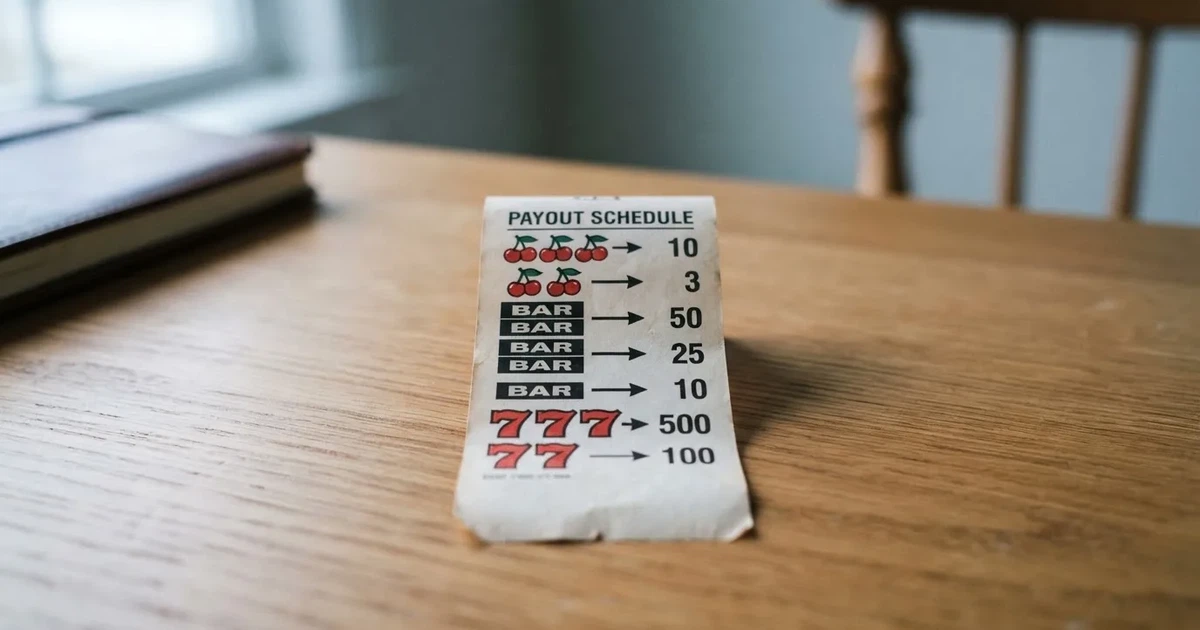
The interface screen a player looks at on a pokie has a small printed table called a paytable. Reading it well is the single most cost-effective thing a player can do, because the paytable is the only place the game’s contract with the player is written down.
The paytable carries four things. The symbol values: each pokie symbol has a payout, expressed either as a credit multiple of the line bet (5x, 25x, 100x) or as a fixed credit amount. The wild and scatter symbols — wild substitutes for other symbols to complete a winning combination; scatter triggers a bonus feature regardless of position. The win lines: a win line, or payline, is the geometric pattern across the reels that determines a win. Older games used a single horizontal line across the centre of three reels; modern games use 20 to 1,024 ways to win, and the paytable spells out whether each line is evaluated left-to-right only, whether scatters count anywhere on the reels, and whether the per-line bet is multiplied across all active lines. The bonus-feature rules: free-spin triggers, pick-a-prize games, expanding wilds, cascading reels, multipliers; the paytable describes the trigger condition and the maximum payout from the feature, but not the volatility.
The return-to-player percentage sits in the paytable too, but it isn’t always printed in plain figures on the machine; online, it’s usually one click away in an “info” or “help” panel rather than on the printed screen. The legally licensed Australian land-based pokies range from 85% (NSW, the Northern Territory, Queensland) to 87% (the ACT, Tasmania, Crown Melbourne) to 87.5% (South Australia) to 90% (Western Australia). Online pokies, where licensed somewhere and disclosed, generally publish an RTP of 94% to 97%. Every percentage point of RTP is the house edge in the other direction: at 95% RTP, the house takes 5 cents of every A$1 the machine processes, in the long run.
What the paytable doesn’t tell a player is everything else that matters. It doesn’t tell the player how volatile the game is — whether the wins come in frequent small amounts or rare big ones. It doesn’t tell the hit frequency, the proportion of spins that produce any return at all. It doesn’t tell the player that a single bonus round can return 1,000x the line bet, which both inflates the win tail and concentrates the variance on the bonus round. None of those are typically disclosed by online pokies, and none of them show up on a printed paytable.
The point that matters for a reader inside the Australian prohibition: even if a player downloads a paytable PDF for an offshore pokie, the numbers inside it are not enforceable in Australia. A paytable is a contract between the game studio and the casino operator; for a player, it is a marketing document. An Australian consumer has no regulator they can complain to about a paytable mismatch on an offshore site, because no Australian regulator licensed the game.
Prohibition at the offshore edge: what a fair comparison of warned brands weighs
A fair “Top 11” comparison of online pokies sites for Australian players cannot be written in 2026, because the data a fair comparison would rest on is not available to the writer. What is available is the ACMA’s record of who it has warned, on what date and for what conduct. That record, plus the regulator’s published blocking round-by-round cumulative count, is what the table below sits on.
The columns: the brand, the ACMA’s formal-warning record with date, the operator the ACMA has named, what broader market listings say about the brand (in most cases — nothing published, because offshore unlicensed sites don’t publish aggregated Australian-relevant data) and any earlier formal warning from the ACMA, because two of the eleven have been warned more than once.
| Brand | ACMA action and date | Operator named by the ACMA | Subject support | Earlier ACMA contact |
|---|---|---|---|---|
| RocketPlay | Formal warning, March 2026 | Pulsup Ltd | — | Dama N.V., May 2022 |
| Level Up Casino | Formal warning, May 2022 | Dama N.V. | Listed in BGaming’s distribution | — |
| Woo Casino | Formal warning, March 2025 | Dama N.V. | — | — |
| Spirit Casino | Formal warning, May 2025 | Dama N.V. | — | — |
| National Casino | Formal warning, July 2025 | Consolutetish S.R.L. | Referenced on an encyclopedic page that tracks Australian gambling regulation | — |
| Bizzo Casino | Formal warning, July 2025 | Consolutetish S.R.L. | — | TechSolutions, 2022 |
| Ignition Casino | Formal warning, July 2025 | Bamboo Media | — | — |
| Instant Casino | Formal warning, February 2025 | EOD Code SRL | — | — |
| Jackbit | Formal warning, April 2026 | Ryker B.V. | — | — |
| Casino Intense | Formal warning, April 2025 | Sterplay Holding Ltd | Named in Australian media, regulator and competitor-casino sources | — |
| Sky Crown | Formal warning, September 2022 | Hollycorn N.V. | — | — |
What the table actually shows is eleven different operators, eleven different corporate wrappers and a six-year arc of ACMA action. Dama N.V. alone has been warned four times across this set; the single Hollycorn N.V. warning (Sky Crown, with Blue Leo) is the oldest. The two most recent warnings — March 2026 for RocketPlay and April 2026 for Jackbit — sit four months apart and against different operators, which tells a reader that the ACMA’s enforcement tempo in 2026 is the highest this table records.
A reader who came to this page looking for a recommendation will not find one. The regulator does not rank sites; it warns them. Choosing among the eleven is, structurally, a choice among different versions of the same warning. The fairest statement this page can make is that none of them is licensed to offer what they are offering to Australians, and every one of them is currently subject to an ACMA formal warning that names them. The “Top 11” the search implied is the list of brands the regulator has put on notice — and the regulator’s notice, not the brand’s catalogue, is the comparison this page can make.
RocketPlay: a second formal warning, to a new operator
The ACMA’s record on RocketPlay is two formal warnings separated by three years and two operating companies. The first warning went to Dama N.V. in May 2022; the second went to Pulsup Ltd in March 2026 over the RocketPlay domain.
What that pair of warnings tells a reader is that the brand moved corporate wrapper without moving the practice. The same game is being offered to Australians under a different registered company. The ACMA’s enforcement tempo in 2026 has reached the point where a second warning to a brand with a prior warning is what the regulator does as a matter of course; the formal-warning register is one step short of a blocking direction to Australian ISPs.
No game catalogue, RTP data or payment-rail list is published for RocketPlay in any Australian-readable source. The brand’s website carries its own marketing, which is what an offshore casino carries and what an Australian reader is meant to weigh on its own.
The brand’s standing on this page is the standing of every brand on it. RocketPlay will not be licensed to offer what it is offering to Australians. It has been told so, twice.
Level Up Casino: one of six brands in the ACMA’s May 2022 sweep
In May 2022 the ACMA issued a single formal warning covering six casino brands under Dama N.V., and Level Up was among them. The other five were Bambet, Dazard, Rocketplay, Wild Tornado and Cobra Casinos.
What the level of detail in that warning tells a reader is that the ACMA’s May 2022 action wasn’t a sweep at the brand-by-brand level — it was a single correspondence addressed to the parent operator. Level Up’s standing on this page reflects the underlying position of the operator, not any signal from the Level Up brand specifically. The 2022 letter did not separate the brands out by their own conduct; it treated them as a group under a single operator.
Level Up appears in BGaming’s distribution listings. BGaming is a game studio, and being in its distribution means Level Up hosts BGaming-made games. That tells the reader about game sourcing. It doesn’t tell the reader about payout timing, bonus terms or dispute resolution, and it doesn’t change the brand’s regulatory status.
Level Up sits at the older end of the ACMA’s formal-warning timeline for this set. The warning is just under four years old, and the brand’s status under Australian law hasn’t changed in the interval.
Woo Casino: a Dama N.V. follow-up warning three years after the original
Dama N.V. returned to the ACMA’s formal-warning register in March 2025 over Woo Casino. The 2022 Dama N.V. warning covered six brands; the 2025 Dama N.V. warnings cover two more — Woo in March and Spirit in May — on top of the original six. Four of the original six didn’t make it back onto the register; Woo and Spirit did.
The pattern in those follow-up warnings is the same one RocketPlay shows across its own two warnings: the same operator name, different domains, the same Australian customer base. The ACMA’s correspondence addresses the operating company; the blocking directions, when they come, address the domains.
Woo Casino has no published listing at the level of bonus terms, RTP data, payment methods or responsible-gambling policy that an Australian-readable source sets out. What the March 2025 warning tells a reader, by itself, is the brand’s regulatory status. The rest of what the site offers is the site’s own pitch.
Spirit Casino: the second of two follow-up Dama N.V. warnings in 2025
The ACMA’s May 2025 formal warning over Spirit Casino completes the second pair of follow-up actions to Dama N.V.’s original May 2022 sweep. Woo and Spirit run together as the regulator’s recent statement on a parent company that was warned once in 2022, dropped off the register for a while, and reappeared in 2025 over two new brands.
The page’s subject — an “online pokies” comparison — cuts against Spirit the same way it cuts against every other brand on the list. There is no detail the brand publishes to an Australian reader that would change that. The ACMA’s statement is on the register; the brand’s marketing is on the site; the rest is positioning.
National Casino: a Consolutetish S.R.L. brand alongside Bizzo
In July 2025 the ACMA issued formal warnings over three brands — National Casino, Bizzo Casino and Ignition Casino — naming two different operators. National Casino was addressed to Consolutetish S.R.L. alongside Bizzo Casino; Ignition Casino was addressed to Bamboo Media. The July 2025 round is the densest the table records: three brands in a single month.
National is referenced on an encyclopedic page that tracks Australian gambling regulation — the Gambling in Australia encyclopedia entry. That kind of listing is a back-reference, not a brand-side disclosure. It doesn’t carry RTP, wagering terms, payout speed or a withdrawal policy. What the encyclopedic reference confirms is that the brand’s reach into the Australian market is enough to be reference material — and the material is the formal warning.
What National Casino’s standing tells the reader comparing brands is no different from what Woo’s, Spirit’s or Level Up’s standing tells them: the ACMA has named the operator, the operator has not changed conduct, and the brand is on the register.
Bizzo Casino: a brand warned twice under two different operators
In 2022 the ACMA’s formal warning went to TechSolutions (CY) Group Limited and TechSolutions Group N.V. over Bizzo Casino. In July 2025 the warning went to Consolutetish S.R.L. over the same brand.
The Bizzo record is the clearer case of corporate rotation in this set. There is no continuity of operator name between the 2022 warning and the 2025 warning — they go to different registered entities. What carries across is the brand and the Australian customer base. The ACMA, in July 2025, addressed its correspondence to whoever had the brand that month.
What a reader comparing the two warnings will conclude is that the practical effect of a 2022 ACMA warning was limited to the corporate wrapper that received it, not to the brand under it. The brand moved operators and kept operating. Three years after the first warning, the regulator is back addressing the brand, this time to a different company in a different jurisdiction. The brand has not been the subject of any change in what the page’s own subject is — online pokies — to a legal product.
Ignition Casino: a single 2025 warning to a single operator
Bamboo Media is the operating company the ACMA has named in its July 2025 formal warning over Ignition Casino. The Ignition file is among the shortest on this page — single warning, single date, single operator, no follow-up on the public record.
That short file is its own statement. The ACMA’s pattern across this set is that one warning tends to be followed by a second within three years; Ignition Casino has been warned once and not, in the public record, again. Brand-published payout times, RTPs and bonus terms are not in the Australian-readable record. The July 2025 ACMA warning is what an Australian reader has.
The brand’s position on the list is otherwise the position every brand on this list holds. Whether the next action is another warning, a blocking direction or both is the regulator’s call to make, not the brand’s to influence.
Instant Casino: a single 2025 warning to EOD Code SRL
EOD Code SRL is the operating company the ACMA named in its formal warning over Instant Casino in February 2025. The Instant Casino file is one of the shortest in the table — single operator, single date, single warning. The EOD Code SRL corporate wrapper doesn’t appear elsewhere on this set of eleven; the company was new to the ACMA’s published register when the February 2025 warning went out.
What that wrapper singularity tells a reader is the kind of name behind an offshore brand operating into Australia: a single-purpose corporate vehicle, not an established operator with a track record of warnings. Whether EOD Code SRL was set up specifically for Instant Casino or existed prior isn’t disclosed in the ACMA’s published record; the public register simply names the company. The brand’s regulatory status is the warning; the marketing is the brand’s own. The reader’s check is the ACMA register, not the brand’s claims.
Jackbit: a brand alongside CasinOK in the most recent ACMA action
In April 2026 the ACMA issued a formal warning naming Ryker B.V. as the operating company. The April 2026 warning covers Jackbit and CasinOK on the same operator. Jackbit is the most recent ACMA formal action in this set of eleven brands.
What recency buys a reader is current information about who the regulator is acting against, not current information about who the regulator has stopped. April 2026 is one formal warning; it is not a blocking instruction to ISPs. The next step in the ACMA’s sequence — the blocking direction, the direction to telcos to cut the brand off at the network edge — has not, in the public record, been issued against Jackbit yet. The brand is on the warning register, not on the blocking register.
Jackbit’s brand-published payout times, RTPs and bonus terms are not in the Australian-readable record. The April 2026 ACMA warning is what an Australian reader has, and recency doesn’t change the structure of what that is.
Casino Intense: a 2025 warning to a holding company, named across multiple Australian sources
Sterplay Holding Ltd is the operating entity the ACMA named in its April 2025 formal warning over Casino Intense. Casino Intense is the only brand on this set whose record surfaces across multiple Australian-readable sources — an ABC reporting reference, the ACMA’s own warning publication, and a mention on Crown Melbourne’s site.
What the unusual Australian-source citation tells a reader is partly about the brand’s reach into Australian news. Problem-gambling journalism, in particular, has covered unlicensed sites; Casino Intense is one of the brands those pieces have referenced. The Crown Melbourne mention is harder to read — competitor casinos don’t typically list competing offshore brands in their product literature, but a reference to Casino Intense appears on Crown’s site in a context that doesn’t amount to an endorsement. The most consistent reading is that Casino Intense had enough Australian-customer reach to be name-checked across several independently maintained sources.
The sources named don’t tell a reader the brand’s RTP, payout timing or dispute pathway. What they confirm is the same position Casino Intense holds alongside every brand on this list: Casino Intense is named in Australia because the ACMA named it.
Sky Crown: the oldest ACMA formal warning on this page
The ACMA’s formal warning over Sky Crown (and Blue Leo) went to Hollycorn N.V. in September 2022. Sky Crown is the oldest single-operator warning on this list, and the only Hollycorn N.V. warning in the set — there is no follow-up file for either Sky Crown or Blue Leo in the public record.
Three and a half years is a long time to sit on an ACMA formal-warning register. The brand has not been the subject of a 2025 or 2026 escalation in the published register; the warning is the warning, not the opening of a sequence. That said, a single warning is itself a regulatory statement — Hollycorn N.V. has been told once, and the operator has not been told again. The next step is the regulator’s to take.
What the standing of the September 2022 warning tells a reader is that the ACMA names brands it has not yet blocked. A blocking direction is the regulator’s next step, not its first. The warnings are the recorded register of those first steps, and the regulator’s reading of what each warning does next is, in this case, sitting still.
The blocking rate: the arithmetic behind the cumulative count
The ACMA reported that, by 26 June 2026, it had directed Australian ISPs to block 1,751 illegal gambling and affiliate-marketing websites since the first blocking request in November 2019. That is the running total. It is the number that frames the regulator’s activity in the public record.
The arithmetic that frames a reader’s sense of pace is the blocking rate — how many sites per month, on average, the regulator has been adding to the blocklist. Total divided by months since November 2019 gives that average. Counting from November 2019 as the first blocking month through to June 2026 inclusive of both endpoints gives a 79-month window; 1,751 ÷ 79 ≈ 22.2. Counting with stricter exclusions of the start month gives a slightly wider window and a figure closer to 23. A reasonable band sits between 20 and 23 blocks per month on average across the period; the exact figure depends on how the start month is treated.
That average is rising rather than falling. The blocking round the ACMA reported on 26 June 2026 alone added 12 sites in a single decision (7Signs, ChromaBet, Donbet, Duospin, Freshbet, Slots Gem, Jacks Club, Lucky Start, Pointsbetz, Spinrise, Vinyl Casino and Wildsino). Earlier rounds averaged smaller numbers per decision but happened more frequently. The cumulative rate the 1,751 figure implies is the long-run average; the short-run rate, in 2025 and 2026, is running higher than the average suggests.
The rate is also not uniform across the kinds of sites being blocked. The 1,751 figure combines what the ACMA calls illegal gambling sites with what it calls illegal affiliate-marketing websites — the latter are sites whose primary product is the marketing of illegal gambling services to Australians, not the gambling itself. The blocking round on 26 June 2026 was a gambling-site round, not an affiliate round. As the regulator’s machinery has matured, the share of affiliate sites in the cumulative blocklist has shifted, and the share the public record reports has changed too.
What the rate tells a reader directly: blocking is not a one-time response to a single enforcement campaign. It is an ongoing activity whose pace has accelerated to the point where, in any given week of 20266, an Australian reader’s favourite offshore site may have joined the 1,751 set without warning. The earlier rate matters less than the current one. The current rate, in the cumulative average, runs at roughly 22 sites a month; at the 2026 pace, the regulator is adding sites faster than the long-run average suggests, and a reader sitting in 2026 should expect the cumulative count to move past 2,000 within months rather than years.
Frequently asked questions
Is there any licensed, ranked list of online pokies sites for Australian players?
No. Online pokies are prohibited for anyone in Australia under the Interactive Gambling Act 2001; no state or territory issues a licence for them. There is no Australian regulator maintaining a ranked list of licensed online pokies sites, because there is nothing to rank. The closest the regulator maintains is the formal-warning register.
What separates a licensed pub or club poker machine from an online pokies site?
The first is a physical machine in a state-licensed venue with a return-to-player percentage the regulator sets and audits. The second is a software product delivered to a browser by an offshore company holding an offshore licence. Australian law treats the second as prohibited; the first is the regulated product.
Can an offshore online pokies site legally advertise a sign-up bonus credit to Australians?
The IGA’s prohibition targets providers, not players — but an offshore operator cannot lawfully accept an Australian customer in the first place, regardless of what inducement it advertises. A “sign-up bonus credit” advertised to an Australian IP address is therefore not a lawful offer. The credit itself is real money only if the site chooses to honour it.
How would payouts on an offshore online pokies site be verified as fair?
They aren’t, in any enforceable sense. There is no Australian regulator that audits payout ratios on an offshore site, no consumer-protection body to complain to about a refused withdrawal, and no requirement on the operator to make a game-design or transaction log available. An offshore pokies site runs on whatever the operator’s own terms say.
Is online pokies play covered by the same ban as online casino table games?
Yes. Under the Interactive Gambling Act 2001, online casino games — including table games like baccarat and blackjack — and online pokies are treated the same way: both are prohibited interactive gambling services that cannot be provided to a person in Australia. An offshore site offering one cannot lawfully offer the other to Australians either.