
Online Pokies in Australia in 2026: The Honest Landscape
The first thing to say plainly: there is no honest list of “the best Aussie pokies online” in Australia. The phrase promises a ranking that the law does not let exist. Online casino games — online pokies included — are prohibited for anyone in Australia under the Interactive Gambling Act 2001, strengthened in 2017. No state or territory issues a licence for them. The closest legal alternative is the licensed pub, club or casino floor.
So the page below does something different from a ranking. It describes what the Australian market for online pokies actually is: a prohibition enforced by the ACMA, a long list of offshore brands the regulator has publicly warned or had internet service providers block, and a licensed land-based machine sector that runs about 200,000 gaming machines across the country. It walks through the offers those offshore sites advertise, explains why the bonus terms and “Aussie-friendly” branding mean what they mean, and sets out the only legal alternative. Where offshore brands are named, they are named because the ACMA itself named them — not because they are recommended.
Data current as of 3 November 2026, cross-checked against the Australian Communications and Media Authority register of formal warnings and blocking requests.
Table of Contents
- The Australian Pokies Market at a Glance
- What a Paytable on an Online Pokie Actually Shows
- What a Catalogue of Online Pokies Looks Like in Practice
- What the Interactive Gambling Act Actually Prohibits
- How the ACMA Enforces the Prohibition
- The Blocking Rate as a Band
- Player Protection in the Legal Market — and the Gap Offshore
- How Deposits and Withdrawals Get Handled Offshore
- Bonuses and Free Spins as Background Reading
- What a Real Pokies Session Actually Costs
- A Note on Tax
- The Brand-by-Brand Picture
- The ACMA Record at a Glance
- The Legal Alternative — Licensed Australian Pokies
- What to Do If Play Has Become a Problem
- Frequently Asked Questions About Online Pokies in Australia
The Australian Pokies Market at a Glance
Australia sits at the centre of one of the world’s densest electronic gaming machine markets. Registered clubs in New South Wales installed the country’s first legal poker machines in 1956. By the early 2020s the national picture looked like this: New South Wales alone had 87,298 machines outside casinos spread across 2,195 venues, with player losses of A$8.18 billion in 2022-23. Queensland ran 21,122 machines across 351 venues. Victoria, capped at 30,000 statewide, had 26,380 outside Crown Casino across 488 venues. Western Australia has held the line against the format since Crown Perth opened in 1985; Crown Perth’s own floor grew from about 200 machines that year to roughly 2,500 today, all approved by the state’s Gaming and Wagering Commission.

Nationally, Australians bet close to A$150 billion through gaming machines in 2020-21 and lost A$12.18 billion on them — a sum that puts Australia at about 3% of the world’s pub and club poker machines while holding roughly 0.3% of the global population.
The figure that matters most to anyone reading a page about online pokies is this: the machines above are legal, regulated state by state, and physical. The machines you reach through a browser or an app on the same subject are not. They live offshore, take Australian deposits, and have been the explicit target of the Australian regulator for years.
What a Paytable on an Online Pokie Actually Shows
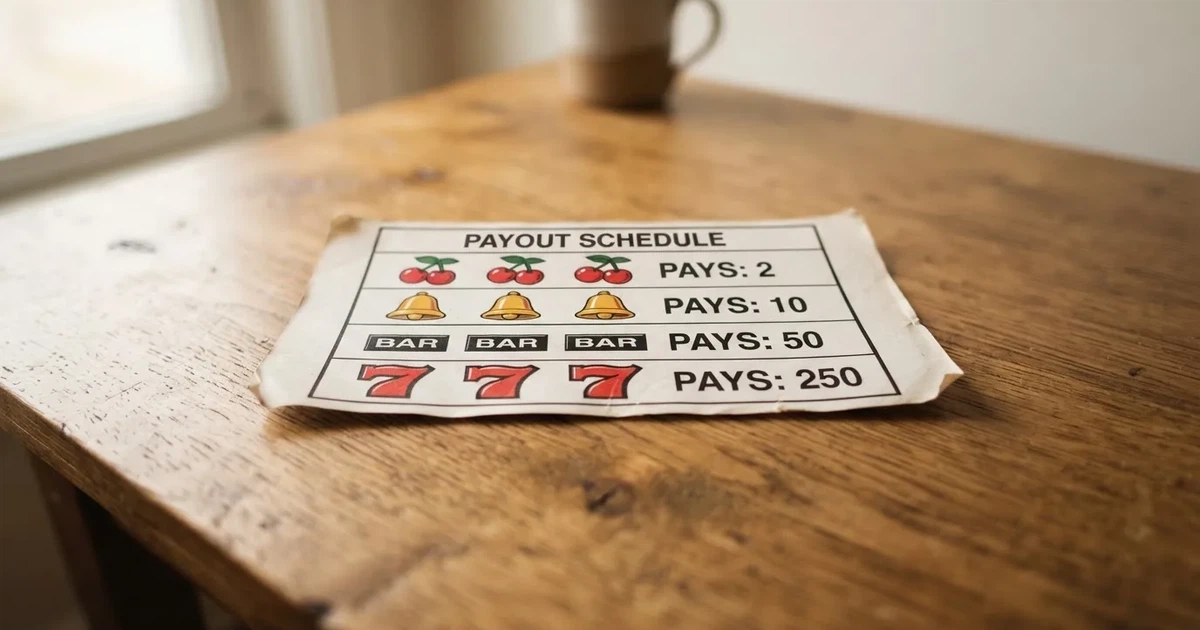
A pokies paytable is the reference card the game itself publishes — usually a button or menu inside the title — listing what each symbol combination pays and which features the title carries. Reading one is closer to reading a flight schedule than to playing a slot. Three things matter.
First, the symbol ladder. Each title pays for matched combinations of its base symbols and pays more for the rarer ones. Wilds substitute for other symbols to complete a line; scatters usually trigger a feature. The paytable sets the per-coin payout for each combination.
Second, the bet lines. A modern pokies title lets a player wager on a fixed number of lines (often 25, sometimes more) and choose the coin value per line. The stake is lines multiplied by coin value multiplied by coins per line. The paytable spells out what each winning combination pays at one coin, at maximum coins, and at the feature-triggering stake.
Third, the return-to-player. This is the long-run percentage of all money wagered that the game returns to players as winnings. The Australian minimum for legal land-based machines sits at 85% in NSW, the Northern Territory and Queensland; 87% at Crown Melbourne and across the ACT and Tasmania; 87.5% in South Australia; and 90% in Western Australia. Online titles are not bound by these minima. The paytable may or may not state the figure; when it does, it sits at the bottom of the help screen.
Volatility — how the title pays out when it does — is not on most paytables. High-volatility titles run long dry stretches followed by large wins; low-volatility titles pay small amounts more often. Neither pays out more than the stated RTP over a meaningful sample.
What the paytable does not say is also worth flagging. It does not state the licensed status of the operator offering it, the jurisdiction of any licence that operator holds, or whether the player’s deposit is going to a regulated entity. On offshore sites these are precisely the things a player most needs to know, and they sit on a different page entirely.
What a Catalogue of Online Pokies Looks Like in Practice
A pokies catalogue is what an operator groups under one roof — branded series, themed titles, jackpot networks, and the studios behind them. The catalogue page is the front door of the offer, and it tells a reader several things at a glance.
A catalogue that runs to a few thousand titles typically leans on aggregator deals: studios such as Microgaming, NetEnt, Play’n GO, Pragmatic Play and Evolution supply titles through distribution partners, and an operator lists everything the partner has. Smaller catalogues of a few hundred titles usually mean a direct deal with a smaller set of studios or a single in-house brand.
Themes cluster. Ancient Egypt, fruit machines, “Book of” mechanics, fishing and mining, and “Megaways” style cascading-reel titles are the most heavily populated shelves. A reader who wants a particular kind of volatility or stake range learns to filter by those instead of by theme; the theme shelf is the marketing of it, not the substance.
The category page also carries the progressive jackpot networks, when present, and any in-house branded series. Megaways, Hold & Win, and Cluster Pays are the mechanics that tend to dominate new releases. None of this tells a reader anything about the operator’s standing under Australian law. The catalogue is the product; the licence status is a separate document, and on offshore sites it almost never lines up with what an Australian reader needs.
What the Interactive Gambling Act Actually Prohibits
The Interactive Gambling Act 2001, tightened by the Interactive Gambling Amendment Act 2017, makes it an offence to provide online casino games — including online pokies — to a person in Australia. The 2017 amendments added in-play online betting and clarified that the prohibition reaches any provider, foreign or domestic, that deliberately targets Australians.
What the Act permits is narrower than the marketing would suggest. Online wagering on races and sport placed before the event is licensable. Lotteries are licensable. Keno is licensable. The Northern Territory Racing and Wagering Commission regulates 52 of Australia’s online bookmakers — Sportsbet, Bet365 and Ladbrokes among them — because the Territory’s licensing regime made it the practical home of online wagering. The commission has no full-time staff and meets once a month in Darwin.
Online casino play is not on that list. A licence displayed in a site’s footer — Curaçao, Anjouan, Malta — is not an Australian licence and does not bring the operator under the Australian regulator’s complaint or consumer-protection framework. The minimum age for the licensed alternatives is 18.
The Interactive Gambling Amendment (Gambling Reform) Bill 2026 passed Parliament on 19 August 2026 and adds advertising and inducement measures that commence on 1 January 2027. It is law with a start date, not yet in force on a 2026 page, but its direction is worth noting now: the inducement side of the market — the bonuses, free spins, sign-up credits — is the part of the offer that is tightening fastest.
How the ACMA Enforces the Prohibition
The Australian Communications and Media Authority runs the prohibition through three tools: formal warnings, blocking requests, and investigation of complaints. The data is published and cumulative.
The first blocking request went to Australian internet service providers in November 2019. As of June 2026, a running total of 1,751 illegal gambling and affiliate marketing websites had been blocked since that date, and more than 230 unlicensed gambling services had left the Australian market since enforcement was strengthened in 2017.
The most recent published round, reported on 26 June 2026, asked ISPs to block another 12: 7Signs, ChromaBet, Donbet, Duospin, Freshbet, Slots Gem, Jacks Club, Lucky Start, Pointsbetz, Spinrise, Vinyl Casino and Wildsino. The blocking action has been roughly continuous — each round adds a single-digit to a low-double-digit number of sites, and the register keeps growing.
Formal warnings are a separate track. They name the operator behind a site as well as the site itself, and they are published on the ACMA register. A non-exhaustive list of the brands publicly warned over the past four years: Rocketplay, Bambet, Dazard, Level Up, Wild Tornado, Cobra Casinos, Woo Casino, Spirit Casino, Ignition Casino, National Casino, Bizzo Casino, Instant Casino, Jackbit, CasinOK, Casino Intense, Sky Crown and Blue Leo. The corporate names behind those brands change between warnings — Dama N.V., Pulsup Ltd, Bamboo Media, Consolutetish S.R.L., EOD Code SRL, Ryker B.V., Sterplay Holding Ltd, Hollycorn N.V. — and the same brand has appeared more than once under different owners. Bizzo Casino was warned in 2022 as a TechSolutions entity and again in 2025 as a Consolutetish entity.
The individual player is not prosecuted. The Interactive Gambling Act targets the provider. That asymmetry matters for a reader weighing whether to sign up at an offshore site: the offshore site does the violating, and the player is the one who ends up without Australian consumer protection, no complaints body, and no recourse if a withdrawal is refused.
The Blocking Rate as a Band
The arithmetic that falls out of the cumulative data is straightforward. The ACMA’s first blocking request went out in November 2019, and 1,751 illegal gambling and affiliate marketing websites had been blocked by June 2026.
Stated as a band with its condition: over the roughly 80 months between November 2019 and June 2026, the ACMA’s blocking action has run at a sustained 20-25 new illegal gambling or affiliate marketing sites blocked per month — averaging close to five per week across the lifetime of the regime. That is the central condition: it is an average across the entire enforcement window, not a steady weekly drip. Round sizes vary; some months add a handful, some add none. What does not vary is the running total, which has moved in one direction only.
The reader-facing meaning is simpler than the arithmetic. The blocking list is not a one-off cleanup followed by a quiet market. It is a continuous drain of the offshore inventory — which implies a continuous supply behind it, because the list keeps growing. The estimated A$3.9 billion a year that H2 Gambling Capital’s 2025 report puts through illegal gambling sites, and the slide in the legal channel’s share of total gambling from 74% in 2021 to 64%, are the demand side of the same picture.
Player Protection in the Legal Market — and the Gap Offshore
The legal Australian market for online wagering carries two protection layers that an offshore pokies site does not. The first is BetStop, the National Self-Exclusion Register, which has been live since August 2023. BetStop binds every Australian-licensed online and phone wagering service. A person who registers is excluded from marketing, deposit and account access across the licensed network. The second is the National Gambling Helpline on 1800 858 858 — free, 24/7, with webchat at Gambling Help Online.
Neither layer reaches an offshore casino. BetStop binds Australian-licensed services; an offshore operator is not a member of the scheme and cannot honour an exclusion. The helpline still answers — that line is for anyone who picks up the phone — but the structural protection it routes a person into does not include the offshore account. If a person on the receiving end of a betting problem self-excludes through BetStop and then opens an offshore account the next day, the only protection that still attaches is the helpline and the offshore operator’s own discretion, which is not a protection at all.
For readers reading this page who are starting to wonder whether the time they spend on online gambling is affecting their wellbeing, sleep or finances, the practical next step is Gambling Help Online, not a further website. The conversation is confidential and free.
How Deposits and Withdrawals Get Handled Offshore
The legal deposit routes for licensed Australian online wagering are debit card, bank transfer, PayID/Osko and BPAY. Credit cards, credit-related products and digital currency have been banned as payment for licensed online wagering since 11 June 2024, with penalties up to A$247,500 for operators that breach the rule. A site that asks an Australian player for a credit card or a crypto deposit is operating outside the Australian rules.
The same offshore pokies sites that ask for those payments run their own settlement processes. PayID is the most commonly advertised “Australian-friendly” rail on offshore sites because the deposit is near-instant. What the marketing does not flag is the corresponding withdrawal path. Withdrawals from offshore sites typically move through international bank transfer, sometimes via an intermediary, and settlement times are the operator’s, not PayID’s. A deposit takes seconds; a withdrawal can take days to weeks, and disputed withdrawals have no Australian complaints body to escalate to.
The cost of that gap shows up in three places: the time the money is out of the player’s account while it is in transit, the FX spread the operator applies on either end, and the absence of any recourse if the operator declines to pay. None of these are spelled out on the deposit page. All three are the reader’s actual bill for using an offshore rail.
Bonuses and Free Spins as Background Reading
The bonus offers on offshore pokies sites are the most heavily marketed feature of the product and the one the new player most often accepts without reading. The standard shape is a matched deposit — the operator matches a percentage of the player’s first deposit up to a ceiling — plus a bundle of free spins on named titles. The reading on the offer is mechanical, and it is unflattering.
A matched deposit at 100% up to A$500 means the operator credits an account with bonus funds equal to the deposit, capped at A$500. Those bonus funds are almost never withdrawable as cash. They sit behind a wagering requirement: the player must wager the bonus amount (and often the deposit as well) a stated multiple of times before any of it converts to withdrawable cash. Wagering requirements on offshore pokies offers commonly run from 35x to 50x the bonus. At 40x on a A$500 bonus, the player has to turn over A$20,000 in eligible wagers before the bonus funds become cash.
Free spins are the second layer. They are usually locked to a single named title at a fixed spin value, with any winnings credited as bonus funds subject to the same wagering requirement. A “200 free spins” headline at A$0.10 per spin is A$20 of nominal spin value, paid in bonus funds, with the wagering requirement applied on top. The headline number is the marketing; the requirement is the cost.
Maximum cashout caps, game weighting (slots often 100%, table games 0-20%), time limits on clearing the bonus and per-spin stake caps while the bonus is active are all standard restrictions. Every one of them shrinks the headline number into a smaller realisable amount. The reader who treats the headline as the offer ends up doing the work the offer would have done had the restrictions not applied.
For an Australian player reading this page, the inducement side is the part of the market the 2026 reform legislation reaches hardest. From 1 January 2027, the advertising and inducement measures of the Interactive Gambling Amendment (Gambling Reform) Bill 2026 commence. None of that is in force on a 2026 page — but the direction of travel is the part of the offshore offer that the legal market has already decided is the problem.
What a Real Pokies Session Actually Costs
The licensed land-based machine has a regulated minimum return-to-player of 85% in NSW, the Northern Territory and Queensland, and 90% in Western Australia. The implied house edge — the inverse — runs from 10% to 15%. That is the structural cost of every dollar run through a legal machine.
Online pokies, where their RTP is published, typically run higher — 94% to 97% is the common published band — but with two structural differences. The first is stake per spin, which can be set lower. The second is that the offer layered on top — the matched deposit, the wagering requirement — adds a second cost layer on top of the house edge. A player running through bonus funds at 40x wagering on a 96% RTP title is paying the 4% house edge on every spin and the bonus has to be cleared before anything can be withdrawn. The two costs compound.
What this means in plain terms: the cost per dollar wagered on a legal Australian machine is 10-15 cents; on an offshore pokies title with a published RTP of 96%, it is 4 cents per dollar; on the same title inside a 40x wagering requirement on a A$500 bonus, the player is committed to A$20,000 of wagering before they can see any of it back as cash, and the average cost of that A$20,000 at the published RTP is roughly A$800. The house edge is the smaller of those two numbers; the bonus structure is the larger one.
A Note on Tax
Gambling winnings of a recreational player in Australia are not assessable income under section 6-5 of the ITAA 1997, and gambling losses are not deductible. The position changes only if the ATO considers the gambling activity to be a business — a much higher bar than casual play. This page is not tax advice and the model only goes this far: check with the ATO.
The Brand-by-Brand Picture
What follows is not a ranking. It is the ACMA’s own list of brands the regulator has publicly named in connection with the prohibition. The brands are presented in the order the ACMA has documented them, with the warning dates, the corporate operators behind them, and the product support those operators have published. None of these brands holds an Australian licence for online casino games. No player should treat the listing below as a shortlist of operators to visit; the listing is a record of the regulator’s actions, and the reader’s next move on any of these names is to understand what the warning meant.
The eleven brands, in order: RocketPlay, Level Up Casino, Woo Casino, Spirit Casino, National Casino, Bizzo Casino, Ignition Casino, Instant Casino, Jackbit, Casino Intense and Sky Crown.
RocketPlay: the warning record
RocketPlay sits at the top of the ACMA’s recent enforcement activity. The regulator issued a formal warning to Pulsup Ltd over Rocketplay in March 2026, and the same brand was previously the subject of a May 2022 warning to Dama N.V. (a Dama N.V. round in 2022 covered six brands: Bambet, Dazard, Level Up, Rocketplay, Wild Tornado and Cobra Casinos). The 2022 and 2026 warnings are the regulator’s own record; the intervening years show the brand changing corporate hands rather than changing regulatory standing.
RocketPlay publishes no Australian licence. The page publishes no bonus terms for it — the only sources for those were affiliate marketing pages, and affiliate terms are not the offer. What the brand does publish is a casino lobby and a sportsbook, both of which sit inside the prohibited category for an Australian reader. The subject support row for RocketPlay is empty: research did not return a verifiable catalogue or product line, so this page attaches no positive claim to the brand on that front.
The cost to a reader considering this brand is the one the ACMA warning already names: it is operating outside the Interactive Gambling Act, it has been warned before, and the same operator name has come back under a different corporate parent. For a reader evaluating the brand, the warning is the definitive statement from the regulator: the site is prohibited, and the brand is now part of the public enforcement record.
Level Up Casino: a 2022 warning, listings-only support
Level Up Casino was named in the ACMA’s May 2022 formal warning to Dama N.V., one of six brands covered by that action. The regulator’s record from that point is fixed; what has changed since is the corporate landscape around the brand. The site’s product support in industry listings identifies a provider that aggregates a number of studios, but the brand itself has not been the subject of a published ACMA action since 2022 — which is a fact about the regulator’s published actions, not an endorsement.
Level Up’s product catalogue sits in the listings-only category: the page can record that the brand appears in third-party provider listings, but it cannot attach that listing to Level Up as the brand’s own claim. For an Australian reader the legal standing is the same as every other brand on this list.
The verdict on Level Up comes from what the warning does not say as much as from what it says. A 2022 warning to one entity does not bind a different entity that runs the same brand in 2026; an Australian reader who lands on the brand today is reading a page the ACMA has not publicly addressed in four years. That is not a clean bill of health. It is silence from the regulator, which is a different thing from clearance.
Woo Casino: the March 2025 warning
In March 2025, Dama N.V. received a formal warning from the ACMA regarding Woo Casino. That is the brand’s most recent entry on the regulator’s published list. The brand runs a standard offshore casino lobby and a sportsbook; both sit inside the prohibited category for an Australian reader.
The product support row for Woo Casino is empty in research; this page attaches no positive claim. The 2025 warning is current and the ACMA has not publicly recorded any operator response to it.
The cost to a reader here is the regulator’s own statement: the brand was actively warned twelve months ago and the regulator chose to publish the warning rather than resolve it out of court. A reader who treats the publication of a formal warning as the regulator’s working assumption about the operator is reading the page the way the ACMA publishes it.
Spirit Casino: the May 2025 warning
Spirit Casino was subject to an ACMA formal warning in May 2025, directed at operator Dama N.V., just two months after the action taken against Woo Casino. The same corporate operator, the same prohibition, two warnings in quick succession. The pattern is consistent and it is not ambiguous.
Spirit Casino’s product support row is empty in research. The brand’s catalogue is the standard offshore casino lobby. None of this alters the regulatory standing for an Australian reader.
The verdict on Spirit Casino is the same one that fits Woo Casino: a formal warning published by the regulator in the past twelve months is the regulator’s own working position, and The publication of the warning puts the brand firmly outside the legal market; it is a clear-cut signal to any Australian user.
National Casino: the Consolutetish S.R.L. warning
In July 2025, the ACMA published a formal warning to Consolutetish S.R.L. concerning National Casino. The brand’s product support row is listings-only: the brand appears in third-party industry listings (including a Wikipedia entry that documents the broader Australian gambling landscape), but research does not return a verifiable operator-published catalogue.
National Casino’s regulatory standing for an Australian reader is the same as every other brand in this list: no Australian licence, formal warning published by the ACMA in 2025.
The cost to a reader considering this brand is the gap between the operator’s marketing and the regulator’s record. The listings the brand appears in are not endorsements; the formal warning is a regulator action. A reader who weighs the two correctly weighs the warning heavier, because the warning is the regulator and the listings are not.
Bizzo Casino: warned twice under different owners
In July 2025, Consolutetish S.R.L. received a formal warning from the ACMA concerning Bizzo Casino. The same brand had already been the subject of a 2022 formal warning to TechSolutions (CY) Group Limited and TechSolutions Group N.V. Two warnings to two different corporate owners of the same brand, three years apart.
Bizzo’s product support row is empty in research. The brand’s catalogue is the standard offshore casino lobby. What the warning record adds is the second one — and the second one is the relevant one for an Australian reader in 2026.
The cost to a reader here is the pattern itself. A brand that has been warned under two different corporate owners in three years has shown the regulator that the brand name survives a warning. The warning works on the operator; the brand moves on. The warning history speaks to the brand’s resilience in the offshore market, but it remains a formal prohibition from the Australian regulator.
Ignition Casino: the Bamboo Media warning
The ACMA issued a formal warning to Bamboo Media over Ignition Casino in July 2025. The brand’s product support row is empty in research; this page attaches no positive claim to the brand on the product front.
Ignition Casino’s regulatory standing for an Australian reader is the same as every other brand on the list: no Australian licence, formal warning published by the ACMA in 2025. The brand targets an Australian audience through its marketing; the regulator has published its response.
The cost to a reader considering Ignition Casino is the same pattern the regulator has been publishing across the rest of the list: a formal warning is the regulator’s own statement, and a brand that has received one in the past twelve months has been told, in writing, that its offer to Australians is prohibited. Whether the brand complies with that warning is a question the regulator’s record does not answer; whether the warning was issued is the regulator’s record.
Instant Casino: the February 2025 warning
The ACMA issued a formal warning to EOD Code SRL over Instant Casino in February 2025. The brand runs the standard offshore casino lobby; the product support row is empty in research.
The verdict on Instant Casino is the same pattern in a different month: a formal warning published by the regulator, no record of compliance published by the regulator, no Australian licence. The page attaches no positive claim to the brand on the product side because research returns no verifiable product line.
The cost to a reader here is the regulator’s working assumption about the brand — and the working assumption, on the regulator’s own page, is that the brand is offering prohibited services to Australians.
Jackbit: the April 2026 warning
The ACMA issued a formal warning to Ryker B.V. over Jackbit and CasinOK in April 2026. Jackbit’s product support row is empty in research.
Jackbit is the most recent operator name on the list, alongside its sibling brand CasinOK. The brand is the regulator’s current example, not its historical one. A reader who treats the freshness of the warning as a marketing claim in the brand’s favour is reading the record backwards; the regulator’s most recent publication is the regulator’s most recent position.
The cost to a reader considering Jackbit is the freshness itself. The regulator’s warning is in the same calendar year as the reader’s browse; there is no “this is old news” reading available.
Casino Intense: the April 2025 warning
April 2025 saw the ACMA issue a formal warning to Sterplay Holding Ltd in relation to Casino Intense. Casino Intense’s product support row is listings-only: the brand appears in third-party industry listings (ABC News and ACMA pages cited by research, plus a Crown Melbourne reference on baccarat variants). Those listings document the broader market; they do not endorse Casino Intense.
The verdict on Casino Intense runs in the same direction as the rest of the list. A formal warning published in April 2025 is the regulator’s record; the brand’s product support is what third-party listings report about it, not what the brand publishes.
The cost to a reader considering Casino Intense is the gap between the third-party listings the brand appears in and the regulator’s record. The listings are not the regulator; the regulator is the regulator.
Sky Crown: the Hollycorn N.V. warning
The ACMA issued a formal warning to Hollycorn N.V. over its Sky Crown and Blue Leo casino services. The product support row is empty in research.
Sky Crown and Blue Leo share the same warning, which is the same prohibition, which is the same gap in Australian consumer protection for any reader who lands on either brand. The Hollycorn N.V. record is one of the longer ones on the regulator’s published list.
The verdict on Sky Crown is the same pattern in a different corporate owner: a formal warning published by the regulator is the regulator’s own statement. A reader who treats that statement as the brand’s regulatory position is reading the ACMA’s record correctly.
The ACMA Record at a Glance
The table below collects the eleven brands above into a single view. Each row carries the brand name, the ACMA action and date, the corporate operator the ACMA named, and the product support row research returns. The product support column uses an em dash where research returned nothing verifiable.
| Brand | ACMA action and date | Operator named by the ACMA | Subject support |
|---|---|---|---|
| RocketPlay | Formal warning, March 2026; earlier May 2022 | Pulsup Ltd (2026); Dama N.V. (2022) | — |
| Level Up Casino | Formal warning, May 2022 | Dama N.V. | Listings-only (provider listings) |
| Woo Casino | Formal warning, March 2025 | Dama N.V. | — |
| Spirit Casino | Formal warning, May 2025 | Dama N.V. | — |
| National Casino | Formal warning, July 2025 | Consolutetish S.R.L. | Listings-only (industry listings) |
| Bizzo Casino | Formal warning, July 2025; earlier 2022 | Consolutetish S.R.L. (2025); TechSolutions (2022) | — |
| Ignition Casino | Formal warning, July 2025 | Bamboo Media | — |
| Instant Casino | Formal warning, February 2025 | EOD Code SRL | — |
| Jackbit | Formal warning, April 2026 | Ryker B.V. | — |
| Casino Intense | Formal warning, April 2025 | Sterplay Holding Ltd | Listings-only (industry listings) |
| Sky Crown | Formal warning, September 2022 | Hollycorn N.V. | — |
The Legal Alternative — Licensed Australian Pokies
The licensed alternative is not online. It is the gaming machine floor of a pub, club or casino. New South Wales led the rollout from 1956; Tasmania’s monopoly over machine licences ran from 1968 until the November 2021 legislation that moved oversight to the Tasmanian Liquor and Gaming Commission; Western Australia kept pubs and clubs free of poker machines when Crown Perth opened in 1985. Each state and territory separately regulates the design and operation of its machines.
The regulatory floors differ. Legal minimum return-to-player for a poker machine runs from 85% in NSW, the Northern Territory and Queensland, to 87% at Crown Melbourne and across the ACT and Tasmania, 87.5% in South Australia, and 90% in Western Australia. Tasmania’s pre-commitment card reform — mandatory cards for poker machine play — was scheduled for late 2025 after earlier delays. Pre-commitment is the structural response to the issue the offshore market ignores: a player setting their own loss limit before they sit down, in writing, with the venue honouring it.
For a reader who wants the experience the offshore pages advertise but inside the law, the licensed machine floor is the only answer. The offer is narrower (no autoplay at 3am, no crypto deposit, no bonus code) and the return is lower (85-90% RTP versus the 94-97% some offshore titles publish), but the consumer protection is real. BetStop binds; the regulator enforces; the venue pays out.
What to Do If Play Has Become a Problem
If reading this page has put a reader in mind of their own play — time on site, money on deposit, sleep lost — the practical next step is free and confidential. Gambling Help Online is the webchat arm of the National Gambling Helpline on 1800 858 858. Both are 24/7. The conversation is with a counsellor, not a sales line.
BetStop, the National Self-Exclusion Register, applies to Australian-licensed online and phone wagering services. A minimum exclusion period of three months applies, and exclusions can be extended up to a permanent ban. Offshore casinos are not members of BetStop, which is the structural reason the register cannot reach an offshore account a person has signed up to — and the reason the helpline is the better first move for someone whose play has reached offshore sites.
For a family member or friend of someone whose gambling has become a concern, the same helpline takes those calls too. The 2020-21 figure of A$12.18 billion lost on Australian gaming machines is a national number; the family conversations that hide behind it are not. They are the point.
Frequently Asked Questions About Online Pokies in Australia
Does calling an online pokies site “Aussie” change where it is actually licensed?
No. The label on the marketing does not change the corporate structure behind it. An “Aussie pokies” site is typically licensed in Curaçao, Anjouan or Malta — the standard offshore jurisdictions — and runs from a corporate operator the ACMA has, in most cases, already named on its register. The “Aussie” branding tells the reader who the site is targeting; it does not tell them who regulates it.
Are the bonus credits and free spins on an “Aussie pokies” site legal to advertise here?
The inducement side of the offer is the part of the market the Australian regulator has moved against fastest. The Interactive Gambling Amendment (Gambling Reform) Bill 2026 passed Parliament on 19 August 2026 and its advertising and inducement measures commence on 1 January 2027. On a 2026 page those measures are law with a start date, not yet in force — but the offer they address is the bonus-credit-and-free-spin offer that offshore sites have been running for years. The reader’s bill on those bonuses is the wagering requirement that sits behind them.
Is there a dedicated app for Aussie-branded online pokies that is legal to install locally?
No. Online casino games — online pokies included — are prohibited for anyone in Australia under the Interactive Gambling Act 2001, and no Australian app store legally offers them. The “Aussie pokies app” marketing refers to offshore mobile sites or sideloaded apps, neither of which sits inside Australian consumer protection. A reader who finds one in an app store is looking at a store’s gap in enforcing the local rules, not at an Australian licence.
Do state gaming regulators recognise any “Aussie online pokies” brand as licensed?
No. No state or territory issues a licence for online casino games or online pokies. The state regulators (Liquor & Gaming NSW, the Victorian Gambling and Casino Control Commission, the Queensland Office of Liquor and Gaming Regulation, the Tasmanian Liquor and Gaming Commission, the WA Department of Local Government, Sport and Cultural Industries, the ACT Gambling and Racing Commission, and the NT Licensing Commission) regulate land-based gaming machines, lotteries and licensed wagering. None of them regulates an “Aussie online pokies” brand, because none of them can.
How does an Aussie-branded online pokies catalogue differ from a licensed pub’s machines?
The licensed pub catalogue runs whatever the state regulator has approved for venue use, at the regulated minimum RTP of 85-90%, with mandatory pre-commitment in Tasmania, mandatory shut-down periods in several jurisdictions, and venue-level staff training. The offshore catalogue runs whatever the operator has licensed from its own offshore regulator, at whatever RTP the title publishes (typically 94-97% if published at all), with no venue, no staff, no shut-down period, and no pre-commitment. The difference is structural, not cosmetic: the licensed venue is a regulated environment; the offshore site is a product on a server.
Can an Aussie-branded online pokies site accept a PayID deposit and still be unlicensed?
Yes. PayID is a payment rail operated by Australian banks for the New Payments Platform. It does not check what the deposit is for. An unlicensed offshore casino can accept a PayID deposit, and many do, because the rail is instant and the deposit is friction-free for an Australian player. The fact that a site takes PayID tells the reader nothing about whether the operator holds an Australian licence. The credit-card and crypto ban that took effect on 11 June 2024 for licensed wagering does not bind an offshore casino; the offshore site can take whatever its own payment page lists, and the Australian rules that apply are the prohibition rules, not the deposit-method rules.