
high-RTP pokies in Australia: what the percentage is, what it isn’t, and what it costs
A pokie with a 97% return-to-player figure does not pay back A$97 of every A$100 wagered on the next visit, the next session, or the next hour. It pays back A$97 over the full design life of the machine, after millions of spins, with the rest going to the operator as house edge. The “97” is the theoretical long-run average, not a coupon, not a guarantee, not a number a player can verify on any single afternoon. Most of the marketing around “high RTP pokies Australia” pushes that distinction to one side, and the rest of this page does not.
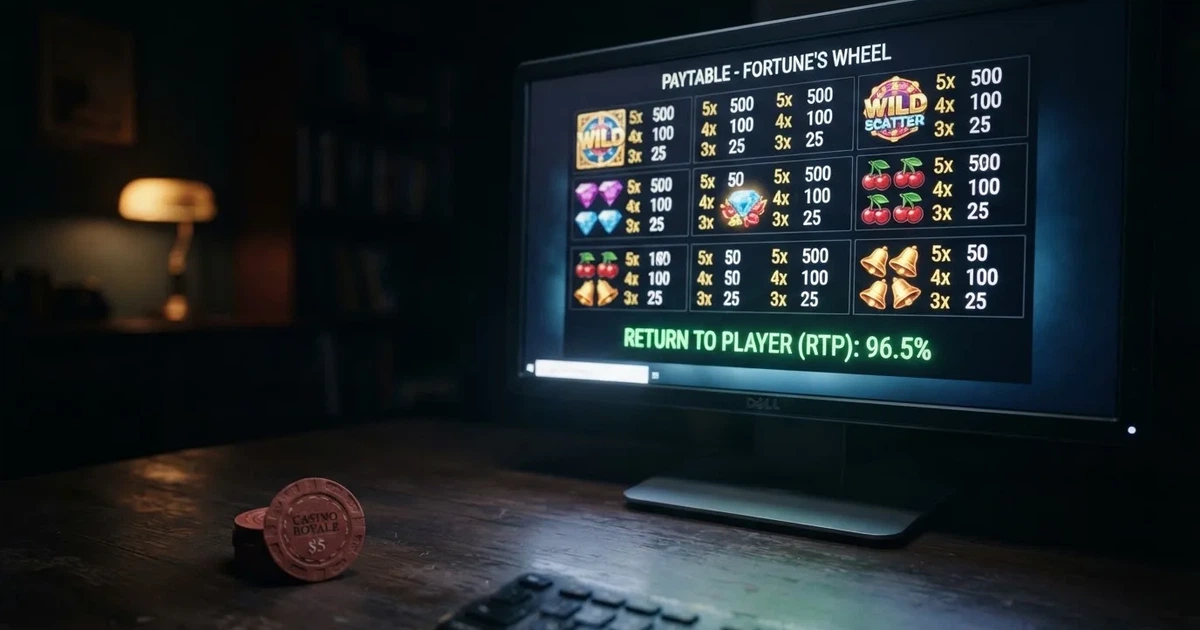
The currency stamp below says what is true as of the date the page was last refreshed, and against which register those figures were checked. Where an offshore site claims a 98% figure, that figure comes from a paytable the operator wrote and the regulator has not seen. The Australian Communications and Media Authority has spent several years blocking and warning exactly the operators that run those ads; the bottom of this page is the list of those names, in the order the ACMA itself named them.
Currency stamp: as of 8 November 2026; verified against the ACMA’s published list of formal warnings and blocking actions.
Table of Contents
- What RTP is, and what the percentage on a paytable actually represents
- How RTP is set, disclosed, and enforced on Australian machines
- The offshore landscape and what “best RTP pokies Australia” usually points to
- Why the legal minimum matters more than the advertised maximum
- Variance, hit frequency, and the part of “high RTP” the marketing leaves out
- What an RTP figure legally has to do in Australia, and what it does not have to do
- Why offshore “best RTP” lists are not the same as the Australian floor
- The Australian regulatory frame: who does what, and where the ACMA fits
- Player protection: what is and is not connected to an offshore account
- Payment rules: what an Australian site can and cannot ask for
- Tax, winnings, and what an Australian player actually keeps
- The casino and table-game frame, and why baccarat and blackjack surface here
- What the ACMA’s enforcement record actually tells a reader
- The blocking-rate calculation, in plain terms
- What an Australian reader should take from the page
- Operators the ACMA has warned over online pokies and casino products
- The takeaway, in one paragraph
- Frequently asked questions about high-RTP pokies in Australia
What RTP is, and what the percentage on a paytable actually represents
Return-to-player, written as a percentage on the paytable or the help screen of a licensed machine, is a theoretical average. It is calculated by the game’s designer across the full set of outcomes the machine can produce — every combination on every reel, weighted by the probability it lands. A 95% RTP machine keeps, on average, A$5 of every A$100 wagered over the lifetime of its design. A 90% machine keeps A$10. The remaining money goes back to players as wins, small and large, across millions of spins.

The percentage is not a session return. A player can put A$100 into a 96% machine and walk away with A$40, or with A$180. Both outcomes are consistent with a 96% design. The variance is what makes the machine feel like gambling rather than savings, and the long-run average is what regulators cite when they set a minimum. In Australia that minimum is set state by state, and it is not high everywhere.
The published Australian minimums, state by state, sit at 85% in New South Wales, the Northern Territory, Queensland and (generally) Victoria, with 87% at Crown Melbourne, 87% in the Australian Capital Territory and Tasmania, 87.5% in South Australia, and 90% in Western Australia.
| State/Territory | Legal Minimum RTP |
|---|---|
| New South Wales | 85% |
| Northern Territory | 85% |
| Queensland | 85% |
| Victoria | 85% |
| Australian Capital Territory | 87% |
| Tasmania | 87% |
| South Australia | 87.5% |
| Western Australia | 90% |
Those are legal floors, not market averages. Many venue machines run higher — Aristocrat and IGT titles common in pubs and clubs typically publish figures in the 90–96% range — but the floor is the line below which no operator can set a machine and still hold a licence.
“High RTP” in Australian marketing usually means anything above the jurisdictional minimum. “Highest RTP pokies Australia” usually means a list curated by an affiliate site, citing percentages the affiliate itself has not verified. Both terms are loose, and both are best treated that way.
How RTP is set, disclosed, and enforced on Australian machines
A licensed Australian machine has its RTP printed on the help screen, in the player information menu, or on a sticker affixed to the cabinet. The exact location is set by the state or territory regulator. In New South Wales the Liquor & Gaming NSW publishes a public register of approved games and their settings; in Victoria the Victorian Gambling and Casino Control Commission (VGCCC) does the same; in Queensland the Office of Liquor and Gaming Regulation maintains the equivalent list. A player can ask venue staff for the game’s information sheet, and on a regulated machine that sheet will give the figure.
A venue cannot legally change a machine’s RTP setting after installation without notifying the regulator and re-approving the change. The games are certified in a laboratory before they go onto a floor, and the certified configuration is what runs on the cabinet. A pub cannot quietly turn down the payout on a 94% game to 88% to chase a margin; the change has to go through the regulator, and the regulator publishes the approved settings. This is the system offshore online casinos do not run.
An offshore site, by contrast, has no Australian regulator reviewing its paytable. The site publishes whatever percentage it likes; the player has no way to confirm the figure against a register; and the regulator that does oversee the operator — usually Curaçao or Anjouan — does not publish per-game RTP certifications in a form an Australian player can search. Where an Australian-facing site advertises “highest RTP pokies”, the figure is usually a marketing line lifted from the developer’s own game info page, with no Australian cross-check.
The offshore landscape and what “best RTP pokies Australia” usually points to
Online pokies — the internet version of the same machine — are prohibited for people in Australia under the Interactive Gambling Act 2001. No state or territory licenses them. What is licensed is wagering on sport and races placed before the event, lotteries, and keno; the Northern Territory Racing and Wagering Commission regulates 52 online bookmakers from Darwin for historical tax reasons, including Sportsbet, Bet365 and Ladbrokes. Casino games and online pokies are not in that licensable set, whatever licence badge a site displays at the bottom of its home page.
The brands that market “high RTP pokies” to Australian players are, almost without exception, offshore operators that the ACMA has warned or blocked. H2 Gambling Capital’s 2025 report puts annual Australian losses to illegal gambling sites at about A$3.9 billion, and notes that the share of gambling going through legal channels fell from 74% in 2021 to 64%. The market exists; the legal channel does not cover it; and the operators running the offshore side are the ones the ACMA has spent the last decade directing Australian ISPs to block.
Where this page lists eleven operators at the bottom, that list is not a ranking and not a recommendation. It is the ACMA’s own list of formal warnings, in the order the regulator published them. Every one of those brands offers, or has offered, online pokies to Australian players; every one sits outside the Interactive Gambling Act’s licensable set; and the RTP figure each one quotes in its advertising has no Australian regulator behind it.
Why the legal minimum matters more than the advertised maximum
A higher theoretical return-to-player is not free money. The house keeps the difference, and the difference is what funds the game’s variance, the bonus features, the larger top-end jackpots, and the venue’s own revenue share. A 96% machine in a NSW pub returns, on average, A$96 of every A$100 its players cycle through it, and keeps A$4. That A$4 — across 87,298 machines outside NSW casinos and A$8.18 billion in player losses in 2022–23 — is what runs the clubs and the venues and the state racing-and-gaming tax base.
Queensland runs 21,122 gaming machines across 351 venues (October 2023). Victoria runs 26,380 outside Crown Casino across 488 venues, under a 30,000-machine statewide cap. Western Australia banned poker machines in pubs and clubs when Crown Perth opened in 1985, and the casino’s machine floor has grown from about 200 in 1985 to roughly 2,500 today — every one approved by the state’s Gaming and Wagering Commission. The shape of the machine stock, the shape of the loss numbers, and the shape of the legal regime vary across states in ways the marketing never mentions.
The licensed floor is regulated. The numbers on the wall have been checked. A 96% game at the front of a Sydney club is a 96% game because Liquor & Gaming NSW has approved that configuration, and the regulator’s register says so. That register is the single document an Australian player can point at and say: the figure on this machine is the figure the regulator approved. No offshore site has the equivalent.
Variance, hit frequency, and the part of “high RTP” the marketing leaves out
Two machines can both publish 96% and feel nothing alike. One pays back in small, frequent line wins and rarely climbs; the other goes quiet for long stretches and then drops a larger feature payout that recovers the ground. The first has a low-volatility profile, the second a high-volatility profile, and the RTP figure alone says nothing about which one the player is sitting at.
Australian pokies terminology follows the broader “pokies” label rather than the international “slots” label, and the volatility classes are the same: low, medium, high. A low-volatility 96% machine will produce more paid spins per hundred, with most wins below the stake; a high-volatility 96% machine will produce fewer paid spins, with a heavier share of the return concentrated in bonus rounds and feature triggers. A player who wants longer sessions on a small bankroll generally wants lower variance; a player chasing a larger top-end payout accepts longer dry stretches for the chance of a heavier hit.
The hit frequency — the share of spins that produce any return at all — is a separate number from RTP, and it is what shapes the player’s experience of the session. A 30% hit frequency at 96% RTP plays very differently from a 12% hit frequency at 96% RTP, and both are common. None of this is visible on a paytable summary that lists only the percentage.
What an RTP figure legally has to do in Australia, and what it does not have to do
The legal minimums listed earlier are floors, not targets. A venue can install a game set at 90% in New South Wales — above the 85% floor, fully compliant — and the regulator will not object. A venue running an Aristocrat or Light & Wonder title set at 94% or 95% is running a more generous configuration than the law requires, but the additional generosity is the venue’s commercial decision, not the player’s right.
A pokie’s help screen in Australia discloses the RTP. The location varies by jurisdiction — embedded in the game’s info menu, on the cabinet, in a printed handout — but it is disclosed. What is not disclosed is the hit frequency, the volatility class, or the contribution of each bonus feature to the overall return. Those details live in the developer’s design documentation, which the regulator holds but the player usually does not.
What is also not disclosed is any session-level payout behaviour. The regulator approves the theoretical configuration; it does not track and publish what the machine did yesterday. Past session results on a regulated machine are not a predictor of future results, and the venue has no obligation to display them.
Why offshore “best RTP” lists are not the same as the Australian floor
An Australian-facing offshore site that advertises “best RTP pokies Australia” is quoting from a catalogue it does not own. The games are licensed from developers — Pragmatic Play, BGaming, NetEnt, Evolution, Play’n GO, and the rest — and the RTP figures come from those developers’ own information sheets. The site selects which titles to feature, often on the strength of affiliate commission rather than payout, and it displays the developer’s number as if the site itself had certified it.
The site has not certified it. No Australian body has cross-checked it. The number is whatever the developer published, often with multiple RTP configurations per title, and the site may be running the lower configuration without telling the player. A BGaming or Pragmatic Play slot can ship with two or three certified RTP settings, and the operator chooses which to load. There is no Australian register the player can search to confirm which setting the offshore site is actually running.
That is the practical meaning of “best RTP pokies Australia” when it appears in an offshore ad. It is a list of developer-published figures, on sites the ACMA has already warned or blocked for offering the product in the first place. The page does not endorse those lists and does not reproduce them; it explains why they are not the same thing as a licensed Australian machine.
The Australian regulatory frame: who does what, and where the ACMA fits
The Interactive Gambling Act 2001 (IGA), strengthened by the Interactive Gambling Amendment Act 2017, makes it an offence to provide online casino games, online pokies, or in-play betting to a person physically in Australia. The ACMA investigates, issues formal warnings, and directs Australian internet service providers to block illegal sites. As of June 2026 the ACMA had asked ISPs to block 1,751 illegal gambling and affiliate marketing websites since the first blocking request in November 2019, and more than 230 unlicensed gambling services had left the Australian market since enforcement was stepped up in 2017.
The most recent blocking round reported on 26 June 2026 covered 12 sites: 7Signs, ChromaBet, Donbet, Duospin, Freshbet, Slots Gem, Jacks Club, Lucky Start, Pointsbetz, Spinrise, Vinyl Casino and Wildsino. Those joins sit on top of a steady cadence of formal warnings to the operators behind the brands. The ACMA’s enforcement record is the source for the operator list at the bottom of this page.
The IGA targets the provider, not the player. An Australian who opens an offshore casino account is not prosecuted. The cost falls on the player in a different form: no Australian consumer protection, no local complaints body, no recourse if a withdrawal is refused, and the site can be blocked with a balance still on the account. The ACMA’s blocking list has grown by several hundred sites since 2019, and the block is a one-line instruction to ISPs, not a process that asks whether anyone has money on the site at the time.
Player protection: what is and is not connected to an offshore account
BetStop, the National Self-Exclusion Register, has been live since August 2023. It binds Australian-licensed online and phone wagering services — sportsbooks, bookies, the licensed operators. It does not bind an offshore casino. A player who registers with BetStop is excluded from licensed Australian wagering; an offshore casino, by definition, is not part of that system and will not check the register.
The National Gambling Helpline (1800 858 858) is free, 24/7, and offers chat at Gambling Help Online. It is the right first call for someone whose gambling has moved beyond what they meant it to. State-level services sit beside it: New South Wales GambleAware, Victoria’s Gambler’s Help, Queensland’s Gambling Help Service, and the equivalents in the other jurisdictions. Tasmania planned nation-leading mandatory pre-commitment cards for its poker machines, with implementation delayed until late 2025; the policy is in place, but the rollout took longer than the legislation originally envisaged.
The 2026 reform package — the Interactive Gambling Amendment (Gambling Reform) Bill 2026 — passed Parliament on 19 August 2026. Its advertising and inducement measures commence on 1 January 2027. On a page read before that date, the law has been passed but is not yet in force; a page read on or after 1 January 2027 reports it as active.
Payment rules: what an Australian site can and cannot ask for
Since 11 June 2024, credit cards, credit-related products, and digital currencies are banned as payment for licensed online wagering in Australia. Penalties for operators running afoul of the ban reach A$247,500. The legal deposit routes for licensed wagering are debit card, bank transfer, PayID/Osko, and BPAY. An Australian-facing site asking for a credit card or a crypto deposit is running outside the Australian rules, and is therefore not a licensed Australian wagering service in the first place.
The ban does not extend to land-based gaming. A player can still use a credit card at a venue to withdraw cash and feed it into a machine; the ban is on the digital payment rails. The distinction matters because most offshore casino marketing pushes crypto deposits, on the reasoning that crypto sidesteps the Australian banking system entirely. From the regulator’s standpoint, the deposit is what counts, not the rail it arrived on.
Tax, winnings, and what an Australian player actually keeps
Gambling winnings of a recreational player are not assessable income in Australia, under section 6-5 of the ITAA 1997. Losses are not deductible. The position changes only if the ATO decides the person is carrying on a business of gambling, which is a much higher bar than being a regular punter. The “check with the ATO” line that surfaces in gambling tax guides is a real instruction: the ATO makes the call case by case, and the page does not second-guess it.
The tax treatment is one of the few areas where the law is genuinely settled, and where the difference between a licensed Australian operator and an offshore one does not change the answer. A recreational player pays no tax on winnings at either; an offshore operator does not give a better tax outcome than a licensed one. The tax line is not a reason to choose offshore; it is also not a reason to avoid it on tax grounds. The reasons to avoid offshore are the ones in the section above: no local protection, no complaints body, and a balance that can be stranded by an ACMA block.
The casino and table-game frame, and why baccarat and blackjack surface here
Two table games come up repeatedly in Australian casino marketing alongside pokies: baccarat and blackjack. They are not pokies, and they are not the subject of this page. They come up because a few offshore sites use “high RTP” as a hook for the whole lobby, and baccarat and blackjack sit at the top of the table-game RTP table.
Baccarat, on the Banker bet, has a house edge of 1.06%. On the Player bet, 1.24%. On the Tie bet, 14.36% — the bet the marketing never quite mentions. Punto banco, the variant most casinos deal, runs from a shoe of six or eight decks, with the casino banking the game at all times and both hands played out by fixed drawing rules. Chemin de fer, the French two-player variant, emerged from baccarat banque in the late 19th century and is faster to play than the original. Crown Melbourne offers Traditional Baccarat, Crown Baccarat and 2 to 1 Baccarat as approved table games under the VGCCC, which replaced the VCGLR as Victoria’s casino regulator on 1 July 2022. Under section 66 of the NSW Casino Control Act 1992, a casino operator must not permit a game such as baccarat unless its rules are approved by the regulator, and the operator must make a copy of the approved rules available on request.
Blackjack, with optimal strategy, has a house edge of about 0.28% under liberal Las Vegas Strip rules and about 0.43% under Atlantic City rules. The game’s ancestor is the English vingt-un, with a related veintiuno described in Cervantes’ Rinconete y Cortadillo around 1601–1602, formal British rules published in 1800, and the modern name dating to about 1899 around the Klondike Gold Rush. Variants like Spanish 21, Double Exposure, Blackjack Switch and Super Fun 21 shift the rules around the edges. Blackjack is the lowest-house-edge game most Australian players will encounter on a licensed floor, and it is the one that explains why “RTP” is not a pokies-only conversation.
The reason this is on the page: an Australian who searches “best RTP pokies” often lands on offshore sites that bundle baccarat and blackjack into the same high-RTP pitch. The bundle is the marketing, not the analysis. The numbers above are real, but they are table-game numbers, and the offshore sites pitching them have already been warned by the ACMA for offering prohibited products to Australians in the first place.
What the ACMA’s enforcement record actually tells a reader
The cumulative effect of the ACMA’s blocking and warning programme is not hard to read. 1,751 sites blocked since November 2019. More than 230 unlicensed services have left the Australian market since 2017. The blocking rate, averaged over the period from the first request in November 2019 to the most recent reported round in June 2026, works out to roughly 26 site blocks per month — and that is the floor of the rate, not a recent spike, because the actual monthly volume has been higher in the more recent rounds and lower in the early ones. The headline figure to take from the record is the cadence: every few weeks another batch of names appears on the ACMA’s list, and the names on it cycle through the same handful of operator shells.
The operator shell pattern is the second thing the record tells. Many of the formal warnings the ACMA has issued are not to the brand the player sees on the website; they are to the company behind the brand. Dama N.V. has been warned over Bambet, Dazard, Level Up, Rocketplay, Wild Tornado, Cobra Casinos, Woo Casino and Spirit Casino at different points. Consolutetish S.R.L. has been warned over National Casino and Bizzo Casino. Hollycorn N.V. has been warned over Sky Crown and Blue Leo. The same operator runs several brands; the ACMA warns the operator, not the brand, and the same warning can name several brands at once. A player who avoids one brand by name and not by operator is one rebrand away from landing back on a warned site.
The third thing the record tells is that the warnings are real and are published. The ACMA’s website carries the formal-warning list as public PDFs, with the operator name, the brand name, the date and the legal basis. The names below are taken from those PDFs. None of them is paraphrased; none is “according to reports”; the ACMA’s own publication is the source for each line.
The blocking-rate calculation, in plain terms
The arithmetic the page is built around is the running total of blocked sites against the time elapsed since the first blocking request. The ACMA’s running total as of June 2026 is 1,751 sites, from a first request in November 2019. That is approximately 79 months from November 2019 to June 2026, which gives a long-run average of roughly 22 blocked sites per month across the full period — and a more recent rate, since enforcement was stepped up, that runs higher than that average and is the figure the more recent rounds reflect. The exact per-month figure moves as the ACMA publishes new rounds; the order of magnitude — somewhere between twenty and thirty site blocks a month, sustained over nearly seven years — is what the record supports.
The point of doing the arithmetic is not to land on one number. It is to put a scale on the operation: the ACMA is not issuing an occasional warning and considering the matter closed. It is running a continuous enforcement programme, in batches, against a market that has roughly A$3.9 billion a year in Australian player losses behind it. The blocking rate is the visible shape of that programme, and the rate has not slowed.
What an Australian reader should take from the page
A licensed Australian machine, on a regulated floor, has its RTP disclosed and certified. The disclosure is the legal floor on the marketing claim; it is also the ceiling on what the player can verify. A higher theoretical RTP is not a higher session return, and a 96% game can still cost a session’s bankroll in full. Variance, hit frequency, and the shape of the bonus features are the second-tier questions a paytable summary does not answer, and the questions that decide whether the game feels the way the player wants it to feel.
An offshore site advertising “best RTP pokies Australia” is offering a product the IGA prohibits from being supplied to Australians. The RTP figure on those sites is the developer’s number, not an Australian regulator’s certification, and the operator may be running a lower configuration than the one advertised. The site itself is one blocking round away from disappearing, with whatever balance the player has on it. The brands at the bottom of this page are the ACMA’s record of that market, in the order the regulator published it.
The land-based floor remains. NSW clubs and pubs run 87,298 machines; Queensland runs 21,122; Victoria runs 26,380 under a 30,000 statewide cap; Western Australia keeps its pub-and-club floor closed and concentrates the stock at Crown Perth. Tasmania’s mandatory pre-commitment cards were scheduled for late 2025. The licensed machines are the ones with a regulator behind them, and the figures on their paytables are the figures the regulator has approved.
Operators the ACMA has warned over online pokies and casino products
The table below is the ACMA’s record, not a ranking. Each row is one brand the regulator has published a formal warning against, with the operator name the warning names and the date the warning was issued. “Online casino games cannot be licensed anywhere in Australia, whatever licence the site displays” applies to every row; the licence badge at the bottom of an offshore site is not an Australian licence, and the ACMA’s warning is over the act of offering the product to Australians in the first place. Where research carries no further information about a brand, the row carries the warning and nothing else.
| Brand | ACMA action and date | Operator named by the ACMA | What research establishes |
|---|---|---|---|
| RocketPlay | formal warning, March 2026 | Pulsup Ltd | — |
| Level Up Casino | formal warning, May 2022 | Dama N.V. | listed by BGaming |
| Woo Casino | formal warning, March 2025 | Dama N.V. | — |
| Spirit Casino | formal warning, May 2025 | Dama N.V. | — |
| National Casino | formal warning, July 2025 | Consolutetish S.R.L. | listed by en.wikipedia.org |
| Bizzo Casino | formal warning, July 2025; earlier 2022 | Consolutetish S.R.L.; earlier TechSolutions | — |
| Ignition Casino | formal warning, July 2025 | Bamboo Media | — |
| Instant Casino | formal warning, February 2025 | EOD Code SRL | — |
| Jackbit | formal warning, April 2026 | Ryker B.V. | — |
| Casino Intense | formal warning, April 2025 | Sterplay Holding Ltd | referenced by ABC News, acma.gov.au, Crown Melbourne |
| Sky Crown | formal warning, September 2022 | Hollycorn N.V. | — |
RocketPlay sits at the top because the ACMA’s most recent warning over it is March 2026, and the earlier 2022 warning over the same brand named Dama N.V. rather than Pulsup Ltd — a change of operator shell between the two warnings, and a useful illustration of the operator-rotation pattern the ACMA’s record shows. The pattern is what the table makes visible: Dama N.V. appears four times, Consolutetish S.R.L. twice, and a different operator shell backs each of the rest. A reader who avoids one brand by name and not by operator is one rebrand away from landing back on a warned site.
The takeaway, in one paragraph
A high RTP figure on an Australian licensed machine is real and disclosed; a high RTP figure on an offshore site pitching to Australians is a developer-supplied number on a product the IGA prohibits. The licensed floor is the place the figure has a regulator behind it; the offshore market is the place the figure is a marketing line, and where the ACMA’s record is the only external cross-check the player has. The arithmetic the page runs — roughly twenty to thirty site blocks per month sustained since November 2019, against an illegal market of about A$3.9 billion a year — is the scale of the gap the regulator is trying to close, and the scale of the risk a player accepts by sitting on the offshore side of it.
Frequently asked questions about high-RTP pokies in Australia
What counts as a “high” RTP figure on an Australian pokies machine?
There is no industry-wide definition. Australian regulators set minimums, not targets — 85% in NSW, the Northern Territory and Queensland, 87% in the ACT and Tasmania, 87.5% in South Australia, and 90% in Western Australia. A “high” figure is anything above those floors; common pub and club titles sit in the 90–96% range, but the marketing phrase is loose and the player should always check the help screen rather than trust the headline.
Is RTP the same thing as the chance of winning on any single spin?
No. RTP is the theoretical average over the full design life of the machine, across millions of spins. A 96% RTP game can pay back more or less than 96% in any given session, and either outcome is consistent with the design. Hit frequency — the share of spins that return anything at all — is a separate figure, and that one shapes how the game feels to a player during a session.
Where is a pokies machine’s RTP figure legally required to be disclosed in Australia?
On the machine itself, in the player information menu or the help screen, and in the regulator’s register of approved games. The exact placement is set by the state or territory regulator; a player can ask venue staff for the game’s information sheet, and on a regulated machine the figure will be on it. Offshore sites are not part of this system and have no equivalent disclosure obligation to an Australian regulator.
Can a venue change a machine’s RTP setting after it’s installed?
Not without notifying the regulator and re-approving the change. The certified configuration is what runs on the cabinet, and the regulator publishes the approved settings in its public register. A venue cannot quietly turn down a 94% game to chase a margin, and that constraint is the structural difference between a regulated Australian floor and an offshore site.
Does a high RTP figure mean smaller or larger individual wins?
It means neither, on its own. Two games can both publish 96% and feel nothing alike — one pays back in small, frequent line wins, the other goes quiet and pays back through a heavier bonus-round hit. The volatility class and the hit frequency are the figures that decide what a session feels like; the RTP figure alone is silent on both. A player chasing larger top-end wins generally accepts higher volatility; a player on a small bankroll generally wants lower.
How does the number of pokies machines vary between Australian states?
Substantially. NSW runs 87,298 machines outside casinos across 2,195 venues; Queensland runs 21,122 across 351; Victoria runs 26,380 outside Crown Casino across 488 venues, under a 30,000-machine statewide cap. Western Australia keeps pubs and clubs free of machines entirely, with the stock concentrated at Crown Perth. The shape of the machine stock, the loss numbers, and the regulatory regime vary state by state, and any “Australian pokies” generalisation is best treated as a starting point rather than a conclusion.