
gambling casino sites and slots in Australia in 2026: what sits where, what is blocked, what the maths leaves behind
Data current as of 8 November 2026. Licences and ACMA enforcement claims verified against the Australian Communications and Media Authority’s published blocking and formal-warning notices.

Every offshore casino reviewed on this page is illegal to provide to a person in Australia under the Interactive Gambling Act 2001. The ranking that follows is not a recommendation: it is a record of what the ACMA itself has acted against, what the brands offer, and what an Australian player actually pays for the privilege of using them. The market sits in two pieces that do not touch. One piece is licensed wagering — Sportsbet, Bet365, Ladbrokes — regulated by the Northern Territory Racing and Wagering Commission, restricted to pre-event race and sport betting, lotteries and keno. The other piece is everything marketed to Australians as “real money online casino”, and none of it is licensed here. The Interactive Gambling Act targets the provider, not the punter; that is the only reason the offshore sites keep operating at all.
That gap is the subject of the page. It shows up in the cost column — an offshore site has no local dispute body, no Australian payment oversight, and a regulator that can pull the domain without warning. It shows up in the deposit column — credit cards and crypto are banned for licensed wagering since 11 June 2024, so a site asking for either is operating outside the Australian rules by design. And it shows up in the responsible-gaming column — BetStop, the National Self-Exclusion Register, binds only Australian-licensed services; an offshore casino is not connected to it.
Table of Contents
- How the Australian market actually splits
- What offshore blocking actually does to a casino
- Calculation — the blocking rate over the enforcement era
- What a “trusted” or “safe” offshore casino actually has behind the label
- Crypto at an offshore casino: same software, different rails
- Online slots vs pub and club pokies: the machine under both names
- How the maths sits on a few other casino games
- The ACMA record: what each warning covers, and what it leaves open
- The eleven operators the regulator has named
- What sits in the comparison block, and what each column costs the reader
- What the offshoreness costs in real money
- What sits inside the responsible-gaming register that matters
- Tax, winnings and what the ATO will and will not do
- What the offshore market looks like from the inside
- What a punter who has been playing offshore should know
- Frequently asked questions
How the Australian market actually splits
Australian gambling regulation runs along a fault line drawn by the Interactive Gambling Act 2001 and the Interactive Gambling Amendment Act 2017. The 2017 amendments are what made it an offence to provide online casino games, online pokies and in-play betting to a person physically in Australia. None of the eight state and territory regulators license online casino products. Lotteries, keno, and pre-event wagering on races and sport are licensable, and the practical regulator for online wagering is the Northern Territory Racing and Wagering Commission — a body with no full-time staff, meeting once a month in Darwin, that nonetheless oversees 52 online bookmakers including Sportsbet, Bet365 and Ladbrokes. The arithmetic of that arrangement is itself the story: most of the wagering licensed in Australia is licensed in one Territory for tax reasons, and the rest of the country lets it through.

What is illegal to provide is the offshore casino and online pokies market that most search results point Australians toward. The ACMA’s enforcement tool is section 313 of the Telecommunications Act 1997, which lets the regulator ask Australian internet service providers to block illegal services at the network level. As of the regulator’s June 2026 tally, 1,751 illegal gambling and affiliate marketing websites had been blocked since the first blocking request in November 2019, and more than 230 unlicensed gambling services had left the Australian market since enforcement was strengthened in 2017. The June 2026 round alone added twelve more domains: 7Signs, ChromaBet, Donbet, Duospin, Freshbet, Slots Gem, Jacks Club, Lucky Start, Pointsbetz.com, Spinrise, Vinyl Casino and Wildsino.
The punitive effect on the offshore side is real. The protective effect on the player is not. An Australian player who signs up with an offshore casino gets none of the things the Australian licensing regime provides: no external dispute resolution, no guarantee that a withdrawal request will be honoured, no BetStop binding, and no payment-route integrity. A player can be blocked mid-session with a balance still on the books. The 2017 amendments did not change that calculus; the law still aims at the provider, not the punter.
H2 Gambling Capital’s 2025 estimate puts Australian losses to illegal offshore sites at roughly A$3.9 billion a year. The same estimate records that the share of gambling going through legal channels fell from 74 per cent in 2021 to 64 per cent in 2025 — i.e. the offshore share has grown while the block list has lengthened. That is the picture this page is written against. Every offshore casino reviewed below sits inside that 36 per cent slice, with all the regulatory gaps that slice carries.
What offshore blocking actually does to a casino
The blocking mechanism is procedural, not criminal. The ACMA identifies a service it believes is providing prohibited interactive gambling to Australians, writes to the relevant Australian ISPs, and the ISPs add the domain to a network-level block. The operator is then notified, has an opportunity to respond, and may seek a take-down of the order through the Administrative Appeals Tribunal. In practice, most blocked operators rebrand and reappear under a new domain. The June 2026 round was notable less for the brands themselves than for the cadence: a fresh batch every reporting period, each one named in the ACMA’s public notice.
The first blocking request under the strengthened regime went out in November 2019. Between then and June 2026 the ACMA has averaged close to 260 blocking actions per year — a meaningful but porous barrier, since the work is in the blocks and the operators’ work is in the next domain. The relevant comparison for a player is not “is this site on today’s block list” but “this site has been blocked before and will be blocked again, with no Australian recourse when it is”.
The H2 estimate of A$3.9 billion in annual losses to illegal sites sits inside that frame. Roughly 260 blocks per year against a market that has grown its illegal share by ten percentage points since 2021. The arithmetic does not flatter the enforcement regime. It does, however, give the reader the rate at which the regulator is finding illegal services and the rate at which illegal services are getting through anyway.
Calculation — the blocking rate over the enforcement era
The ACMA’s first blocking request went out in November 2019. By the regulator’s own June 2026 tally, 1,751 illegal gambling and affiliate marketing websites had been blocked across that span — a period of roughly 79 months. That works out to an average of around 22 blocked domains per month across the period, with the per-month rate higher in the most recent rounds. The figure is a band rather than a single number because the actual cadence has not been steady: the early years saw fewer rounds, the 2024–2026 period saw the ACMA publishing blocking rounds with greater frequency and larger batches. A reader who watches the ACMA’s enforcement register sees the rate climb; a reader who joins an offshore casino tomorrow sees one block among 1,751 already filed. The key takeaway is that the regulator’s pace has accelerated, rather than any single block stopping the operator it names.
The assumption that has to be stated is the date span itself: November 2019 to June 2026, taken from the ACMA’s own cumulative totals. The figure should be read as the rate at which the regulator has found services it considers illegal and moved to block, not as the rate at which illegal services appear — the latter is unknown because there is no registry of new illegal launches.
What a “trusted” or “safe” offshore casino actually has behind the label
Every offshore casino in the ranking below carries some flavour of trust claim — a Curacao or Anjouan licence number in the footer, a “responsible gaming” page, an SSL badge, sometimes an independent testing-house logo. None of it means what the same words mean on a Sportsbet or Bet365 page. An Australian-licensed wagering service is bound by the IGA, by the relevant state or territory regulator’s rules, by BetStop, by the credit-card and crypto ban on deposits, by the National Gambling Helpline’s referral pathway, and by advertising rules that take a further step on 1 January 2027 under the Interactive Gambling Amendment (Gambling Reform) Bill 2026. An offshore licence buys none of those bindings.
The concrete differences show up at withdrawal time. An offshore operator can refuse a payout on a bonus-abuse finding, on a source-of-funds review, or on a max-cashout clause that the player did not read at sign-up; the player has no Australian complaints body to escalate to. An offshore operator can re-route a withdrawal in a currency the player did not deposit in, charging a conversion margin in the process. An offshore operator can require fresh KYC documents after a large win, in the same way an Australian operator can — but with no recourse if the operator then closes the account.
The responsible-gaming register that an offshore casino displays is also not BetStop. BetStop, the National Self-Exclusion Register that has been live since August 2023, binds only Australian-licensed online and phone wagering services. A punter who self-excludes through BetStop is not excluded from offshore casinos. The reverse holds too: a punter who self-excludes on an offshore casino’s own page has excluded themselves from one site, on that site’s terms, with no cross-operator reach. The cross-operator binding that Australian licensed wagering provides does not exist offshore.
The helpline works regardless. National Gambling Helpline 1800 858 858 is free, 24/7, and reachable by chat through Gambling Help Online. It is independent of every operator, licensed or not, and the people who answer it can talk a player through BetStop enrolment, through financial counselling, and through what self-exclusion looks like when an offshore site is involved.
Crypto at an offshore casino: same software, different rails
A crypto gambling casino is an offshore casino that accepts deposits in bitcoin, ethereum, litecoin or stablecoins instead of — or alongside — bank cards. The slot catalogue is the same catalogue. The RNGs are the same RNGs. The studio behind the game is the same studio: Pragmatic Play, BGaming, Wazdan, Evolution for live tables, and a long tail of smaller studios whose games show up across both card-funded and crypto-funded skins of the same operator group. Swapping a Visa for a Bitcoin wallet changes how the deposit moves and how the withdrawal arrives; it does not change what is being played.
What changes is the regulatory exposure. Since 11 June 2024, credit cards, credit-related products and digital currency have been banned as payment for licensed online wagering in Australia, with penalties of up to A$247,500 for operators that accept them. A site that takes a Bitcoin deposit from an Australian customer is, by definition, not an Australian-licensed wagering service — the IGA’s prohibition on providing online casino games to Australians makes it impossible to be licensed and to offer the product at the same time. So crypto here is a tell, not a feature: it marks the site as offshore, and offshore means no Australian recourse on a withdrawal dispute.
The transaction shape is also worth naming. Crypto deposits are typically one-way at the casino end — the player funds the wallet in Bitcoin or equivalent, the casino credits the account in AUD or USD at an exchange rate the casino sets, and any withdrawal is converted back at a rate the casino again sets. The exchange-rate margin is a real cost the player pays, separate from the house edge on the games. It is also the part of the offer that the marketing page never advertises.
Litecoin is sometimes pitched as a faster or cheaper alternative to bitcoin. Mechanically, it is the same workflow — wallet, exchange, house edge, casino-set rate. Bitcoin, ethereum, litecoin and stablecoin deposits all reach the same destination: a casino account outside Australia that the ACMA can block, that BetStop does not touch, and that the operator can refuse to pay out under terms the player accepted at sign-up.
Online slots vs pub and club pokies: the machine under both names
The terms overlap in a way that confuses the first-time reader. “Slot” is the global English; “pokie” is the Australian shorthand, drawn from “poker machine” and applied to anything reel-and-payline. Outside casinos, Australia runs a large installed base: 87,298 pokies-style machines in New South Wales as of June 2023, 26,380 in Victoria across 2021–22, 21,122 in Queensland in October 2023, 11,672 in South Australia in September 2023, and 3,587 in the ACT in November 2023. New South Wales legalised the machines in 1956; by 2010 Australia was operating an estimated 97,103 gaming machines outside casinos — a per-capita rate around five times that of the United States. None of those machines is a casino table game, and none of them is an offshore online slot; they are licensed, regulated at state level, and tied to a physical venue.
The reel-and-symbols history is the same on both sides of that line. Charles Charles Fey of San Francisco developed the first automatic slot mechanism in the late 19th century — a three-reel machine with five symbols (horseshoes, diamonds, spades, hearts and the Liberty Bell), where three bells in a row paid the top prize of ten nickels. Bally’s “Money Honey” in 1963 was the first slot with a bottomless hopper and automatic payout of up to 500 coins without an attendant. The first video slot came out of Fortune Coin Co. in Kearny Mesa, California, in 1976. From there the form diversified: modern video slots can use five or more reels with 50 or more symbols per reel, producing odds as high as 300 million to one against a top combination, against the roughly 1,000 possible combinations of a classic three-reel machine with ten symbols per reel.
The outcomes, on both sides of the line, are decided by a random number generator — a piece of software that picks a value for each reel the instant a spin is initiated, with the visible symbols derived from that value. The RNG does not know what happened on the last spin, has no memory of the player’s session, and has no stake in the result. A spin is statistically independent of every spin that came before it. That is the same whether the machine is a pub pokie in Sydney or a video slot on an offshore casino’s browser tab, which is what makes the comparison legitimate: the maths is the same, the regulatory wrapping is not.
How the maths sits on a few other casino games
Baccarat sits at the table-game end of any casino floor. Under standard punto banco rules — the variant developed in Havana during the 1940s and dealt from a six- or eight-deck shoe, where the casino banks both hands and plays them by fixed drawing rules — the house edge is 1.06 per cent on the Banker bet, 1.24 per cent on the Player bet and 14.36 per cent on the Tie. Cards two through nine count at face value, ten/J/Q/K count as zero, and aces count as one, with hand totals taken modulo 10. Chemin de fer, the two-player variant named for being quicker to play than the original game, emerged from baccarat banque in the late 19th century; its origins overall are disputed, with accounts placing the game in fifteenth-century Italy at the end of the reign of King Charles VIII and others locating it in nineteenth-century France. Under section 66 of the NSW Casino Control Act 1992, a casino operator must not permit baccarat to be played unless the game and its rules are approved by the regulator, with approved rules made available on request. Crown Melbourne offers three approved variants — Traditional Baccarat, Crown Baccarat and 2 to 1 Baccarat — regulated by the Victorian Gambling and Casino Control Commission, which replaced the VCGLR on 1 July 2022.
Blackjack is the table game with the smallest house edge for a player who plays correctly. Under liberal Las Vegas Strip rules — dealer stands on soft 17, double on any two cards, double after split, resplit aces, late surrender — the house edge is about 0.28 per cent. Under Atlantic City rules, it sits at roughly 0.43 per cent. The game’s lineage runs through the English vingt-un and a related veintiuno described in Miguel de Cervantes’ Rinconete y Cortadillo, written around 1601–02, with formal rules published in Britain in 1800; card historian Thierry Depaulis traces the name “blackjack” to about 1899, with prospectors during the Klondike Gold Rush of 1896–99 credited with the modern coinage. Number cards count at their number, jack/queen/king count as ten, and an ace counts as one or eleven; a starting two-card total of 21 is a “blackjack” or “natural” and is the strongest hand, with the dealer required to draw until reaching 17 or higher. The VGCCC maintains a public log of approved rule changes at Crown Melbourne — the “Perfect Pairs” side bet renamed “Crown Pairs” on 23 December 2024, a new “Free Bet” option with a “Pot of Gold” side bet added on 25 March 2024 — and any change to blackjack rules at the Melbourne casino requires VGCCC approval under the Casino Control Act 1991. Established variants that show up on Australian-licensed floors and offshore sites alike include Spanish 21 (no tens, liberal player rules), Double Exposure (both dealer cards up), Blackjack Switch (swap cards between two hands) and Super Fun 21 (up to four splits).
Craps is the dice game whose house edge on the simplest bets the punter can place is in the same ballpark as baccarat’s. Pass and Come bets carry a 1.41 per cent house edge, Don’t Pass and Don’t Come 1.36 per cent, and Any Craps 11.11 per cent. The proposition bets at the centre of the craps layout carry edges two to three times higher again; the reader who knows the layout knows to leave them alone.
What these figures share is the structural shape: a house edge is the price the punter pays to play. On a licensed Australian floor the price is what the regulator has approved; on an offshore site it is whatever the operator’s house rules say, with no external check.
The ACMA record: what each warning covers, and what it leaves open
The ACMA’s formal-warning register is the public face of its enforcement. A formal warning is published when the regulator has reasonable grounds to believe a provider has offered or advertised a prohibited service to Australians. It is not a prosecution, not a fine, and not a binding order; it is a documented step that strengthens the regulator’s case for any later blocking request and that the operator cannot quietly ignore.
The record reads as a who’s-who of offshore casino ownership. Dama N.V. is the most-noticed operator group on the list: a May 2022 warning covered six brands — Bambet, Dazard, Level Up, Rocketplay, Wild Tornado and Cobra Casinos — followed by separate warnings over Woo Casino in March 2025 and Spirit Casino in May 2025. Rocketplay has surfaced again in March 2026, this time under Pulsup Ltd rather than Dama N.V. The single operator group has been warned four times across four years; the brands keep changing names under the same corporate parent.
Consolutetish S.R.L. picked up a July 2025 warning covering National Casino and Bizzo Casino — Bizzo Casino’s second warning since a 2022 letter to TechSolutions (CY) Group Limited and TechSolutions Group N.V. Bamboo Media was warned the same month over Ignition Casino. EOD Code SRL was warned in February 2025 over Instant Casino. Ryker B.V. was warned in April 2026 over Jackbit and CasinOK. Sterplay Holding Ltd was warned in April 2025 over Casino Intense. Hollycorn N.V. was the subject of a formal warning over Sky Crown and Blue Leo casino services, with the ACMA publishing the warning document as a PDF in September 2022.
The pattern across these entries is worth pausing on. A formal warning is not the end of an operator’s business — it is the regulator’s record that the operator has been told, in writing, that the service is prohibited. The operator can continue to operate; the regulator can move on to a blocking request; the player, on the other side of the screen, sees no change to the casino’s branding or its marketing.
The eleven operators the regulator has named
The brands below are the ACMA’s own list. Each one is presented as the regulator presented it — operator name, date of action, what the action covered. The ranking order follows the ACMA’s chronology from most recent to earlier. None of these is licensed to offer online casino games to an Australian resident.
RocketPlay
The ACMA’s most recent formal warning on RocketPlay dates to March 2026, naming Pulsup Ltd as the operator behind Rocketplay.com.au. It is not the first warning the brand has received: Dama N.V. was warned over Rocketplay in May 2022 as one of six brands in a single enforcement letter. The March 2026 letter is the brand’s second formal warning in four years, and the corporate parent behind it has changed at least once across that span. The product on offer — online casino games and online pokies to Australian residents — is prohibited under the IGA, irrespective of whatever offshore licence the operator displays in its footer. A punter who deposits here has no Australian recourse on a withdrawal dispute and no BetStop binding if they later want to exclude themselves.
Level Up Casino
Level Up Casino was named in Dama N.V.’s May 2022 formal warning, alongside Bambet, Dazard, Rocketplay, Wild Tornado and Cobra Casinos. The site continues to operate under the same brand. What the brand offers is the standard offshore casino catalogue; BGaming lists Level Up among the operators carrying its games, which is what the published subject-support data confirms. The operator has not been subject to a further published warning since the 2022 letter. The product is still prohibited; the warning still stands.
Woo Casino
Woo Casino picked up its own formal warning in March 2025, with Dama N.V. named as the operator. The site is one of two brands that the ACMA returned to in 2025 after the 2022 Dama N.V. round (Spirit Casino being the other). The product is online casino games to Australians — prohibited. The corporate parent is the same one the regulator has now warned four times across four years. A punter using Woo Casino in 2026 is using a brand the regulator has specifically written to its operator about.
Spirit Casino
Spirit Casino was the subject of a formal warning in May 2025, also naming Dama N.V. as the operator. It is the second 2025 Dama N.V. warning after Woo Casino in March, and the third published action against the operator group in three years (counting the 2022 letter). The site offers online casino games and online pokies to Australians. None of those games can be licensed in Australia. None of them has BetStop binding. The casino is not connected to the National Self-Exclusion Register.
National Casino
National Casino was named in a July 2025 formal warning to Consolutetish S.R.L. — the same enforcement letter that named Bizzo Casino. The Wikipedia entry on the brand is what the published subject-support data confirms, and the brand’s Australian-facing operations are still active. The product is prohibited, and the formal warning stands on the public record.
Bizzo Casino
Bizzo Casino carries the unusual distinction of being the subject of two formal warnings under different corporate parents. The first came in 2022, addressed to TechSolutions (CY) Group Limited and TechSolutions Group N.V. The second came in July 2025, addressed to Consolutetish S.R.L. The product — online casino games and online pokies to Australians — has not changed; the regulator has now written to two separate corporate owners about the same brand. Online casino games and online pokies to Australians are prohibited here; the regulator’s stance on this brand is well-documented.
Ignition Casino
Ignition Casino was named in the same July 2025 formal warning as part of an enforcement action against Bamboo Media. The brand is not new to offshore casino marketing; the formal warning is the regulator’s first published action against this operator group on the brand. The product is prohibited under the IGA. A punter using Ignition Casino in 2026 is using a brand the ACMA has specifically written to its operator about.
Instant Casino
Instant Casino was the subject of a formal warning in February 2025, with EOD Code SRL named as the operator. The brand markets itself on speed — the word “instant” sits in the name — and offers online casino games and online pokies to Australians. None of those games can be licensed here. The product is prohibited; this warning has been published by the ACMA.
Jackbit
Jackbit was named in an April 2026 formal warning to Ryker B.V., the same enforcement letter that named CasinOK. The site operates as a crypto-led casino: the deposit page takes bitcoin, ethereum and litecoin, which is the standard offshore crypto offer and is also a tell, since licensed Australian wagering cannot accept digital currency. The warning is recent; the product is prohibited.
Casino Intense
Casino Intense was the subject of a formal warning in April 2025, with Sterplay Holding Ltd named as the operator. The brand is one of the smaller-skin operations in the Dama-family-adjacent offshore space, and the published subject-support data traces the brand’s footprint across aggregator listings rather than to its own marketing. The product is prohibited; this brand is one of the ACMA’s documented enforcement cases.
Sky Crown
Sky Crown was the subject of a formal warning to Hollycorn N.V., with the ACMA publishing the warning document as a PDF in September 2022 and naming Blue Leo casino alongside it. Hollycorn N.V. is a Curacao-licensed operator group running a stable of brands across the offshore casino market. The product is prohibited under the IGA. The warning is on the public record.
What sits in the comparison block, and what each column costs the reader
The table below is built from the ACMA’s published enforcement record. Every brand appears; every row carries what the regulator has said about the operator, the date the regulator said it, and the operator name the regulator attached to the warning. The columns are: brand, ACMA action and date, operator named by the ACMA, subject support. The reader who wants to know which brand has been on the regulator’s radar longest, which has been named twice, and which sits under a corporate parent the regulator has now warned four times, has the answer in this block.
| brand | ACMA action and date | operator named by the ACMA | subject support |
|---|---|---|---|
| RocketPlay | formal warning, March 2026; prior warning May 2022 | Pulsup Ltd (2026); Dama N.V. (2022) | — |
| Level Up Casino | formal warning, May 2022 | Dama N.V. | listings carry BGaming |
| Woo Casino | formal warning, March 2025 | Dama N.V. | — |
| Spirit Casino | formal warning, May 2025 | Dama N.V. | — |
| National Casino | formal warning, July 2025 | Consolutetish S.R.L. | listings carry the brand |
| Bizzo Casino | formal warning, July 2025; prior warning 2022 | Consolutetish S.R.L. (2025); TechSolutions (2022) | — |
| Ignition Casino | formal warning, July 2025 | Bamboo Media | — |
| Instant Casino | formal warning, February 2025 | EOD Code SRL | — |
| Jackbit | formal warning, April 2026 | Ryker B.V. | — |
| Casino Intense | formal warning, April 2025 | Sterplay Holding Ltd | listings carry the brand |
| Sky Crown | formal warning, September 2022 | Hollycorn N.V. | — |
The table reads as a record, not a recommendation. The column gaps are deliberate: where the research carries no subject-support figure, the cell carries an em dash. The audit that runs downstream reads em dashes as “this is what the data looks like”, not as missing content.
What the columns do not say is what each operator’s offer costs the punter in expected-loss terms — that is the work of the maths, not the table. What the columns do say is that every of the eleven brands sits under a corporate parent the regulator has named in writing. The cost the reader pays for that is not on the marketing page; it is the absence of BetStop binding, the absence of an Australian complaints body, and the realistic prospect of the brand’s domain appearing on a future blocking notice.
What the offshoreness costs in real money
A punter signing up with an offshore casino pays four costs that a punter on Sportsbet or Bet365 does not pay. The first is the exchange-rate margin on a crypto or AUD-funded deposit — the casino sets the rate, the punter pays the spread. The second is the absence of an Australian complaints body, which means a refused withdrawal has nowhere to escalate. The third is the realistic prospect of a domain block that strands any balance still on the books. The fourth is the responsible-gaming gap: BetStop does not bind the operator, so a punter who has excluded themselves from Australian wagering can still open an account here.
The maths on the games themselves is comparable across both sides of the offshore/licensed line. A video slot pays out at the rate its return-to-player percentage sets, typically between 92 and 97 per cent on a modern title, with the remainder being the house edge. A blackjack hand played under liberal Las Vegas Strip rules has a 0.28 per cent house edge; under Atlantic City rules, 0.43 per cent. A baccarat Banker bet has a 1.06 per cent house edge; a craps Pass bet has 1.41 per cent. None of those edges changes between a Crown Melbourne table and an offshore casino’s browser tab. What changes is what surrounds the maths when it does not go the punter’s way.
What sits inside the responsible-gaming register that matters
BetStop — the National Self-Exclusion Register, live since August 2023 — is the structural piece of Australian online-gambling harm-minimisation. A punter who enrols is excluded from every Australian-licensed online and phone wagering service, for a minimum period of three months and up to a permanent exclusion. The cross-operator binding is what makes BetStop effective. The fact that it binds only Australian-licensed services is what makes it irrelevant to the eleven operators above.
The National Gambling Helpline 1800 858 858 is the second piece. The helpline is free, available 24/7, with chat reachability through Gambling Help Online. The helpline is independent of every operator — licensed or offshore — and the staff are trained to handle a punter who has self-excluded, a punter who has not, a punter whose losses are on licensed wagering, and a punter whose losses are on an offshore site that has stopped paying out. The referral pathway from the helpline includes financial counselling and BetStop enrolment.
The credit-card and crypto ban, in force since 11 June 2024, is the third piece. Licensed Australian wagering cannot accept credit cards, credit-related products or digital currency as deposit methods, with penalties up to A$247,500 for operators that breach the rule. Legal deposit routes for licensed wagering are debit card, bank transfer, PayID/Osko and BPAY. A site that asks for a credit card or a bitcoin wallet is operating outside the Australian rules by design.
The Interactive Gambling Amendment (Gambling Reform) Bill 2026 passed Parliament on 19 August 2026. Its advertising and inducement measures commence on 1 January 2027 — law with a start date, not yet in force on a 2026 page. The relevant point for the reader now is that the law was passed in 2026 and the relevant advertising restrictions will bind Australian-licensed services from the start of next year. They will not, on their face, bind offshore operators that do not advertise on Australian-licensed channels.
Tax, winnings and what the ATO will and will not do
The Australian Taxation Office treats gambling winnings of a recreational player as not assessable income, under section 6-5 of the Income Tax Assessment Act 1997. Losses are not deductible unless the person carries on a business of gambling, which is a much narrower test than the marketing pages sometimes imply. A punter who plays online slots recreationally, wins A$10,000 on a Tuesday afternoon and withdraws, does not owe income tax on the A$10,000 and cannot claim the deposit against it. A punter who runs a documented gambling business — staking patterns, bankroll management, a profit motive — sits in a different frame entirely and should check with the ATO or a tax agent.
The offshore dimension does not change the tax treatment. The ATO treats the win as either assessable or not on the basis of whether the punter is in business, not on the basis of where the casino is licensed. A punter using an offshore casino recreationally still does not owe tax on a recreational win. A punter using an offshore casino as a business still does, with the offshore location adding a layer of compliance around source-of-funds declarations and bank record-keeping that is best handled by a tax agent.
What the offshore market looks like from the inside
Eleven brands under eleven different corporate names sit in this ranking; the ACMA has warned four of the eleven under the same operator group (Dama N.V.) at different times. The pattern is the regulator’s case in compressed form: the operator groups rotate brand skins faster than the regulator can write to them, and the regulator’s enforcement tool is the formal warning and the blocking request, not the licence revocation. The brands do not disappear; they re-emerge.
The brand catalogue, across all eleven, is broadly similar. Online slots and online pokies, live tables where the catalogue runs to that length, jackpots, sometimes a sportsbook, and a deposit page that lists Visa, Mastercard, a wallet or two, and increasingly a crypto rail. The marketing pages are interchangeable in shape and tone. The T&Cs that the punter agrees to at sign-up are where the brands diverge — and where the punter pays the cost the marketing page does not advertise. A max-cashout clause, a bonus-abuse definition that the operator reserves the right to interpret, a withdrawal pending period that runs longer than the deposit pending period: these are the specifications that decide what the punter walks away with, and they are the specifications the marketing page does not lead with.
A reader who arrived at this page looking for a recommendation has not been given one, and that is the correct outcome. The recommendation the IGA, the ACMA’s enforcement record and the responsible-gaming register together support is the recommendation the regulator has been writing in formal warnings for years: do not use these services. The reader who arrived looking for a record of what is on the market, what it costs, and what sits where has been given one.
What a punter who has been playing offshore should know
The first piece of information is that the operator has no Australian obligation to the punter. The product is prohibited under the IGA, the operator is not licensed here, and the regulator that has acted against the operator has done so on the provider side, not the customer side. The punter is not in breach of the law; the operator is. That asymmetry is what the offshore model relies on.
The second piece is what BetStop does and does not do. A punter who wants to stop playing offshore casinos cannot reach that outcome by enrolling on BetStop, because BetStop does not bind offshore operators. The path that does work is the National Gambling Helpline 1800 858 858, which can talk through a financial counselling referral, a self-exclusion plan, and the offshore-specific tools (bank-level gambling blocks, transaction-monitoring apps) that sit alongside BetStop rather than inside it.
The third piece is the practical reality of a blocked domain. If the operator’s domain is added to the ACMA’s blocking list while the punter has a balance on the books, the punter cannot reach the casino through their usual ISP. The operator is supposed to honour withdrawal requests from existing customers, but “supposed to” is the operative phrase, and the punter has no Australian body to escalate to if the operator does not. Keeping balances small and withdrawing regularly is the practical countermeasure.
Frequently asked questions
Is real-money online casino gambling legal for an Australian?
No. Under the Interactive Gambling Act 2001, as strengthened by the Interactive Gambling Amendment Act 2017, it is an offence to provide online casino games, online pokies and in-play betting to a person physically in Australia. No state or territory regulator licenses these products. Wagering on races and sport placed before the event, lotteries and keno are licensable, in practice by the Northern Territory Racing and Wagering Commission. The IGA targets the provider, not the punter, which is why offshore sites keep operating.
How does a slot machine’s random number generator decide the result of a spin?
The RNG is a piece of software that picks a value for each reel the instant the spin is initiated. The visible symbols are derived from those values. The RNG has no memory of prior spins, no stake in the outcome, and no stake in the player’s session — every spin is statistically independent of the one before it. That is the case whether the slot is a pub pokie in New South Wales or a video slot on an offshore casino’s browser tab; the regulatory wrapping is what differs.
Do crypto gambling casinos use the same slot software as card-funded sites?
Yes. The catalogue is the same catalogue — Pragmatic Play, BGaming, Wazdan, Evolution for live tables, and a long tail of smaller studios. Swapping a Visa for a bitcoin wallet changes how the deposit moves and how the withdrawal arrives; it does not change what is being played. Crypto here is also a tell: licensed Australian wagering has been banned from accepting digital currency since 11 June 2024, so a site that takes a bitcoin deposit is operating outside the Australian rules by definition.
What is the difference between an online slot and a pub or club pokies machine?
The maths is the same — reels, symbols, an RNG, a house edge — and the lineage is shared. The difference is regulatory: a pub pokie is licensed at state level, tied to a physical venue, and bound by Australian consumer-protection rules. An offshore online slot is none of those things. New South Wales runs 87,298 pokies-style machines outside casinos as of June 2023; the offshore slot market sits in a different regulatory universe entirely, with no Australian complaints body and no BetStop binding.
Does a site calling itself trusted or safe mean it has been independently checked?
No. An offshore “trusted” or “safe” claim is a marketing claim, made by the operator about itself. The bindings that an Australian-licensed wagering service carries — BetStop, the credit-card and crypto ban, the National Gambling Helpline referral pathway, the regulator’s approval of rules, the external dispute resolution — are not present on an offshore site. The label is the operator’s own; the binding is the regulator’s.
What tools can help someone track and limit time spent playing online slots?
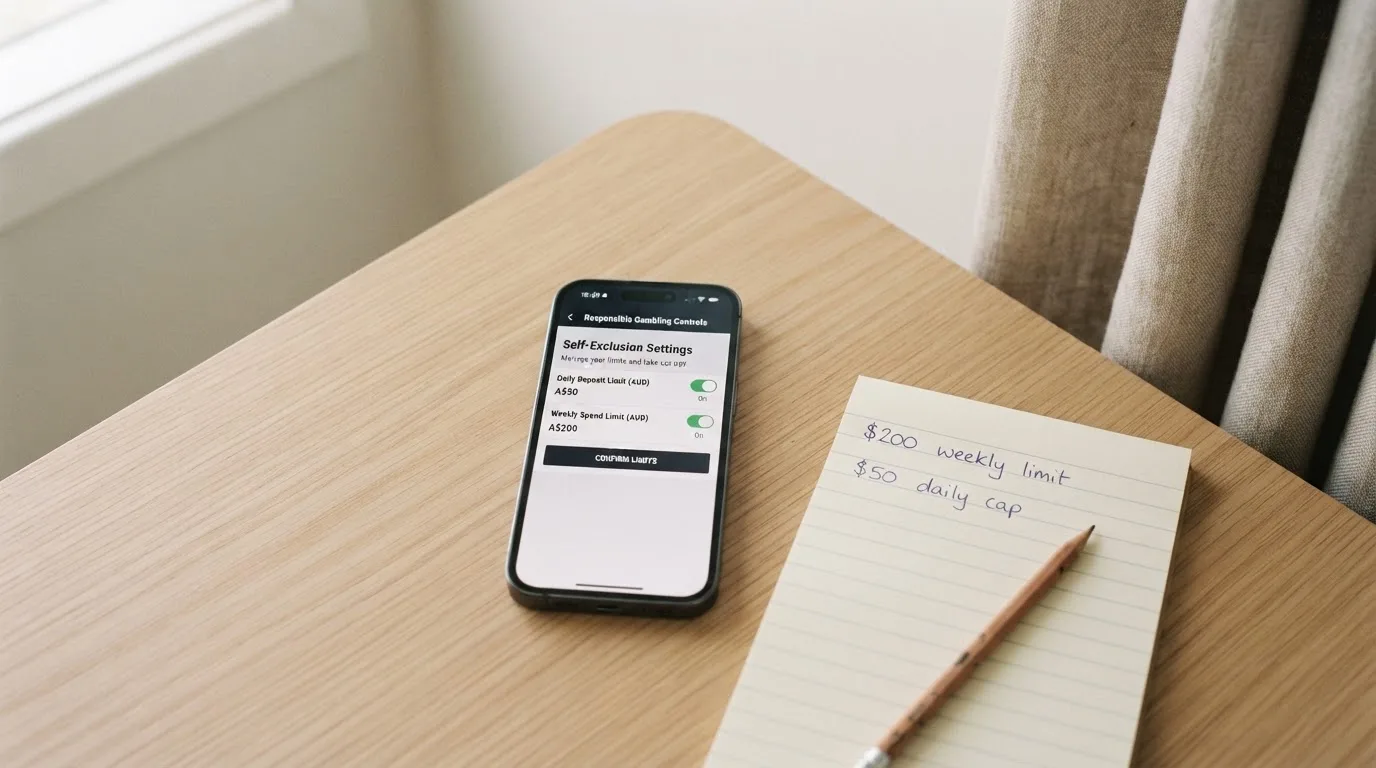
BetStop, the National Self-Exclusion Register, binds Australian-licensed online and phone wagering services, with a minimum exclusion period of three months. The National Gambling Helpline 1800 858 858 is free, 24/7, with a chat option at Gambling Help Online. Bank-level gambling blocks and transaction-monitoring apps can add a layer that the offshore operators do not provide. The helpline is the single point of contact that covers all of these.