
Plinko Casino in Australia: A 2026 Reader’s Field Guide to What It Actually Costs
The Plinko casino game has a clean pitch. A ball drops through a peg array, lands in a multiplier slot and pays out in seconds; the return-to-player sits at 99%; the maximum multiplier is a thousand times the stake; and offshore sites market it as a casual alternative to the spinning reels. Australian readers who land on this page are, statistically, part of the audience the Australian Communications and Media Authority has been trying to redirect since 2017. This page walks through what is actually being sold, what Australian law says about selling it, what an Australian reader stands to lose if something goes wrong, and which offshore brands the regulator has already had cause to write to. None of it is a recommendation to play.
Verified as of 8 November 2026 against the ACMA’s register of formal warnings, blocking notices and adverse findings, plus the operator-name mapping the regulator publishes for each action.
Table of Contents
- Plinko casino fundamentals: how the ball-drop mechanic actually decides a payout
- The online casino prohibition in Australia
- Where Australian readers get help if gambling stops being fun
- Crypto payments do not legalise an offshore Plinko casino
- Payment methods and payout claims on Plinko casino pages
- The Plinko paytable: pegs, multipliers and the real cost per drop
- Eleven Plinko-adjacent brands in the ACMA’s enforcement landscape
- Frequently asked questions
Plinko casino fundamentals: how the ball-drop mechanic actually decides a payout
The format has a clean family tree. Plinko first aired as a pricing game on the US television show The Price Is Right on 3 January 1983, and the studio board is still the cleanest description of what an online Plinko casino game is trying to imitate: a contestant drops a chip from the top, gravity and a fixed grid of pegs decide where it ends up, and the bottom slot pays out a fixed amount. The 1983 board had nine bottom slots paid at $100, $500, $1,000 and $0 from the outside in, with the centre worth $10,000 and a maximum possible win of $50,000 per chip. Before 1998 the centre was worth $5,000, so the modern game’s headline prize is roughly double what a contestant could have won on the same show twenty-five years earlier.

The online version keeps the board and drops the studio lights. BGaming’s Plinko, the version most offshore Plinko casino sites advertise, asks the player to set a stake, choose a risk level — low, normal or high — and decide how many lines to drop, from eight to sixteen. A ball then falls through the same kind of fixed peg array and lands in one of the bottom multiplier slots, with the result of each drop paid out as the stake multiplied by the slot value. The advertised return-to-player sits at 99%, with a maximum multiplier of ×1,000. The player can drop one ball at a time or run an auto-bet that drops them in sequence.
That 99% is where the marketing starts to deserve a careful read. The figure sits across every combination of risk level and number of lines the player can pick, and the headline ×1,000 sits in the centre slot only at the highest risk setting with all sixteen lines active. Pull either of those levers down and the maximum multiplier falls sharply: at the low risk setting on eight lines the top end of the board is a fraction of ×1,000, and the geometry of the pyramid means the high-paying slots are narrow. The 99% number is an average across millions of drops; the actual maximum any one drop can pay out depends on how the game was set before the player pressed play.
A short comparative point lands here. A 99% RTP equals a 1% house edge, which compares to 1.06% on the baccarat Banker bet, around 0.28% on blackjack under liberal Las Vegas Strip rules and 1.41% on the craps Pass Line. Plinko is not exceptional on this measure; it is competitive. The marketing case for the game is not the edge but the pace. A round resolves in roughly five seconds, which makes a thousand drops a roughly ninety-minute session, and that tempo is the structural reason a player on a set budget reaches the end of it faster than on a blackjack table where hands resolve every thirty seconds and players stop to think.
The Price Is Right version is the cleanest demonstration of what the game is selling. A contestant dropping one chip has a roughly one-in-nine chance of any given slot, with the centre paid at $10,000 and the corners at $100. The show is entertainment; the offshore Plinko casino page is monetising the same shape of probability distribution at speed, and the show pays nothing to keep a player at the board.
Five seconds a round. The math does not care.
The online casino prohibition in Australia
No state or territory in Australia licenses an online casino to offer games like Plinko. That sentence is the one fact the rest of this page keeps coming back to, and it is worth setting out where it comes from before going further into the offshore brands the ACMA has acted against.
| Feature | Status in Australia |
|---|---|
| Online Casino | Prohibited |
| Sports Wagering (Pre-event) | Licensed |
| Lottery / Keno | Licensed |
The federal framework is the Interactive Gambling Act 2001, strengthened by the Interactive Gambling Amendment Act 2017. The 2001 Act makes it an offence to provide online casino-style games — including Plinko-style multiplier games — to customers in Australia, with penalties of up to A$220,000 per day for individuals and up to A$1.1 million per day for corporations. The 2017 amendment extended the prohibition to in-play online wagering and gave the ACMA the explicit power to direct Australian internet service providers to block offending services. What is licensable is wagering on races and sporting events placed before the event, lotteries and keno — and in practice those wagering services are licensed by the Northern Territory Racing and Wagering Commission, which regulates 52 of Australia’s online bookmakers including Sportsbet, Bet365 and Ladbrokes for tax reasons, has no full-time staff and meets once a month in Darwin.
Enforcement runs through the ACMA. The regulator investigates complaints, issues formal warnings to the operators and licensee names it can identify, and asks Australian internet service providers to block offending services. According to the ACMA, 1,751 illegal gambling and affiliate marketing websites had been blocked since the first blocking request in November 2019, and more than 230 unlicensed gambling services had left the Australian market since enforcement was strengthened in 2017. A round reported on 26 June 2026 alone named twelve further sites: 7Signs, ChromaBet, Donbet, Duospin, Freshbet, Slots Gem, Jacks Club, Lucky Start, Pointsbetz, Spinrise, Vinyl Casino and Wildsino.
The arithmetic of that record tells its own story. Across the seventy-nine months from November 2019 to the most recent published round, the regulator averaged somewhere in the low-twenties per month — just over twenty-two sites blocked every month across the full enforcement period — with the rate visibly back-loaded toward the post-2024 years as reforms took effect and the agency widened its criteria for inclusion. H2 Gambling Capital’s 2025 estimate puts annual Australian losses to illegal gambling sites at roughly A$3.9 billion, with the share of gambling going through legal channels falling from 74% in 2021 to 64% by 2025. The reader who lands on this page is, statistically, one of the people the regulator is trying to redirect.
The legal position for an individual player is more limited than the position for the offshore operator. The Interactive Gambling Act targets the provider, not the customer, and there is no record of an Australian player being prosecuted for placing a bet on an offshore site. What the law does not give the player is recourse. An offshore site gives no Australian consumer protection, no Australian complaints body and no court to walk into if a withdrawal is refused; the offshore operator’s licence, whatever it claims, is not an Australian one, and the ACMA can block the site with the player’s balance still on it.
A second reform is on the horizon. The Interactive Gambling Amendment (Gambling Reform) Bill 2026 passed Parliament on 19 August 2026, with its advertising and inducement measures commencing on 1 January 2027. It is law with a start date, not yet in force on a 2026 page. A reader checking back later in the year will find the inducement clauses active and the offshore marketing environment tighter than it sits today.
Tax is the quieter end of the framework. Gambling winnings of a recreational player are not assessable income under section 6-5 of the ITAA 1997, and losses are not deductible, unless the person carries on a business of gambling. That is the model and the ATO is the body to check with on the edge cases; the offshore Plinko casino site has no role in the answer.
Not licensed here. The rest follows.
Where Australian readers get help if gambling stops being fun
The Australian safety net is built around licensed wagering, which the offshore Plinko casino sits outside. That gap matters because the help lines and exclusion registers most readers have heard of were designed for licensed services and stop at the offshore border.
BetStop, the National Self-Exclusion Register, has been live since August 2023 and binds Australian-licensed online and phone wagering services — Sportsbet, Ladbrokes, Bet365 and the rest of the NTRWC’s 52. A player who registers with BetStop is locked out of every participating brand simultaneously, for a chosen period. An offshore Plinko casino is not connected to BetStop, and the self-exclusion does not extend to a single offshore site, let alone the rest of them. A reader who feels the offshore sites are the problem cannot use BetStop to fix that problem.
The 24-hour support line is the National Gambling Helpline on 1800 858 858 — free, confidential and reachable from anywhere in Australia. The web companion is Gambling Help Online, which offers live chat and counselling by state and territory. Both services are staffed independently of any casino, licensed or otherwise, and exist for the reader who has decided that the next click needs to be a different one.
The practical point is short. The Australian safety net is real for wagering on licensed services and absent for offshore Plinko casino play. The tools exist; they just do not extend to the marketing page an Australian reader might be sitting on.
A wagering help line is one phone call. The offshore site will not make it for you.
Crypto payments do not legalise an offshore Plinko casino
The crypto pitch on offshore Plinko casino pages sits next to the Plinko pitch. Bitcoin, Ethereum, USDT and a list of altcoins are presented as the default deposit method, sometimes as the only method. The marketing frames this as faster, cheaper, more private. None of those adjectives is wrong about the payment rail; all of them are wrong about the legal status of what the rail is paying for.
The Interactive Gambling Act makes the offering of online casino games to Australians the offence, not the payment method used. A site that takes Bitcoin and a site that takes Visa are both offering a prohibited service. Credit cards, credit-related products and digital currency are banned as payment for licensed online wagering in Australia since 11 June 2024, with penalties of up to $247,500 for operators — and that ban applies to the legal side of the line. A licensed wagering service cannot take a credit card or a crypto deposit; an offshore casino faces no such rule because it faces no Australian rule at all.
The privacy claim is the part worth lingering on. An offshore site that takes crypto is not anonymous in the way the marketing copy suggests. The on-chain payment is pseudonymous; the casino’s wallet address is visible to anyone with a block explorer; and the casino still has the player’s email, the player’s IP address and, in many cases, the player’s KYC documents the moment a withdrawal is requested. Crypto is the payment method that solves the slowest problem in payments — settlement — and it does nothing for the structural problem the reader is actually facing, which is that the casino is unregulated for the purposes of an Australian dispute.
The crypto detail also intersects with the Plinko detail. A Plinko round is a few seconds. A crypto settlement is a few minutes, or a few blocks. The two speeds are well matched, and the pairing is exactly why offshore Plinko casino pages tend to lead with the crypto deposit. The cost angle is the simpler version of the same point: the speed of the deposit is also the speed of the loss, and the speed of the loss is exactly the speed at which an unregulated site can drain a bankroll before a reader has had time to second-guess it.
A reader who came to this page looking for a crypto-native Plinko site has the answer in two sentences. Crypto does not legalise the site. Crypto does not insure the site.
Payment methods and payout claims on Plinko casino pages
The payment list on offshore Plinko casino pages reads like a tour of the global payments rail. Visa, Mastercard, a handful of e-wallets, a long tail of cryptocurrencies, and the occasional bank transfer that lands only after the casino has decided to honour the request. The marketing positions the breadth as flexibility. The reader sees it as the cost of doing business with an entity the Australian regulator has no authority over.
The most prominent marketing claim on these pages is the no-deposit bonus. A Plinko casino game real-money no-deposit bonus typically offers a small starting balance — often in the $10 to $50 range — to a player who has registered but not yet deposited. The framing is “free money to try the game.” The actual structure is a bonus with a wagering requirement attached: a 30× to 50× playthrough on the bonus amount, a cap on the maximum cashout (often five to ten times the bonus value), and a list of games the bonus can be played on, with Plinko sometimes included and sometimes excluded. The cost of “free money” is the gap between the bonus amount and what a player can actually withdraw after meeting the requirement, and that gap is the size of the house edge multiplied by the volume of play the requirement demands.
The payout time is the next marketing pillar. A Plinko casino “instant withdrawal” claim usually means the casino approves the withdrawal request in minutes; the time from approval to the funds arriving depends on the payment method — seconds for an internal e-wallet, hours for a card, days for a bank transfer the receiving bank pauses to check. The instant claim is half true. The Australian reader who lands on the page has no Australian payment-system ombudsman to escalate to when the “instant” turns into “pending” turns into “under review”.
For a reader using a debit card or a bank transfer from an Australian account, the offshore site is taking a payment that the Australian bank’s fraud team may flag and reverse. That is not consumer protection in the formal sense, but it is a friction the offshore marketing does not advertise. The friction goes the other way too: the offshore site has no Australian presence to refund to, no Australian business address for the disputes process, and no obligation under Australian law to honour a withdrawal the operator has decided to delay.
The pattern is short and consistent. Every payment method on an offshore Plinko casino page comes with a marketing line that does not survive the operator’s own terms. The reader who reads the small print is reading the offer; the reader who reads only the headline is reading the marketing.
Read the small print. Or do not play.
The Plinko paytable: pegs, multipliers and the real cost per drop
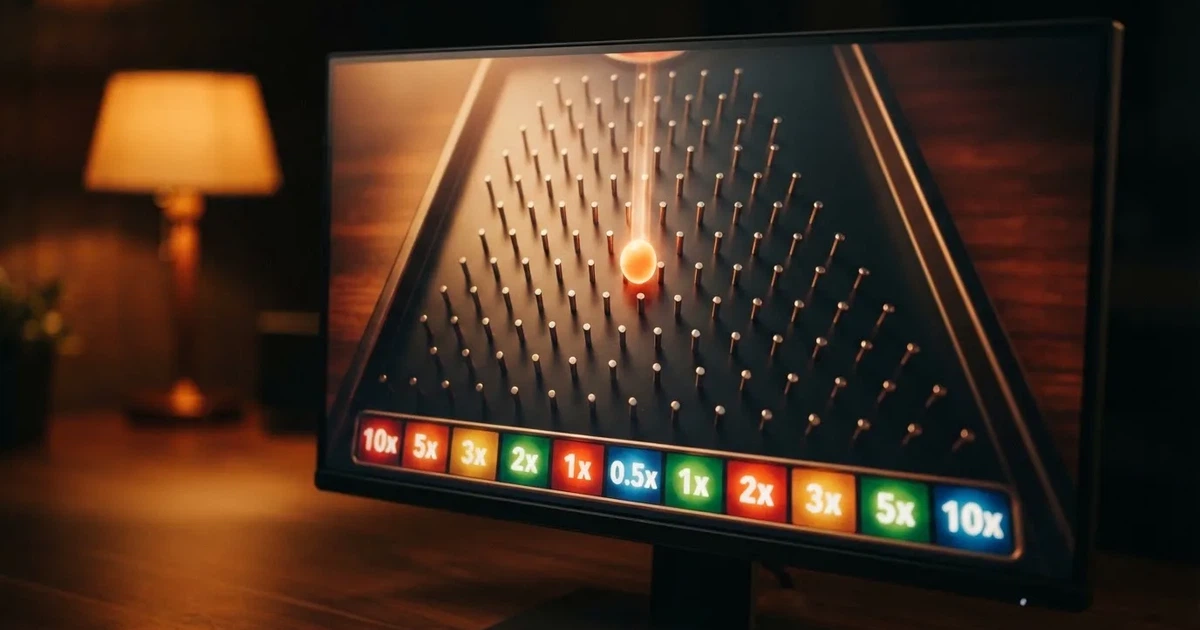
The paytable is the most carefully designed piece of an offshore Plinko casino page, and it is the easiest piece to misread. The image on the page shows a pyramid of pegs with multiplier slots at the bottom: small numbers on the outside, larger numbers toward the centre, the headline ×1,000 in the middle. The visual logic is intuitive — drop a ball, watch it bounce, hope it lands in the high-paying centre. The math behind the visual is where the cost is.
The structure starts with the lines. A Plinko board has 8 to 16 lines, set by the player. The lines determine how many slots the ball can land in: 8 lines gives 9 slots, 16 lines gives 17 slots. The wider the board, the more slots, the narrower the high-paying centre relative to the low-paying edges. The ×1,000 headline is a 17-slot board; on a 9-slot board the centre is ×130 or similar, with the edges paying out the same small multipliers they always do.
The risk level is the second lever. Low risk narrows the range of multipliers and pushes more of the probability mass into the middle of the board; high risk widens the range and shifts probability mass toward the edges, raising the maximum multiplier and lowering the floor. The 99% RTP is invariant across these settings, which is the most important fact the marketing does not put on the page: the average payout stays at 99% of stake regardless of how the player has rigged the board, because the operator has already priced each configuration to land at that average. The reader who picks high risk and 16 lines is not getting better odds — the reader is getting a wider distribution of outcomes with the same mean.
A worked example on one configuration lands here. A player who sets the game to 16 lines, high risk and a stake of A$1 per ball is betting A$1 per drop and accepting a 99% RTP. After 1,000 drops the average loss to the player is A$10. After 10,000 drops it is A$100. The pace of those 10,000 drops is just under fourteen hours at five seconds a round, and that is the structural shape of the cost: a small percentage of stake compounded at a pace the player does not consciously track.
The paytable is the only piece of the marketing that survives a careful read. The 99% RTP is real. The ×1,000 maximum is real. The player controls over risk and lines are real. None of those facts is a marketing lie, and none of them changes the cost shape the previous paragraph walks through. The cost is real on the page. The protection is not.
Eleven Plinko-adjacent brands in the ACMA’s enforcement landscape
The Australian Communications and Media Authority has issued formal warnings to operators of eleven casino brands that the regulator has identified as offering Plinko-style and other prohibited casino games to Australian customers. None of these brands is licensed to offer casino games in Australia. The table below sets out the ACMA’s record for each, the operator name the regulator has published alongside the warning, and what — if anything — third-party listings say about whether the brand actually carries the Plinko game. The writeups below the table walk through each brand and what the warning record means for a reader landing on it today.
| Brand | ACMA action date | Operator named by the ACMA | Plinko availability |
|---|---|---|---|
| RocketPlay | March 2026 (also May 2022 under Dama N.V.) | Pulsup Ltd | — |
| Level Up Casino | May 2022 | Dama N.V. | Listed in BGaming’s game catalogue |
| Woo Casino | March 2025 | Dama N.V. | — |
| Spirit Casino | May 2025 | Dama N.V. | — |
| National Casino | July 2025 | Consolutetish S.R.L. | Referenced in encyclopaedic listings |
| Bizzo Casino | July 2025 (also 2022 under TechSolutions) | Consolutetish S.R.L. | — |
| Ignition Casino | July 2025 | Bamboo Media | — |
| Instant Casino | February 2025 | EOD Code SRL | — |
| Jackbit | April 2026 | Ryker B.V. | — |
| Casino Intense | April 2025 | Sterplay Holding Ltd | Referenced in Australian press and the ACMA register |
| Sky Crown | September 2022 | Hollycorn N.V. | — |
RocketPlay: the brand with two warning rounds across two operators
The ACMA wrote to Pulsup Ltd over RocketPlay in March 2026 — the most recent of the eleven warnings. The same domain had previously been the subject of a May 2022 warning to Dama N.V. alongside five other brands. A reader who follows the trail sees that RocketPlay has been on the ACMA’s record for the better part of half a decade under two different operator names, which is the cleanest illustration of how the offshore sector rebrands around enforcement. The RocketPlay page carries a Curacao licence number at the bottom of the homepage. That licence is not an Australian one and does not change the regulator’s record; two warnings, two operators, one brand, and that brand is the pattern.
Level Up Casino: the brand the BGaming catalogue names
The May 2022 warning to Dama N.V. covered six casino brands. Level Up Casino is one of them, and it is the only brand in this set for which a third-party listing — BGaming’s own game catalogue — names the brand as carrying Plinko. The catalogue entry is not a recommendation and not a licence; it is a list of casinos the developer distributes the game to. The ACMA’s warning predates the listing by several years, which is itself a useful data point on the lifecycle of an offshore brand: warned in 2022, listed as a Plinko distributor years later, no Australian licence either time.
Woo Casino: the first 2025 Dama warning
Dama N.V. received the second warning on this list in March 2025, this time over Woo Casino. Woo had not been on the 2022 warning list, so the ACMA’s record here is a single formal warning against an operator that has been a continuous presence on the offshore scene for years. The Dama N.V. name on the warning matters because it is the same operator that received warnings in 2022 and again over Spirit Casino a few months later. The pattern is operator-level, not just brand-level, and a reader who only watches the brand will miss it.
Spirit Casino: the second 2025 Dama warning
Two months after the Woo Casino warning, in May 2025, the ACMA wrote to Dama N.V. again over Spirit Casino. The two warnings together are the cleanest illustration of how the regulator approaches a single offshore operator: one warning per brand, but the brand-by-brand record stitches into an operator-level picture. Spirit Casino’s homepage carries the same offshore licence structure as the rest of this list. The Dama N.V. record is the relevant document for an Australian reader, not the licence footer on the site.
National Casino: the first Consolutetish warning
July 2025 brought the first formal warning to Consolutetish S.R.L. The regulator named National Casino as the offending service. The brand is referenced in encyclopaedic listings that catalogue offshore operators — useful as background, but not as evidence the brand is licensed to offer anything to anyone in Australia. The cost of the brand’s status is the same as every other brand on this list: no Australian licence, no Australian dispute path, and a regulator’s record that already names the brand.
Bizzo Casino: the warning with a 2022 echo
Bizzo Casino received a July 2025 warning under Consolutetish S.R.L. — the same operator name as National Casino — but the brand itself was on the ACMA’s record before that. A 2022 formal warning was issued to TechSolutions (CY) Group Limited and TechSolutions Group N.V. covering Bizzo, which means the regulator has had cause to write about this brand under two different corporate names. The continuity of the brand across two warnings is the data point; the rest is the offshore licence footer on the homepage, which is not an Australian one, and two warnings, three operators, one brand is the structural shape of the record.
Ignition Casino: the Bamboo Media warning
July 2025 also brought a warning to Bamboo Media, an operator name that does not appear on any other entry in this list. Ignition Casino is the brand named in the warning. Ignition has a long history as a US-facing offshore operator, and the ACMA’s record here is the regulator’s first warning against this operator name; the brand has run under other operator names in other markets. The Australian reader who lands on Ignition today is looking at the same offshore licence structure as the rest of the list, on a brand whose operator is freshly on the regulator’s record.
Instant Casino: the February 2025 EOD Code warning
EOD Code SRL received the ACMA’s February 2025 warning over Instant Casino. This is the earliest 2025 warning on the list and the brand most explicitly marketed around “instant” deposit and withdrawal flows. The irony is structural: the marketing emphasises speed, and the regulator’s record is the relevant speed at which the brand can be blocked at the ISP level if the regulator decides to escalate. The brand’s name is its own marketing claim, and the regulator’s page is the answer to that claim.
Jackbit: the April 2026 warning paired with CasinOK
Ryker B.V. received an April 2026 warning over Jackbit and CasinOK, named together. Jackbit is the brand most explicitly marketed around cryptocurrency deposit and crypto-denominated play, which is the same intersection the earlier section of this page discusses. The ACMA’s action against a crypto-marketed brand is the regulator’s response to that intersection: a warning that names the brand, the operator and the date, on the regulator’s own register. Crypto marketing does not change what the warning record says.
Casino Intense: the Sterplay Holding warning
April 2025 brought a warning to Sterplay Holding Ltd over Casino Intense. The brand has appeared in Australian press references and on the ACMA’s own pages, alongside the regulator’s record at Crown Melbourne and the major Australian-facing wagering brands. The presence on those references is not an endorsement; it is the regulator naming the brand in the same paragraphs where it names the licensed sector the brand is sitting outside. That the brand shows up at all is the relevant fact, not the paragraph it shows up in.
Sky Crown: the earliest warning on the list
The earliest warning on this list predates most of the others by several years. Hollycorn N.V. was warned over Sky Crown and Blue Leo in September 2022 — a PDF the regulator has kept on its formal-warnings page. The intervening years have not softened the regulator’s stance. A reader who arrives at Sky Crown’s homepage in 2026 is looking at the offshore licence structure the rest of the list carries, on a brand the regulator warned about in 2022 and has not removed from its record. The 2022 PDF is still live, and the warning is still the warning.
Frequently asked questions
How does a Plinko ball actually decide what a player wins?
A Plinko ball drops through a fixed peg array and lands in one of the multiplier slots at the bottom. Each slot has a fixed value, and the stake is multiplied by it. The number of lines and the risk level the player selects change the distribution, but every drop follows the same mechanic: gravity, pegs, one slot, one payout.
Does paying with Bitcoin change what an offshore Plinko game pays out?
No. The crypto is the payment rail; the math of the game is set by the operator and the developer behind it. Crypto changes how quickly a deposit lands and how a withdrawal is settled, but not the return-to-player or the bonus terms. A reader who thinks crypto adds protection is solving the wrong problem.
Is it actually against the law for an Australian to play Plinko offshore?
The Interactive Gambling Act 2001 targets the provider of an online casino game to Australians, not the customer. There is no record of an Australian player being prosecuted for using an offshore site. What the law does not give the player is recourse: no Australian consumer protection, no disputes body, no court if a withdrawal is refused.
What return-to-player figure do offshore Plinko sites usually advertise?
The headline figure on BGaming’s Plinko — the version most offshore sites distribute — is 99%, with a ×1,000 top multiplier. That number is the average across millions of drops and every configuration of risk and lines, not the return on any single session. A reader who treats the 99% as a guarantee is reading past it.
How does a Plinko paytable compare to a standard pokie in terms of the odds?
A Plinko paytable is a fixed distribution: a small number of slots, each with a fixed multiplier. A pokie’s paytable is more layered, with line combinations, scatter pays, free-spin rounds and bonus games feeding into the RTP. Plinko’s 99% sits at the upper end of what an offshore casino advertises for a single title; pokies sit below it.