Aristocrat online pokies in Australia in 2026: the legal picture and what an offshore site costs the punter
 Available in US
24 September 2026 · figures cross-checked against the ACMA’s published formal-warning register
Aristocrat Leisure is a genuine Australian manufacturer, ASX-listed under the ticker ALL, with a North Ryde headquarters and the largest installed base of pokies in the country. That much is uncontested. What follows from it is less comfortable: no Aristocrat-branded online pokie can be lawfully offered to a person sitting in Australia. The Interactive Gambling Act 2001, tightened by the Interactive Gambling Amendment Act 2017, makes the supply of online casino games and online pokies a prohibited interactive gambling service — and no state or territory issues a licence for one. Any website taking real-money Aristocrat-style play from an Australian IP is doing so offshore, unlicensed here, and already known to the regulator by name. This page walks through what that actually means in 2026: the legal frame, the paytable mechanics that follow the games regardless of venue, the responsible-gaming channels that work in Australia, and the eleven operators the ACMA itself has put on the record.
Table of Contents
- Where Aristocrat-branded online pokies fit in the Australian market
- What the Interactive Gambling Act 2001 actually prohibits
- Aristocrat as a company: how the maker sits behind the brand
- How a pokie paytable is actually built
- Responsible gambling: who protects a player who plays offshore
- ACMA enforcement in 2026: what the formal-warning register looks like
- The brands the ACMA has put on the record
- Payments: what an offshore site is asking for, and what the law bans for licensed sites
- Reading the offer on an offshore site
- Comparing the offer without choosing one
- What an Australian actually loses by playing offshore
- Tax, winnings and what the ATO actually does
- The honest bottom line
- Frequently asked questions about Aristocrat online pokies in Australia
Where Aristocrat-branded online pokies fit in the Australian market
Australia runs two parallel gambling economies, and they do not meet. On one side is the licensed retail market — pubs, clubs and casinos running Aristocrat and other manufacturers’ machines under state and territory gaming-machine permits, plus the licensed online and phone wagering that the Northern Territory Racing and Wagering Commission largely regulates. On the other is a much larger offshore market, reached through any device with a browser, that targets Australians with prohibited content and is invisible to Australian consumer law.

H2 Gambling Capital’s 2025 report estimates Australians lose roughly A$3.9 billion a year to illegal gambling sites. The same report puts the share of gambling going through legal channels at 64%, down from 74% in 2021. The licensed offer is shrinking relative to the illegal one not because Australians are gambling less but because more of the spend has moved off-shore, where the ACMA cannot licence, tax or protect the consumer. The Aristocrat-branded online pokie is part of that drift — pitched by affiliate marketing to Australian players, settled by payment routes the licensed sector is banned from using, and unwitnessed by any Australian regulator.
Aristocrat Leisure itself is the second-largest slot-machine manufacturer in the world behind International Game Technology. Its online real-money arm sits inside Aristocrat Interactive, formed in April 2024 from the merger of the Anaxi unit with the NeoGames group acquired that month. That business is regulated in the markets where Aristocrat holds licences — it is not, and has never been, an Australian-facing online casino. The online presence Australians do encounter is almost always a third party: an offshore operator that has licensed a similar-looking game, copied the visual identity, or partnered with a studio that mimics Aristocrat’s catalogue.
For a punter the practical question is therefore narrow. Is there a real, lawful way to play Aristocrat pokies online in Australia this year? The short answer is no. Everything else on this page is the longer version of that no: what Aristocrat actually makes, what an Australian online casino licence does and does not cover, what the ACMA has done about the offshore operators that try to fill the gap, and what an Australian stands to lose if a balance is sitting on a blocked site when an enforcement round lands.
What the Interactive Gambling Act 2001 actually prohibits
The IGA is short and unusually blunt. A person must not provide a prohibited interactive gambling service to a person in Australia. A prohibited interactive gambling service is one in which a wagering or gaming product is supplied online and the product itself is not covered by an Australian licence. Online casino games — roulette, blackjack, online pokies, scratch games — fall on the prohibited side. Online wagering on races and sport, lotteries and keno are licensable, and in practice most of Australia’s licensed online and phone wagering sits with the Northern Territory for tax reasons.

The 2017 amendment tightened two things that matter here. It closed a loophole that had let some operators argue an overseas incorporation moved them outside the Act, and it gave the ACMA a firmer set of enforcement powers, including the ability to direct Australian internet service providers to block illegal sites. The amendments did not change who the law targets — the supplier, not the player — and a recreational punter using an offshore site is not personally prosecuted. What the amendments did change is the regulator’s reach: blocking became routine, and the formal-warning register became a public file.
The 2026 reform layer sits on top of all this. The Interactive Gambling Amendment (Gambling Reform) Bill 2026 passed Parliament on 19 August 2026. Its advertising and inducement measures commence on 1 January 2027, which means the law is enacted but not yet in force at the time of writing. Anything an Australian sees in 2026 marketing material about an offshore casino is governed by the regime in force today; the new advertising rules will be the regime in force tomorrow. For a reader comparing offers in 2026, the relevant rule is still the IGA as amended in 2017.
Minimum age across the whole sector is 18. There is no carve-out for offshore sites: an Australian under 18 cannot lawfully be supplied with any of these services, and an operator that does not check age is breaking the rule that licensed Australian wagering operators have to enforce at the front door.
The Northern Territory’s quiet dominance
Fifty-two of Australia’s online bookmakers — Sportsbet, Bet365 and Ladbrokes among them — are licensed by the Northern Territory Racing and Wagering Commission. The commission has no full-time staff and meets once a month in Darwin, which sounds under-resourced until you realise the work it does is largely a sign-off function on an already-regulated product: racing and sports wagering placed before the event. The structure is what lets a Bet365 or a Sportsbet operate nationally from one territory, and the same structure is what the IGA explicitly does not extend to casino games and online pokies. No territory, NT included, can licence an online pokie.
What an offshore licence on a casino’s footer actually buys
An offshore casino’s footer will usually name a Curaçao, Malta or Kahnawake licence. Those licences are real authorisations in their own jurisdictions — they impose anti-money-laundering obligations, RNG testing requirements and dispute pathways. They do not, and cannot, authorise the supply of a prohibited interactive gambling service to a person in Australia. From the player’s point of view, the licence is a statement about the operator’s home regulator, not a statement of right to take Australian business. The ACMA’s view is consistent on this and has been since the 2017 amendments: an offshore licence displayed at the bottom of the page does not make the offer lawful in Australia.
Aristocrat as a company: how the maker sits behind the brand
Aristocrat Leisure Limited was founded in 1953 by Leonard Ainsworth and listed on the Australian Securities Exchange in 1996. The company develops electronic gambling machines, casino management systems, online real-money gambling technology, iLottery products and social casino games. Its two online arms are Product Madness, which runs social games, and Aristocrat Interactive, the regulated real-money arm.
The 2025 numbers are large by industry standards. Aristocrat Leisure reported 2025 revenue of A$6.30 billion, normalised net profit after tax and amortisation of A$1.55 billion, and 7,400 employees. Past acquisitions tell you how it grew: Video Gaming Technologies in 2014 for around US$1.3 billion, Plarium in 2017 for US$500 million, Big Fish Games in 2017 for US$990 million, and the roughly US$1 billion acquisition of NeoGames, completed in April 2024 after being announced in 2023. A US$3.7 billion bid for Playtech was rejected by Playtech shareholders in 2021. The bid’s rejection is the clearest single piece of evidence that Aristocrat has been trying to consolidate the online real-money supply chain for a decade, and that not every target has wanted to be part of that consolidation.
For a punter, none of that capital structure converts into a licensed online Aristocrat-branded pokie in Australia. Aristocrat Interactive operates in jurisdictions where it holds licences. In Australia, the only Aristocrat product a player can lawfully use in real-money form is the poker machine in the licensed pub, club or casino.
How a pokie paytable is actually built
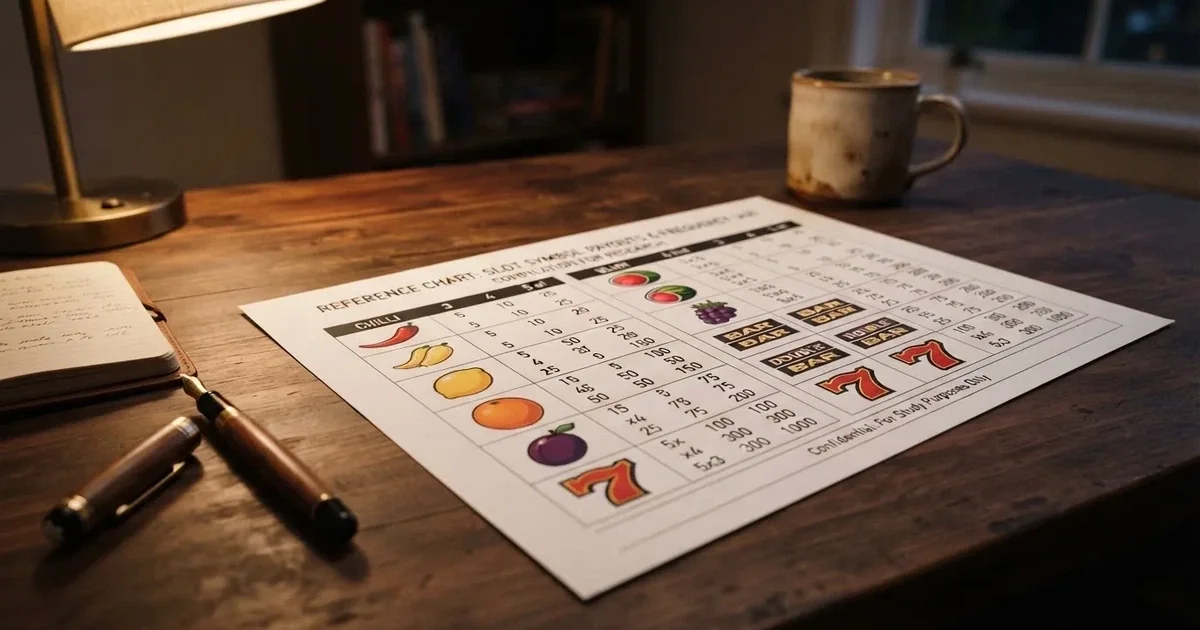
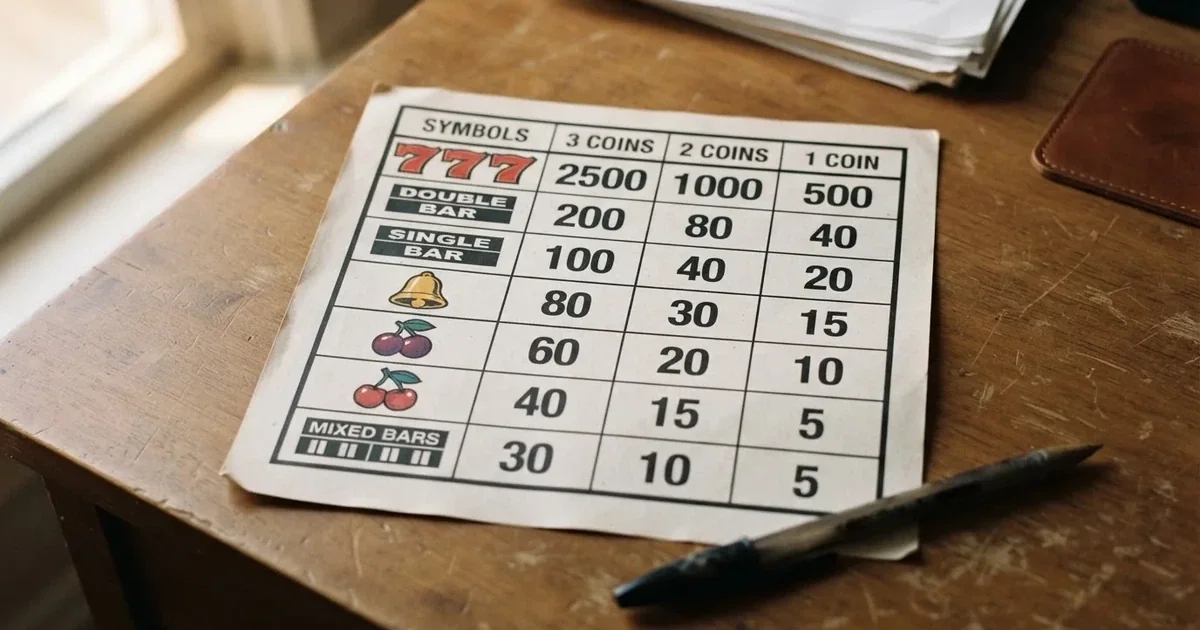
The mechanics do not change when the same game crosses from a club floor to an offshore website. A paytable is the printed or on-screen reference that lists what each symbol pays, how many lines are evaluated and what the bonus features do. The numbers in it are the publisher’s claim, not the regulator’s, and the regulator is the first thing an Australian punter is reading from.
Symbol values and paylines
A standard five-reel Aristocrat-style pokie is built around three to five high-paying symbols and a longer tail of mid- and low-paying symbols. A payline is a path across the reels that the machine evaluates on every spin; the cheapest paylines are usually the three horizontal rows, and the more expensive ones are the diagonals, zig-zags and “ways” patterns that pay in every direction. “243 ways to win” means every left-to-right run of three, four or five matching symbols pays, with no fixed payline to bet on. Some modern titles push that to a genuinely large number of combinations — BGaming’s TRUEWAYS mechanic, for instance, claims up to 262,144 ways to win across its licensed catalogue.
Hit rate is how often a spin returns anything at all. Betsoft publishes an 8.17% hit rate for The Slotfather and a 15.59% hit rate for Good Girl Bad Girl 2. Both are above the floor of a long dry patch, but neither means a win on most spins: an 8% hit rate means roughly one in twelve spins returns something, and on a low-volatility title most of those returns are smaller than the stake. Volatility is the size of the spread around the hit rate. A “Very High” volatility title pays rarely but pays larger when it does; a “Medium” title returns more often, in smaller increments. Neither is a measure of generosity. Both are measures of how the house edge is delivered — in fewer, larger payments or in more frequent, smaller ones.
RTP and the house edge
Return to player is the share of every dollar wagered that the game pays back over a very large number of spins. A 95.69% RTP, like The Slotfather’s, means the house keeps 4.31 cents of every dollar on average across the long run. A 96.22% RTP, like Good Girl Bad Girl 2’s, means the house keeps 3.78 cents. The numbers are close to each other and both are close to industry standard, and that is the point: a small RTP gap compounded across thousands of spins is the entire business model of the slot, and the gap is the same regardless of whether the punter is in a Sydney club or on an offshore site.
The house edge is the arithmetic behind the marketing. Any “return to player” claim on an offshore site is the publisher’s own number, certified by a testing house the punter has no way to verify independently. On a licensed Australian gaming machine the number is checked by the state or territory regulator, the gaming-machine licence conditions are public, and the machine is tamper-evident. On an offshore site the same number is checked by the publisher, not by anyone with jurisdiction over the supply into Australia.
Bonus features and the conditions attached
Free-spin rounds, pick-a-prize features, hold-and-spin mechanics and progressive jackpots are layered on top of the base game. They look like gifts and they behave like part of the math: a feature round pays out more per spin but triggers less often, and the game’s overall RTP includes both the base game and the feature when it fires. The single sharpest thing to know about a feature round on an offshore site is that it is bound by the same withdrawal conditions as the base game. If a bonus comes with a maximum cashout, a wagering multiple, a game-restriction list or an expiry, the feature is part of that envelope, not a way around it.
Responsible gambling: who protects a player who plays offshore
The Australian responsible-gambling infrastructure was built for the licensed market, and it works for the licensed market. BetStop — the National Self-Exclusion Register, live since August 2023 — binds every Australian-licensed online and phone wagering operator. A punter who registers with BetStop is closed out of every licensed account at once, including any new ones opened during the exclusion period. The exclusion periods run from three months to a lifetime, and the operator cannot reverse the registration before the term ends.
BetStop does not bind an offshore casino. An offshore operator has no integration with the Australian register and is under no obligation to honour an Australian self-exclusion. A punter who has self-excluded and then moves to an offshore site has stepped out of the regime that was designed to support that decision. The Gambling Help Online service — chat and 24/7 phone on 1800 858 858 — is free and confidential and does work across the boundary, because it is a counselling service rather than a regulator’s tool. The counsellor does not need to be connected to the operator to be useful; they only need the player to call.
Losses are not deductible against an Australian punter’s other income, and recreational winnings are not assessable income, unless the person is carrying on a business of gambling. That treatment is the same whether the punter is on a licensed Australian wagering site or on an offshore casino. The tax outcome does not make the offshore offer lawful; it only means the ATO’s view of the winnings is not the lever the IGA uses.
If the question has moved from “is this a good offer” to “am I still in control of this”, that is the moment to put the offer down and pick the phone up. The helpline is free, the conversation is confidential, and the call does not have to lead anywhere in particular to be worth making.
ACMA enforcement in 2026: what the formal-warning register looks like
The ACMA’s enforcement against offshore operators has two visible layers. The first is the formal warning: a published notice under the Interactive Gambling Act 2001 that names the operator behind a brand, the legal entity, and the date. The second is the blocking round: a request to Australian ISPs to make a domain unreachable from an Australian connection. The blocking rounds stack up. By the ACMA’s own count, 1,751 illegal gambling and affiliate-marketing websites have been blocked since the first blocking request in November 2019, and more than 230 unlicensed gambling services have left the Australian market since enforcement was strengthened in 2017. In the most recent round reported on 26 June 2026, twelve more domains went onto the block list — 7Signs, ChromaBet, Donbet, Duospin, Freshbet, Slots Gem, Jacks Club, Lucky Start, Pointsbetz, Spinrise, Vinyl Casino and Wildsino.
The math on this provides a clearer picture of the enforcement scale. Take the running total of blocked sites since the first blocking request in November 2019, and divide by the months that have elapsed. That gives a long-run rate: how often, on average across the six and a half years of enforcement, the ACMA has had to add another site to the list. The rate is a band, not a single number — the early rounds were small, the recent ones are larger, and a single month’s count depends on which investigations closed. As a band, the rate is the closest thing to a measurable cost of doing business for the offshore sector, expressed in domains-per-month rather than dollars. The condition that matters: the count includes both gambling sites and their affiliate-marketing pages, which means a single enforcement action can add several entries at once, and a slow month can still be a productive one if a major affiliate network is taken down.
The rate is high enough that the implication for a punter is not abstract. A balance sitting on an offshore site when a blocking round lands does not become reachable again just because the punter wanted it to. The site is unreachable from an Australian connection, the operator is no longer required to honour withdrawals, and the punter’s recourse is whatever the operator’s home regulator — Curaçao, Malta, Kahnawake, or none of these — is prepared to do on a complaint. The BetStop register cannot help here; the helpline can. The arithmetic is the punt-cost of choosing an offshore site over a licensed one, in plain numbers, and the cost is borne by the player, not by the operator.
The brands the ACMA has put on the record
Eleven brands sit on the formal-warning register at the time of writing, each with a published notice that names the operator behind it and the date of the warning. The names below are not a recommendation and not a ranking. They are the operators the ACMA itself has identified, and they are the closest thing the market has to a list of who is currently trying to take Aristocrat-style play from Australians. The headings carry the brand name and what the comparison reveals about it — what the warning tells you that another brand on the list does not.
| Brand | ACMA action and date | Operator named by the ACMA | Subject support |
|---|---|---|---|
| RocketPlay | Formal warning, March 2026; earlier Dama N.V. warning, May 2022 | Pulsup Ltd | — |
| Level Up Casino | Formal warning, May 2022 | Dama N.V. | Wazdan listings |
| Woo Casino | Formal warning, March 2025 | Dama N.V. | — |
| Spirit Casino | Formal warning, May 2025 | Dama N.V. | — |
| National Casino | Formal warning, July 2025 | Consolutetish S.R.L. | Betsoft, Pragmatic Play listings |
| Bizzo Casino | Formal warning, July 2025; earlier 2022 | Consolutetish S.R.L. (2025); TechSolutions (2022) | — |
| Ignition Casino | Formal warning, July 2025 | Bamboo Media | — |
| Instant Casino | Formal warning, February 2025 | EOD Code SRL | — |
| Jackbit | Formal warning, April 2026 | Ryker B.V. | — |
| Casino Intense | Formal warning, April 2025 | Sterplay Holding Ltd | 1spin4win, Betsoft, Pragmatic Play listings |
| Sky Crown | Formal warning (date as published) | Hollycorn N.V. | — |
RocketPlay — the only brand on the list with two warnings against it
RocketPlay is the only brand in this set that has been the subject of two separate ACMA formal warnings, and the only one whose operator changed in between. The first warning, in May 2022, was issued to Dama N.V., a Curaçao-incorporated operator that runs a stable of casino brands. The second, in March 2026, was issued to Pulsup Ltd over RocketPlay. The brand carried over; the corporate wrapper did not. The ACMA’s record is unambiguous: a rebrand does not put a brand outside the IGA. The corporate move RocketPlay made is a normal part of the offshore sector’s life, and it is exactly the move the regime was tightened in 2017 to catch.
Level Up Casino — the oldest Dama N.V. brand on the list
Level Up Casino sits with the May 2022 warning to Dama N.V. and has not been the subject of a more recent warning under a different corporate wrapper. The brand’s only public connection to an Aristocrat-style catalogue is what Wazdan’s listings show on the studio’s own site, which means Level Up’s “subject support” exists only as a third-party listing rather than as a fact the operator has put on its own page. The longer a brand has been on the register without being re-warned under a new corporate name, the more useful it is to check the current operating entity before signing up — the name has not changed but the company behind it may have.
Woo Casino — Dama N.V.’s March 2025 warning
Woo Casino carries the March 2025 Dama N.V. warning. The fact that Dama N.V. has been warned at least three times — May 2022, March 2025 and May 2025, across three brands — is itself the disclosure. A single corporate wrapper warned three times for the same prohibited conduct is a record of repeated, deliberate breach of the IGA’s core prohibition, and the regulator has made that record public.
Spirit Casino — Dama N.V.’s most recent warning
Spirit Casino was warned in May 2025, the most recent Dama N.V. action on the register. The name is new; the corporate wrapper is not. This is the pattern the ACMA has been writing warnings about since the 2017 amendments: a brand that appears, runs for a few months, gets warned, and either rebrands into a sister site or is replaced by another brand on the same corporate wrapper. The Spirit warning is also a Dama N.V. warning, and that is what the reader is supposed to read off the register.
National Casino — the brand with the most third-party listings
National Casino is the brand on this list with the broadest third-party subject support, which is itself an interesting kind of finding. The brand’s site lists Betsoft and Pragmatic Play titles; Betsoft’s own catalogue confirms National Casino as a partner; Wikipedia and the studio pages mention the brand by name. None of that is a fact about Aristocrat. It is a fact about what kind of catalogue the brand sells — third-party licensed content from established studios, not Aristocrat-branded pokies — and it is the closest the ACMA register comes to telling a reader what was actually being marketed to Australians when the warning was issued.
Bizzo Casino — two operators, two warnings, one brand
Bizzo Casino has been warned twice. The first warning, in 2022, was issued to TechSolutions (CY) Group Limited and TechSolutions Group N.V. The second, in July 2025, was issued to Consolutetish S.R.L. The corporate wrappers are different, the warning years are three apart, and the brand is the same. For a reader, the practical content of two warnings is the same as the practical content of one warning with a rebrand in the middle: the ACMA has identified this brand, on two occasions, as offering prohibited services to Australians, and it has done so under two different corporate identities.
Ignition Casino — the Bamboo Media warning
Ignition Casino carries the July 2025 warning issued to Bamboo Media. Ignition’s market positioning has historically been US-facing, and the brand’s appearance on the ACMA register is the clearest single demonstration that “geo-restricted” in an offshore operator’s small print does not mean “not available in Australia.” The site is reachable; the regulator has reached it; the warning is on the public record.
Instant Casino — the February 2025 EOD Code SRL warning
Instant Casino carries the February 2025 warning to EOD Code SRL. The February 2025 date makes Instant the earliest of the 2025 cohort of warnings on this list, and the brand’s appearance is a reminder that the ACMA’s register is not a one-off action: it is a continuing programme, with multiple new entries every quarter and a rolling pattern of re-warnings against corporate wrappers that already have one against them.
Jackbit — the April 2026 Ryker B.V. warning
Jackbit carries the April 2026 warning to Ryker B.V. Ryker is also the operator behind CasinOK, which received the same warning in the same round. Two brands, one corporate wrapper, one warning: the structural pattern is the same as the Dama N.V. set, and the read-across is the same — a single corporate identity warned for prohibited conduct across more than one of its brands.
Casino Intense — the broadest catalogue of the set
Casino Intense carries the April 2025 warning to Sterplay Holding Ltd, and it is the brand on the list with the most populated subject-support column. The brand’s site lists 1spin4win, Betsoft and Pragmatic Play content; the Gambling Commission register and the studios’ own pages mention the brand by name. None of that licensing and listing activity converts Casino Intense into a lawful Aristocrat-style pokie site for Australians. It does mean Casino Intense is the brand on this register that most closely resembles a fully functioning online casino, which is the brand most likely to attract the player who does not realise the brand is on the ACMA’s list.
Sky Crown — Hollycorn N.V.’s entry
Sky Crown carries the formal warning to Hollycorn N.V. and is one of two Hollycorn brands on the register, the other being Blue Leo. Hollycorn’s presence is part of the same pattern as Dama N.V. and Ryker B.V.: a corporate wrapper with multiple brand names, all running prohibited services into the country, all caught in the same enforcement round.
Payments: what an offshore site is asking for, and what the law bans for licensed sites
The credit-card ban came into effect on 11 June 2024 across all licensed Australian online and phone wagering. Credit cards, credit-related products and digital currency are prohibited as payment methods for licensed wagering, with penalties of up to A$247,500 for operators that breach the rule. The legal deposit routes for licensed wagering are debit card, bank transfer, PayID/Osko and BPAY.
An offshore site asking an Australian for a credit card or a crypto deposit is not bound by the Australian rule, because the operator is not licensed in Australia. The read-across for a punter is the opposite of reassuring. A payment method banned for a regulated operator is a payment method the regulator has decided is harmful to the consumer; an offshore operator is using it precisely because the operator is outside the regulator’s reach. The licensed route looks slower; the offshore route looks faster. The licensed route is the one with a complaints body and a withdrawal guarantee, and the offshore route is the one with neither.
Reading the offer on an offshore site
Most of what an offshore site publishes about its offer comes from an affiliate marketing page rather than from the operator’s own terms. That is not a slur on affiliate marketing as an industry; it is a description of where the prose actually comes from. The operator’s own terms are usually shorter, drier and more accurate; the affiliate page is usually longer, glossier and less precise about the conditions. For the punter, the rule is to read the operator’s own terms page before signing up, and to treat the affiliate page as marketing rather than as a contract summary.
Three terms matter more than the rest. The first is the maximum-cashout cap on a bonus — the ceiling on what can actually be withdrawn from a bonus-funded balance. A “no max cashout” bonus is rare on an offshore site; a hard cap of two or three times the bonus amount is common. The second is the game-restriction list — the games the bonus cannot be played on. A bonus that excludes the high-RTP table games is, in effect, a bonus that can only be cleared on the games with the worst odds. The third is the wagering multiple — how many times the bonus must be turned over before it converts to withdrawable cash. A 30x wagering multiple on a deposit-match bonus is ordinary for the offshore market; a 50x or 60x is heavy.
The published RTP on the same site is the publisher’s number, not the regulator’s. On a licensed Australian machine the RTP is checked by the state or territory regulator; on an offshore site it is checked by the publisher’s chosen testing house. The number is not necessarily wrong. It is necessarily unverified by anyone with jurisdiction over the supply into Australia, and that is the difference that matters when a withdrawal is refused.
Comparing the offer without choosing one
The instruction this page is built around is comparison, not recommendation. A reader who wants a fair comparison of what is on the offshore market for Aristocrat-style pokies looks at five things: the licence jurisdiction, the payment methods, the published RTPs, the bonus terms and the withdrawal conditions. The table above carries what the ACMA register carries. The rest of the comparison has to be done on the operator’s own page, with the affiliate-marketing page treated as marketing.
The closer a brand on the ACMA register is to a fully functioning online casino — broad catalogue, multiple studios, named payment methods — the closer it is to looking like a legitimate offer. That is a feature of the offshore market, not a bug. The look of legitimacy is part of the product, and the regulator has had to put each of these names on the public record precisely because the look is convincing. The ACMA register is the document that tells a reader which names to take seriously, and that is the comparison the register is built for.
What an Australian actually loses by playing offshore
Three losses are concrete. The first is the consumer-protection loss: an offshore casino is not connected to the Australian complaints and dispute pathways, and an offshore operator’s home regulator will only act on a complaint if the complaint meets that regulator’s own rules. A punter who is refused a withdrawal by a Curaçao-licensed operator can complain to Curaçao, and the complaint will be processed under Curaçao’s rules, not Australia’s. The second is the BetStop loss: a self-excluded punter who moves offshore has stepped outside the regime that was designed to support the exclusion decision, and the offshore operator has no obligation to honour it. The third is the blocking-round loss: a balance on a site when an enforcement round lands is not recoverable from Australia, and the punter’s recourse is whatever the operator’s home regulator chooses to do.
A fourth loss is subtler. A punter who plays on an offshore site is contributing to the 36% of Australian gambling spend that goes through illegal channels in H2 Gambling Capital’s 2025 estimate, and the legal-channel share has been falling year-on-year. The licensed sector funds harm-minimisation programmes, contributes tax to the states and territories, and is bound by advertising rules that the offshore sector is not. The licensed channel’s erosion is partly the licensed sector’s problem to solve, but the erosion is also the cumulative effect of choices made by individual players. The arithmetic of an individual choice is not the arithmetic of the market, and the two should not be confused.
Tax, winnings and what the ATO actually does
Recreational gambling winnings are not assessable income in Australia, and recreational losses are not deductible against other income. The rule sits in section 6-5 of the Income Tax Assessment Act 1997. A punter who wins on an Aristocrat-style pokie, licensed or not, does not declare the win; a punter who loses does not claim the loss. The ATO’s interest in gambling is in business-like conduct — professional gamblers, horse-training operations, the small number of people for whom gambling is a livelihood rather than a leisure activity. For a recreational punter, the tax outcome is the same on a licensed Australian machine and on an offshore casino, and the tax outcome is not the lever the IGA uses.
The ATO position is worth checking directly when a punter’s activity starts to look more like a business than a hobby. The threshold is not a fixed dollar figure; it is a question of intention, frequency, system and record-keeping. The honest answer for most readers of this page is that the question does not arise.
The honest bottom line
Aristocrat Leisure makes the machines Australians play in pubs, clubs and casinos. Aristocrat-branded online pokies cannot be lawfully offered to Australians, because the IGA prohibits the supply of online casino games to anyone in Australia and no state or territory issues a licence for the product. The eleven brands on the ACMA’s formal-warning register are the operators the regulator has caught trying to fill that gap. The credit-card ban, the blocking rounds, the formal warnings and the licensed wagering regime are all parts of the same framework — a framework that puts the Australian punter inside a set of protections an offshore site cannot match, and that puts the offshore site outside a set of obligations the licensed operator cannot avoid.
For a punter comparing options in 2026, the arithmetic is short. The cost of the licensed route is the friction of slower withdrawals, fewer titles and the absence of the bonus offers the offshore sector uses to recruit. The cost of the offshore route is the absence of Australian consumer protection, the absence of a complaints body with jurisdiction, the absence of BetStop coverage and the risk of a blocked site with a balance on it. The numbers behind that second column are the ACMA’s blocking rate, the H2 Gambling Capital 36% illegal-channel share, and the published RTPs the offshore operator has not had to defend before an Australian regulator. They are the costs that do not appear on the marketing page, and they are the costs that matter.
Frequently asked questions about Aristocrat online pokies in Australia
Are the Aristocrat poker machines in pubs and clubs the same as the Aristocrat-style games online?
The poker machine in a licensed Australian pub, club or casino is the genuine Aristocrat product, manufactured by Aristocrat Leisure and certified by the state or territory gaming-machine regulator. The Aristocrat-style games on offshore sites are not the same product under the same authorisation — they are typically third-party titles with similar mechanics, marketed using the Aristocrat visual identity or under licence to studios that mimic the catalogue. Aristocrat Leisure does not operate a real-money online casino for Australian players; its Australian business is the land-based machine, its online arms are Product Madness (social) and Aristocrat Interactive (regulated in non-Australian jurisdictions).
Is Aristocrat an Australian company, and where is it listed?
Yes. Aristocrat Leisure Limited was founded in 1953 by Leonard Ainsworth and listed on the Australian Securities Exchange in 1996 under the ticker ALL. Its administrative and research headquarters are in North Ryde, Sydney, and the company has marketing and development offices in South Africa, Russia and the United States. Aristocrat is described as the largest gambling-machine manufacturer in Australia and the second-largest slot-machine manufacturer worldwide behind International Game Technology.
Can Aristocrat-branded pokies be played for real money online from Australia legally?
No. Under the Interactive Gambling Act 2001, as tightened by the Interactive Gambling Amendment Act 2017, online casino games and online pokies are prohibited interactive gambling services and cannot be licensed in any Australian state or territory. A website offering real-money Aristocrat-style play to a person in Australia is operating offshore and outside Australian law, regardless of any offshore licence the site displays at the bottom of its pages. The 2026 reform — the Interactive Gambling Amendment (Gambling Reform) Bill 2026, passed 19 August 2026 — tightens advertising and inducement rules, but those measures commence on 1 January 2027 and do not change the underlying prohibition on supply.
What is the difference between an Aristocrat machine in a venue and an Aristocrat-style online slot?
The difference is the regulatory regime around the machine, not the symbol set or the payline structure. A licensed Australian gaming machine has its RTP and volatility checked by the state or territory regulator, sits under tamper-evident hardware rules, and is bound by harm-minimisation settings like time and spend reminders. An Aristocrat-style online slot on an offshore site has its RTP and volatility self-published by the operator or its studio partner, is hosted on a server outside Australia, and is bound by the rules of the operator’s home regulator rather than the rules of any Australian authority. The games look similar; the consumer protections do not.
Does Aristocrat itself operate any online casino sites for Australian players?
No. Aristocrat Leisure’s online real-money arm is Aristocrat Interactive, formed in April 2024 by combining the Anaxi unit with the NeoGames group acquired that month. Aristocrat Interactive holds licences in the jurisdictions where it operates, and those jurisdictions do not include an Australian-facing online casino product. The Aristocrat-branded online pokies an Australian punter encounters are not run by Aristocrat; they are run by offshore operators, often using studios that produce similar-looking titles, and the ACMA has put eleven of those operators on the formal-warning register at the time of writing.
Created by the ”Casino Providers Info” editorial team.