
Sign-up bonuses at Australian online casinos: why the offer in your inbox is not the offer on the page
The phrase “best casino sign-up bonus Australia” describes a product that cannot be lawfully sold to a person sitting in Australia. Online casino games, online pokies and in-play betting are prohibited interactive gambling services under the Interactive Gambling Act 2001. No state or territory issues a licence for them. The shortlist a reader expects from a page like this one — a ranking of operators, each with a deposit match and a free spin package — does not exist in the lawful Australian market. What exists is the gap between what the search asks for and what the law permits, and that gap is what this page actually maps.

Data current as of 30 October 2026, cross-checked against the ACMA register of blocked sites, the ACMA register of formal warnings, and the National Self-Exclusion Register (BetStop).
Table of Contents
- The legal frame: why “best” has no honest answer for an Australian reader
- The marketing offer and the wagering cost behind it
- Crypto and the deposit that the Australian framework does not reach
- Payments, payout speed and what the local rails actually look like
- The brands the ACMA has named, and what that record actually shows
- The arithmetic of the ACMA’s blocking rate
- What the page is not for, and what the reader does next
- Frequently asked questions
The legal frame: why “best” has no honest answer for an Australian reader
The Interactive Gambling Act 2001, as tightened by the Interactive Gambling Amendment Act 2017, makes it an offence to provide online casino games, online pokies or in-play betting to a person physically in Australia. The Act targets the provider, not the player — an Australian punter is not prosecuted for opening an account — but the operator offering the bonus commits the offence the moment an Australian deposits and plays. No licence regime anywhere in Australia covers what a search like this one is looking for. What is licensed is wagering on racing and sport placed before the event, lotteries and keno, and in practice the licensing body is the Northern Territory Racing and Wagering Commission.

That body looks the way it does for a reason. The Northern Territory Racing and Wagering Commission regulates fifty-two of Australia’s online bookmakers — Sportsbet, Bet365 and Ladbrokes among them — under licences issued in the Territory for tax reasons. The commission has no full-time staff and meets once a month in Darwin. A reader looking at this page is not, in any case, looking for a bookmaker: the bookmakers take fixed-odds bets on races and sport, they do not run roulette wheels. The bookmaker regime is what is licensed; the casino regime is what is banned.
A 2026 reform sits beside this. The Interactive Gambling Amendment (Gambling Reform) Bill 2026 passed Parliament on 19 August 2026; its advertising and inducement measures commence on 1 January 2027. The law exists; the start date has not yet arrived. A reader on this page in the months between enactment and commencement sits in a window where the new offences are law but not yet operative. From 1 January 2027, the picture tightens further, including on the marketing of inducements that this page is built around.
What the ACMA does about it
Enforcement sits with the Australian Communications and Media Authority. The ACMA investigates complaints, issues formal warnings under section 139B of the Act, and can direct Australian internet service providers to block illegal sites at the network level. The same body publishes the warnings it issues, and the list is the closest thing this market has to a public ledger of which brands have been told to stop.
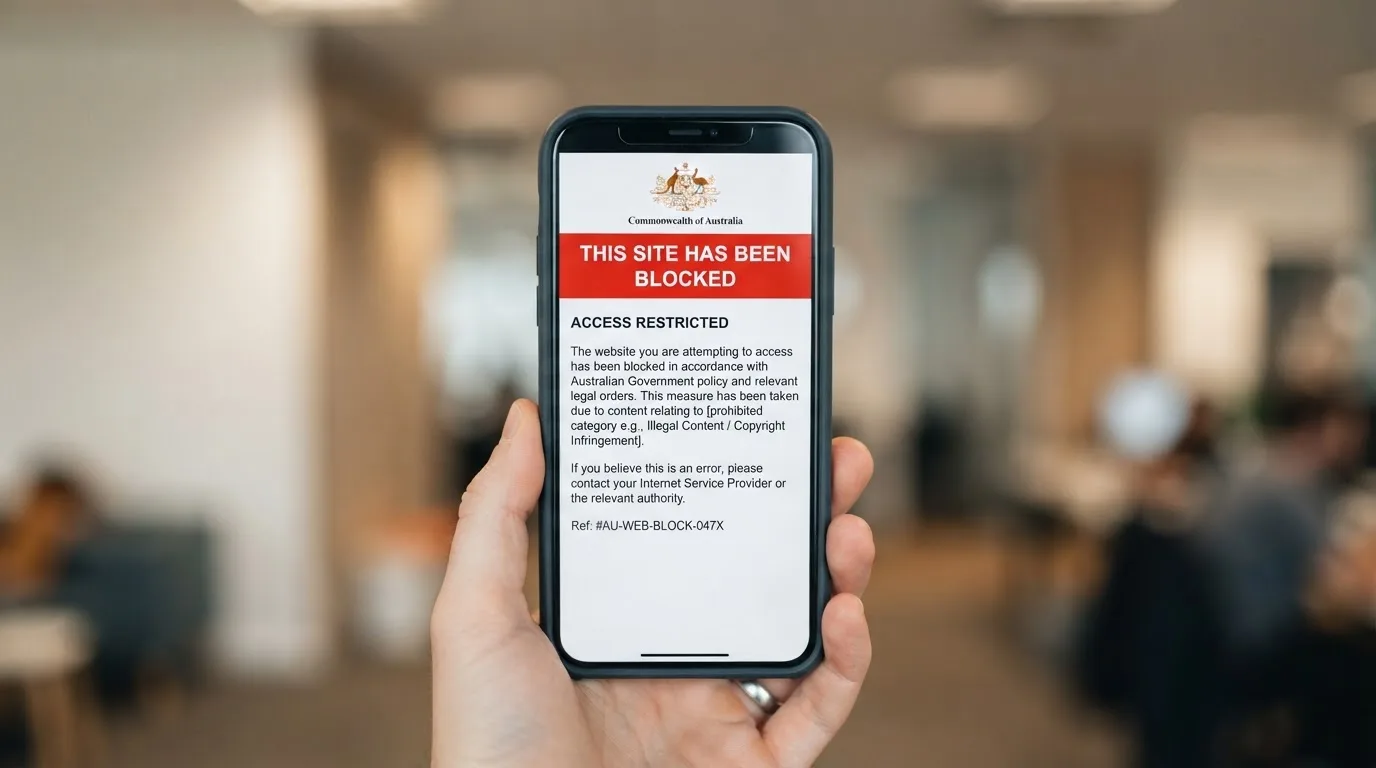
As of the ACMA’s June 2026 update, 1,751 illegal gambling and affiliate marketing websites have been blocked since the first blocking request went out in November 2019, and more than 230 unlicensed gambling services have left the Australian market since enforcement was strengthened in 2017. The pace has not slowed. A round reported on 26 June 2026 asked ISPs to block another twelve sites — 7Signs, ChromaBet, Donbet, Duospin, Freshbet, Slots Gem, Jacks Club, Lucky Start, Pointsbetz, Spinrise, Vinyl Casino and Wildsino. The pattern is consistent: a brand surfaces, takes deposits from Australians, draws an ACMA warning, and either exits or is blocked.
What an Australian player is actually protected by
Almost nothing, on an offshore site. The National Self-Exclusion Register, BetStop, has been live since August 2023 and binds every Australian-licensed online and phone wagering service. It does not bind an offshore casino. A punter who registers with BetStop cannot be marketed to by a licensed Australian bookmaker, and every licensed bookmaker is required to refuse their bets. An offshore casino is not connected to the register, has no obligation to honour it, and will continue to accept deposits and display bonuses to someone who has asked to be excluded.
If a withdrawal is refused, an account is closed with a balance on it, or a bonus term is changed mid-promotion, the complaints path goes nowhere in Australia. The Australian Financial Complaints Authority does not have jurisdiction over an offshore operator. The regulator that issued the licence — Curaçao, Anjouan, Kahnawake — sits in another country, and the operator’s “licence” is what it advertises on its own footer. The licence exists; the protection it confers is for the operator’s own jurisdiction, not the player’s.
A reader who needs help can call the National Gambling Helpline on 1800 858 858 — free, 24 hours a day — or use the chat service at Gambling Help Online. Both are confidential. Both are Australian. Neither fixes the underlying legality of the offshore site, but both are useful before a balance on a blocked site becomes money the reader cannot retrieve.
See also First deposit bonus casinos in Australia.
The marketing offer and the wagering cost behind it
The shelf of “sign-up bonuses” is what the search asks about; the substance of the shelf is what the bonus costs the person who claims it. The two are not the same.
A “sign-up bonus” is the package a casino attaches to a first deposit: a percentage match on the amount deposited, often a stack of free spins on a named slot, occasionally a no-deposit freebie that credits a small balance just for opening the account. The headline figure is what the marketing sends. The figure that decides whether the offer is worth taking sits in the small print underneath it.
Turnover, or wagering, is the load the bonus carries
Every bonus carries a turnover requirement, also called a wagering requirement, and turnover is the multiple of the bonus the player must stake before any winnings become withdrawable. A A$100 bonus with a 40x turnover means A$4,000 must be wagered before the bonus balance converts to real money. A A$500 bonus at the same multiple means A$20,000. The bonus and the turnover move together, and a generous headline on a steep multiple is more expensive than a smaller headline on a lighter one.
Free spins attached to the same package carry their own turnover, almost always on the winnings rather than the stake. A package of two hundred free spins at A$0.20 each with 40x turnover on winnings means the bonus is, in effect, a A$40 bonus with a multiple applied to whatever the spins return. The arithmetic is plain: bonus size, multiple, and the RTP of the slot determine what the offer is really worth, and the marketing does not display any of the three next to each other.
A bonus with a maximum cashout cap is a different animal again. The cap limits the amount of bonus-derived winnings that can be withdrawn regardless of how much the player turns over. A A$100 bonus with 40x turnover and a A$200 cashout cap is, in practice, an offer whose ceiling is A$200 of withdrawable money for A$4,000 of staking. The cap is rarely the headline.
What this looks like in hours
The cost the reader pays is time as well as money. The arithmetic is straightforward: required turnover divided by stake-per-spin gives the number of spins; spins multiplied by a five-second interval gives the seconds spent at the machine. A A$100 bonus at 40x turnover is A$4,000 of staking. At a A$1 spin, that is 4,000 spins; at five seconds a spin, that is roughly five and a half hours of play. At a A$0.20 spin, the same bonus becomes 20,000 spins and about twenty-eight hours of play. A reader with an hour to spare is not the customer for the offer.
The cost-of-play figure is a statistical estimate — an average across many spins under the stated assumptions — and is not a guarantee of any single outcome. No number of spins produces a guaranteed win, and the math describes the load the bonus places on the player, not the return the player can expect.
Why the small print caps the maximum bet
A turnover requirement is policed by a maximum bet rule. The terms usually cap the size of any single wager while the bonus is active — a typical cap is A$5 per spin or hand — and any bet above the cap voids the bonus and the winnings attached to it. The cap protects the operator from a player turning the bonus over in one spin. The cap also bites the player who plays a higher-stake game by habit and breaches the rule without noticing. A reader who skips the small print forfeits the bonus they thought they were clearing.
The expiry is a second guardrail. An unused bonus that sits past the wagering window — usually seven to thirty days from credit — is removed from the account along with any winnings derived from it. The clock runs from the moment the bonus is credited, not from the moment the player next logs in.
Crypto and the deposit that the Australian framework does not reach
A search that arrives at this page often arrives via a related phrase: bitcoin casino sign-up bonus, crypto casino sign-up bonus, no-deposit variant of either. The blockchain side of the market is a particular corner of the same offshore shelf, and the legal frame is identical.
Cryptocurrency is banned as a payment for Australian-licensed online wagering. The 2023 amendments to the Interactive Gambling Act added credit cards, credit-related products and digital currency to the prohibited payment list for licensed services, with the credit-card ban effective from 11 June 2024. An offshore site that accepts Bitcoin, Ethereum or USDT is operating outside the Australian rules by definition; it is also operating outside the rule that lets a player dispute a charge or follow a paper trail through a bank.
Two things follow. The first is that a “crypto sign-up bonus” is, structurally, a sign-up bonus from an offshore operator paid in a currency the Australian framework does not police. The anonymity claim — the marketing line that the deposit cannot be traced — is partly true: the on-chain record is public, but tying an address to an Australian punter requires work the ACMA is unlikely to do for a small-stake punter. The substantive cost is the absence of recourse: no chargeback, no AUSTRAC paper trail, no bank willing to help recover funds to an unlicensed operator.
The second is that AUSTRAC’s threshold-transaction-report rule, which requires reporting of transfers of A$10,000 or more, applies only to physical cash. Ordinary electronic bank transfers are not subject to that per-transaction reporting requirement, regardless of the amount sent. A reader who converts a deposit into crypto before sending it has, in addition, stepped outside the bank rails entirely; the bank that would have processed a chargeback is no longer in the loop. Anonymity and recourse move in opposite directions.
Payments, payout speed and what the local rails actually look like
A reader considering an offshore casino often asks how the deposit gets in and how the withdrawal comes out. The honest answer is that the deposit rails depend on the offshore operator and the withdrawal rails depend on the operator plus the player’s bank, and the entire path sits outside the Australian framework. For a reader who, instead, is comparing licensed wagering services — sports and racing, which is what is licensable — the local payment infrastructure is genuinely fast.
Osko and PayID — what the Australian instant rails do
Osko, run by Australian Payments Plus, settles a bank transfer between participating Australian banks in under a minute, twenty-four hours a day including weekends. The transfer can be addressed to a BSB and account number or to a PayID. PayID-based instant transfers are available at over a hundred Australian financial institutions, and more than 25 million PayID identifiers had been registered on Australia’s New Payments Platform by April 2025. The platform itself became accessible to the public on 13 February 2018, is owned by New Payments Platform Australia Ltd (a non-profit whose thirteen shareholders include the Reserve Bank of Australia and the country’s major banks), and the participants must keep monthly outages to no more than two minutes.
The PayID layer carries an account-name check. Paying to a PayID shows the name of the account holder before the transfer is sent, and AP+ warns that being asked to transfer money to a PayID on an illegal gambling site almost certainly means a scam site. The warning is operational, not advisory: a PayID deposit into a site the ACMA has blocked is a deposit the bank will not recover.
BPAY — the bill-payment rail that licensed wagering still uses
BPAY has operated in Australia since 1997 and is available in the online banking of over a hundred and forty banks and financial institutions, used by over 95,000 businesses. The system is owned equally, through parent company Cardlink Services Limited, by Australia’s four major banks — ANZ, Commonwealth Bank, National Australia Bank and Westpac — and was merged with eftpos and NPP Australia under Australian Payments Plus in September 2021. A BPAY payment is, in practice, a bill payment: the payer enters the Biller Code and the Customer Reference Number from the merchant. The path is Australian-owned, Australian-run, and is the rail licensed wagering services still rely on for deposits.
Apple Pay and the card-side gambling block
Digital wallets are not a way around the merchant-category gambling block. Apple’s terms state that the company does not charge fees to consumers for using Apple Pay in stores, online or in apps — any surcharge is the merchant’s own card-processing fees — and that transaction limits and PIN requirements are set by the card issuer or merchant, not by Apple. The card behind the wallet is what is checked. ANZ’s gambling transaction block, activated in the ANZ app, blocks gambling transactions made through a digital wallet such as Apple Pay on an eligible card, not just the physical card. Once turned on, removing ANZ’s block requires a forty-eight-hour waiting period, and the bank warns that not all gambling transactions will be blocked and that some non-gambling transactions might be blocked in error.
Westpac’s gambling block works at card level and refuses authorisation of transactions registered under the merchant category code “Betting/Casino Gambling” on eligible personal credit and debit cards. Commonwealth Bank lets customers apply a gambling lock to eligible cards via the CommBank app, which automatically blocks most gambling transactions, with the same caveat that the bank cannot guarantee all gambling-related purchases will be stopped. The four major banks have, in effect, built the same wall at the card level, and the wall is what stops an Australian punter from funding an offshore casino through a normal debit card. Crypto and a small set of workarounds are what remain.
The same wall is the reason Apple Pay, Google Pay and Samsung Pay collectively accounted for around 45% of all card payments in Australia by number at the end of 2025. The wallet is the consumer’s choice for everyday spending; the card underneath is still the consumer’s card, and the gambling block sits on the card.
Credit cards, surcharges, and the Amex exception
Under the Interactive Gambling Act 2001 as amended in 2023, Australian-licensed online wagering services cannot accept payment by credit card or other credit-related products. The restriction also constrains gambling use of linked digital wallets, because the wallet is bound to the card behind it and the card is a credit card. The Reserve Bank of Australia’s July 2025 review proposes removing surcharges only on eftpos, Mastercard and Visa card transactions, and explicitly leaves American Express outside the scope of the proposed surcharge ban — Amex is a three-party scheme that issues cards and processes transactions itself, rather than the four-party network Visa and Mastercard run, and the RBA has left it on the surcharge-allowed side of the line. Amex was established in 1850 as a freight-forwarding company and launched its first charge card on 1 October 1958; the surcharge position it occupies in 2026 is a long-standing feature of the Australian card market, not a recent adjustment.
For a reader who treats credit-card surcharges as a marker of which operators pass card-processing costs through, the Amex position is a useful tell: a casino that accepts Amex and does not surcharge it is, in effect, eating the cost of an expensive network; a casino that accepts Amex and surcharges it heavily is passing it through. Neither is, of course, licensed to offer the casino product the surcharge is on.
Sign-up bonuses at Australian online casinos — More on this topic at casino providers.
The brands the ACMA has named, and what that record actually shows
The eleven brands below are not a shortlist. They are the operators the ACMA itself has named in formal warnings issued under the Interactive Gambling Act 2001 for offering prohibited services to Australians. The product they sell is the product the law bans. The list is the ACMA’s ledger, presented in the order the formal warnings were issued or escalated.
The column “Operator named by the ACMA” carries the entity the ACMA put on the warning, not the brand name on the casino’s own footer; offshore operators rebrand, and the warning tracks the parent. The “Subject support” column reflects what the publicly available sources actually say about the brand — it is not an endorsement and not a completeness claim. Where research found nothing, the cell stays empty.
| Brand | ACMA action and date | Operator named by the ACMA | Subject support |
|---|---|---|---|
| RocketPlay | Formal warning, March 2026 | Pulsup Ltd (Rocketplay); earlier Dama N.V., May 2022 | Listing pages note its Australian marketing presence |
| Level Up Casino | Formal warning, May 2022 | Dama N.V. | No source available for this section |
| Woo Casino | Formal warning, March 2025 | Dama N.V. | No source available for this section |
| Spirit Casino | Formal warning, May 2025 | Dama N.V. | No source available for this section |
| National Casino | Formal warning, July 2025 | Consolutetish S.R.L. | Listed by the ACMA register, AUSTRAC and BetStop |
| Bizzo Casino | Formal warning, July 2025; earlier 2022 | Consolutetish S.R.L. (2025); TechSolutions Group (2022) | Listing pages note its Australian marketing presence |
| Ignition Casino | Formal warning, July 2025 | Bamboo Media | No source available for this section |
| Instant Casino | Formal warning, February 2025 | EOD Code SRL | Listings mention ecoPayz and PayID as funding routes |
| Jackbit | Formal warning, April 2026 | Ryker B.V. | No source available for this section |
| Casino Intense | Formal warning, April 2025 | Sterplay Holding Ltd | Listed by AUSTRAC, BetStop and gambling-industry listings |
| Sky Crown | Formal warning, September 2022 | Hollycorn N.V. | No source available for this section |
The table is not a recommendation. A reader looking for a place to play is not the audience for the table; the audience is a reader who wants to see which brands the ACMA has already acted against, in the operator’s own name rather than the casino’s brand. Dama N.V. appears four times in the column because Dama N.V. is the parent of multiple brands the regulator has warned; the brand-level rebrand is real and the parent-level warning is real, and the ACMA’s ledger tracks the parent.
The arithmetic of the ACMA’s blocking rate
The data the ACMA publishes is not a single number; it is a running total updated each round, anchored to a start date. As of June 2026, the ACMA reported that 1,751 illegal gambling and affiliate marketing websites had been blocked since the first blocking request in November 2019 — a span of roughly six and a half years. Spread across that period, the implied rate is in the low hundreds of blocks per year, with the bulk of the volume concentrated in more recent rounds as the enforcement regime has matured.
The pace has accelerated visibly in the years since 2017. More than 230 unlicensed gambling services have left the Australian market since enforcement was strengthened in 2017, and the 26 June 2026 round alone added twelve more. Stated as a band rather than a single figure: the ACMA’s blocking pace runs in the high two hundreds to low three hundreds of sites per year across the most recent reporting window, with earlier years materially lower and single rounds in 2024-2026 adding a dozen or more at a time. The number is an estimate anchored to the ACMA’s own cumulative figures and the elapsed time since the first blocking request, not a guarantee of any individual future round.
The number carries a condition a reader should hold onto: the ACMA’s list counts blocked sites and exited services separately, and the 1,751 figure is the block count, not the exit count. A brand can be on the block list, exit voluntarily, then re-enter under a new brand; the same operator can therefore appear in the cumulative figure under more than one name. The pace figure flattens that churn, and the reader should treat it as a marker of enforcement intensity, not as a registry of unique operators.
What the page is not for, and what the reader does next
A reader who arrived here looking for a ranking has arrived at a page that does not produce one. The reason is structural, not editorial: the product the search describes cannot be lawfully sold to an Australian reader, and a ranking of unlicensed operators would be a ranking of products the regulator has named and acted against. The honest page is the page that says so and points to what is available.
For a reader who wants to play casino games lawfully in Australia, the path is land-based: licensed clubs and pubs with pokies, Crown Melbourne and Crown Perth for table games, and the state-based regulators that licence the venues. For wagering on racing and sport, the path is licensed bookmakers — Sportsbet, Bet365, Ladbrokes and others — under the Northern Territory Racing and Wagering Commission’s regime, with deposit routes that include debit card, bank transfer, PayID/Osko and BPAY, all of which sit inside the Australian framework.
For a reader who is already registered with an offshore casino and is trying to manage the cost, the path is the National Gambling Helpline on 1800 858 858 or the chat service at Gambling Help Online, both Australian and both free. For a reader who wants to be excluded from licensed wagering, BetStop is the register that binds. For a reader who wants to be excluded from the offshore shelf, the answer is that no Australian register can bind it; the only exclusion that works is the personal one — closing the account, asking the operator, and following up with the bank to add the gambling block at the card level.
For a reader whose question is whether to claim a bonus offered by email or in a pop-up: the bonus is being offered by a site that, by the ACMA’s own record, has been told not to do that. The marketing does not change the legal position; the legal position does not change because the bonus looks generous.
Frequently asked questions
What is the difference between a sign-up bonus and a no-deposit bonus?
A sign-up bonus is the package attached to a first deposit — a percentage match and, often, a stack of free spins on a named slot, credited only after the deposit lands. A no-deposit bonus is a smaller credit, sometimes cash, sometimes free spins, credited just for opening an account and verifying an email, with no deposit required. Both carry wagering requirements, both carry expiry windows, and both are attached to the same offshore-shelf legal position: in Australia, neither is offered by a licensed operator. The headline figure on a no-deposit bonus is almost always smaller than the deposit-gated version, and the turnover multiple is almost always higher.
What does turnover, or wagering requirement, mean for a sign-up bonus?
Turnover is the multiple of the bonus a player must stake before bonus-derived winnings become withdrawable. A A$100 bonus at 40x turnover means A$4,000 in total wagers before the bonus balance converts to real money. The multiple sits in the small print, not the headline, and it is the figure that decides whether the offer is worth taking. A bonus with a 20x multiple is half as costly as the same bonus at 40x; a bonus with a maximum cashout cap is cheaper than its turnover suggests, because the cap shortens the upside.
Is it legal for an online casino to offer a sign-up bonus to players in Australia?
No. The Interactive Gambling Act 2001, as amended in 2017, makes it an offence to provide online casino games, online pokies or in-play betting to a person in Australia; offering a sign-up bonus on those products is part of the prohibited service. The Act targets the provider, not the player, but the offer itself is unlawful. The 2026 reform Bill tightens the advertising and inducement rules further, with commencement on 1 January 2027. A reader who receives such an offer is being marketed to by a site operating outside the Australian framework.
Can a sign-up bonus be claimed using a cryptocurrency deposit?
A cryptocurrency deposit is one of the deposit routes an offshore operator commonly offers. The Australian framework, however, bans digital currency as a payment for licensed online wagering, and an offshore site that accepts crypto is operating outside the Australian rules by definition. AUSTRAC’s threshold-transaction-report rule covers physical cash only; an ordinary electronic bank transfer is not subject to the per-transaction reporting requirement regardless of the amount sent. A crypto deposit, in addition, removes the bank from the loop entirely — no chargeback, no paper trail through an Australian bank, no Australian complaints path if a withdrawal is refused.
Why do sign-up bonus terms usually cap the maximum bet allowed?
The maximum bet rule is the operator’s protection against a player turning over the bonus in a single high-stakes spin, which would expose the offer to a quick, large loss. The cap — typically A$5 per spin or hand — voids the bonus and any winnings attached to it if breached. The cap also bites a player who plays a higher-stake game by habit and breaches the rule without noticing; a reader who skips the small print forfeits the bonus they thought they were clearing.
What happens to an unused sign-up bonus if the wagering period expires?
The bonus is removed from the account along with any winnings derived from it. The wagering period runs from the moment the bonus is credited, usually between seven and thirty days, and does not pause when the player logs out. A bonus left untouched at the end of the window is forfeit; the operator’s terms state this in the small print and the player has no recourse to an Australian complaints body if the expiry takes the bonus with it.