
live dealer casinos for australian players in 2026 — the gap the marketing leaves out
Currency stamp: 30 October 2026 — checked against the ACMA register and the Interactive Gambling Act 2001.

The short version of this page is short for a reason. The Interactive Gambling Act 2001 prohibits the supply of online casino games, including live dealer tables, to anyone physically in Australia. No state or territory issues a licence for it. The Australian Communications and Media Authority enforces that prohibition, and the agency’s blocking request of November 2019 is now the spine of every shortlist search like this one collides with. So the question of which live dealer casino is “best” does not have a lawful Australian answer. The question that does is what an Australian reader can actually do, and what a brand is when the ACMA has already issued a formal warning over it.
That is what the rest of this page works through. The legal frame sits first because it decides every other section. The enforcement record sits second because it shows the prohibition being applied, brand by brand. The bonus mechanics sit further on, because the offers live dealer sites advertise to Australians exist, but the offer’s cost and conditions are what an Australian reader actually pays. The game-specific section is shorter than a normal live dealer page would be, because none of those tables can be played from Australia in a licensed venue online. The ranking section at the end is the part most readers came for, and it is also the part that cannot honestly recommend a place to play.
Table of Contents
- the live dealer product, briefly, for readers who have not sat at one
- what the interactive gambling act 2001 actually says
- the acma’s enforcement record, by brand
- what the consumer protection picture looks like for an australian reader
- crypto, anonymity and the live dealer question
- bonus offers on the prohibited side of the market
- the games themselves, for readers who want to know what they would be sitting at
- the eleven brands the acma has acted against, and what each is
- the comparison this page is honest to make
- the lawful alternative, plainly stated
- frequently asked questions
the live dealer product, briefly, for readers who have not sat at one
A live dealer table streams a real dealer, dealing real cards or spinning a real wheel, from a studio or a land-based casino floor. Optical camera recognition converts the dealer’s physical actions into data — the card that came off the shoe, the number on which the ball settled — and the player’s screen reads that data as a game state. Baccarat, blackjack and roulette are the most common live dealer formats offered online.

Evolution, the dominant live-casino supplier, was founded in 2006, reached 100 live tables at its Riga studios in 2013 (then the largest single-site casino operation in Europe) and opened a Malta studio in 2014. The Evolution Group now owns NetEnt, Red Tiger, Big Time Gaming, Nolimit City and Ezugi, and its own pages state that more than 700 gambling platforms worldwide carry its live casino games, streamed around the clock. The acquisition of NetEnt completed on 1 December 2020. None of that footprint is reachable from inside Australia in any lawful way, because the product it powers is prohibited under the IGA.
A live dealer page for any other country would now talk about house edges and table limits. The house edge figures are real and they are worth knowing, because the same games exist at Crown Melbourne and at licensed clubs around the country. In baccarat the Banker bet carries a house edge of 1.06%, the Player bet 1.24% and the Tie bet 14.36%. In blackjack, optimal play under liberal Las Vegas Strip rules yields a house edge of about 0.28%, and about 0.43% under Atlantic City rules. Those numbers are not Australian law, but they are what an Australian player is paying when they sit at the table at a Crown venue or at any of the licensed clubs that operate table games.
what the interactive gambling act 2001 actually says
Under section 8 of the Interactive Gambling Act 2001, providing an interactive casino-style gambling service to a person in Australia is a prohibited interactive gambling service. The IGA covers online blackjack, online roulette and any other live-casino-style game streamed to an Australian end user. The 2017 amendment tightened the regime and broadened what counts as prohibited. The current 2026 reform bill, the Interactive Gambling Amendment (Gambling Reform) Bill 2026, passed Parliament on 19 August 2026, with its advertising and inducement measures commencing 1 January 2027. The bill is law with a start date, not yet in force at the time this page is read, so any advertising restriction invoked by a brand today is not the 2026 reform’s product.
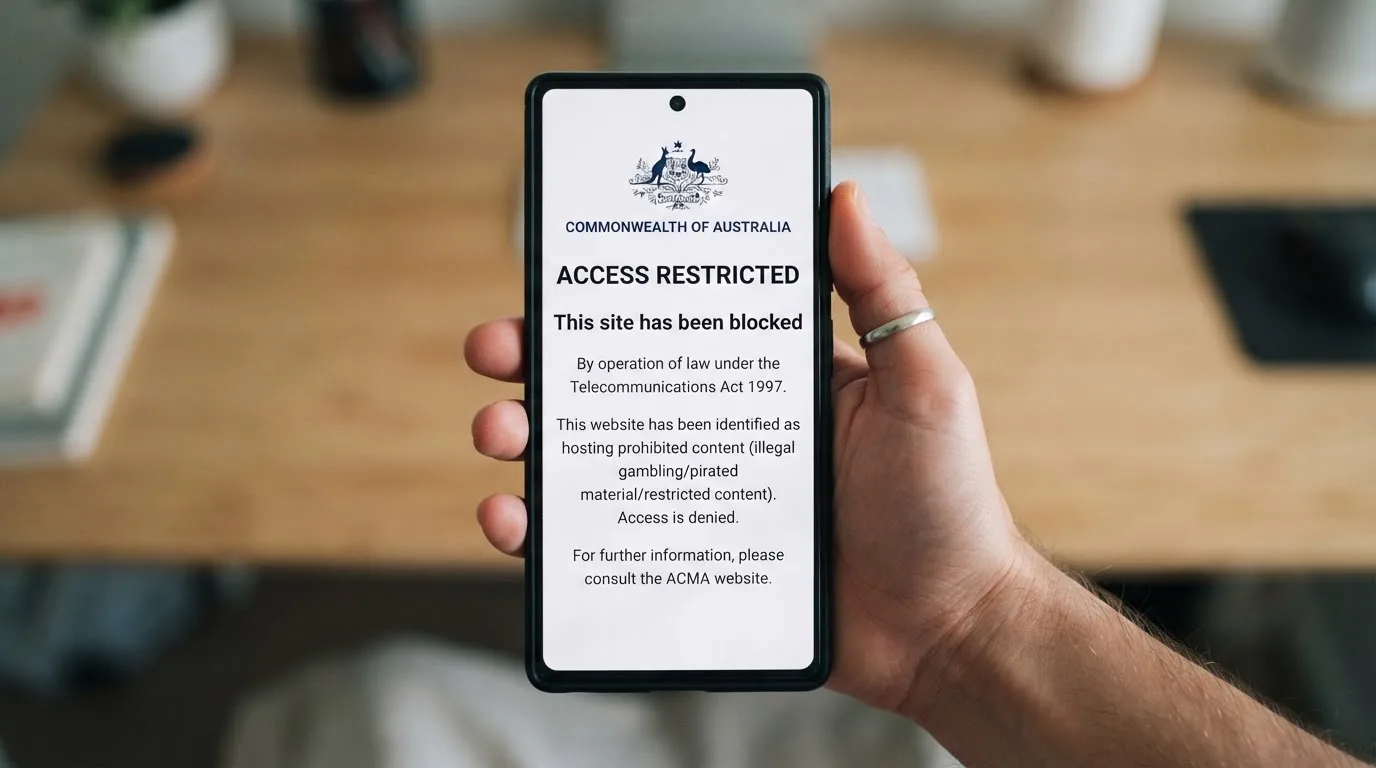
The IGA targets the provider, not the individual player. An Australian who opens an account with an offshore live dealer casino is not committing an offence under the IGA. What the player is doing is dealing with an operator that has no Australian licence, no Australian complaints body and no Australian consumer protection. The ACMA’s lever is the blocking request — a directive to Australian internet service providers to take the site offline for Australian end users. Once a brand is on that list, the URL stops resolving for the majority of Australian connections, and any balance sitting in the account sits there with it.
What is licensable in Australia, and what an Australian reader can place a bet on lawfully, is wagering on racing and sporting events before the event starts, lotteries and keno. Online wagering is regulated, and the Northern Territory Racing and Wagering Commission is the de facto national wagering regulator — it licences 52 of Australia’s online bookmakers, including Sportsbet, Bet365 and Ladbrokes, for tax reasons. The commission has no full-time staff and meets once a month in Darwin.
the acma’s enforcement record, by brand
The ACMA does two things on a live dealer brand: it issues a formal warning, and it asks Australian internet service providers to block the site. The formal warning is the public record; the blocking request is the technical lever. Both land on the same operators, and the table below covers the 11 brands this page reads in detail. Two operational notes sit beside the table. First, “online casino games cannot be licensed anywhere in Australia, whatever licence the site displays” — a Curaçao or Anjouan seal on a live dealer page is a regulatory claim about that jurisdiction, not Australia. Second, every brand in this set has had a formal warning issued against it, which is why the page is structured around the warning record rather than around the offers.
The blocking-rate arithmetic that runs through the material on this page uses two numbers from the ACMA’s own register: the running total of blocked sites and the date of the first blocking request. As of June 2026 the ACMA reported a total of 1,751 illegal gambling and affiliate marketing websites blocked since the first blocking request in November 2019, and more than 230 unlicensed gambling services had left the Australian market since enforcement was strengthened in 2017. The June 2026 round alone asked ISPs to block 12 more sites — 7Signs, ChromaBet, Donbet, Duospin, Freshbet, Slots Gem, Jacks Club, Lucky Start, Pointsbetz, Spinrise, Vinyl Casino and Wildsino. Spread across roughly 80 months from the first blocking request to the June 2026 register, the ACMA’s average blocking pace sits in a band of roughly 21 to 22 sites per month, with a clear pattern of lumpy monthly rounds rather than a flat weekly drumbeat. That band is the arithmetic this page has to offer; it is also a description of an enforcement tempo, not a forecast.
| Brand | ACMA action and date | Operator named by the ACMA | Crypto or other payment posture |
|---|---|---|---|
| RocketPlay | Formal warning, March 2026 | Pulsup Ltd (Rocketplay.com.au); earlier Dama N.V., May 2022 | — |
| Level Up Casino | Formal warning, May 2022 | Dama N.V. | — |
| Woo Casino | Formal warning, March 2025 | Dama N.V. | — |
| Spirit Casino | Formal warning, May 2025 | Dama N.V. | — |
| National Casino | Formal warning, July 2025 | Consolutetish S.R.L. | — |
| Bizzo Casino | Formal warning, July 2025; earlier warning 2022 | Consolutetish S.R.L.; earlier TechSolutions (CY) Group Limited and TechSolutions Group N.V. | — |
| Ignition Casino | Formal warning, July 2025 | Bamboo Media | — |
| Instant Casino | Formal warning, February 2025 | EOD Code SRL | — |
| Jackbit | Formal warning, April 2026 | Ryker B.V. | — |
| Casino Intense | Formal warning, April 2025 | Sterplay Holding Ltd | — |
| Sky Crown | Formal warning, September 2022 | Hollycorn N.V. (Sky Crown and Blue Leo) | — |
A second arc in the ACMA’s record runs through the Hollycorn, Dama, Consolutetish, Bamboo Media and Sterplay operators across 2022 to 2026 — the same parent companies show up again and again under different brand names. Dama N.V. has been warned over Bambet, Dazard, Level Up, Rocketplay, Wild Tornado and Cobra Casinos in May 2022, then again over Woo Casino in March 2025 and Spirit Casino in May 2025. TechSolutions was warned over Bizzo Casino in 2022, and Consolutetish S.R.L. over National Casino and Bizzo Casino in July 2025. Hollycorn’s September 2022 warning covered Sky Crown and Blue Leo at once. The pattern is the same: a corporate entity is warned, the warning is ignored or the brand is recycled under a new wrapper, and the next round finds the same operator behind a different URL.
what the consumer protection picture looks like for an australian reader
The legal prohibition is one half of the consumer story. The other half is what an offshore live dealer site does not provide.
BetStop, the National Self-Exclusion Register, has been live since August 2023. It binds Australian-licensed online and phone wagering services, so a punter who has registered with BetStop is locked out of licensed wagering accounts that they would have been able to open. BetStop does not bind offshore live dealer casinos, because those casinos are not licensed by an Australian regulator in the first place. Self-exclusion, on an offshore site, is a setting the player toggles inside one account, not a national register the operator cannot bypass.
The payment restrictions are sharper. Since 11 June 2024, credit cards, credit-related products and digital currency have been banned as payment for licensed online wagering, with penalties up to A$247,500 for operators that take them. The legal deposit routes for a licensed Australian wagering account are debit card, bank transfer, PayID and Osko, and BPAY. A live dealer site that asks an Australian for a credit card deposit or a crypto deposit is, by definition, not running under the Australian licensed-wagering regime, and the prohibition on credit-card and crypto deposits does not reach it because the prohibition applies to the licensed operators the IGA covers, not to offshore brands outside it.
The National Gambling Helpline is 1800 858 858, free and 24/7, with chat available at Gambling Help Online. Gambling Help Online is the appropriate channel for any reader who is finding the offshore offer hard to step away from, and it is the appropriate channel even when the gambling happens at a venue the ACMA has already asked ISPs to block. The helpline is not a substitute for BetStop for anyone who can self-exclude through a licensed Australian wagering account instead.
On the tax side, the ATO’s position is that recreational gambling winnings are not assessable income under section 6-5 of the ITAA 1997, and losses are not deductible, unless the person carries on a business of gambling. The ATO is the only authority that decides what counts as carrying on a business of gambling for a given reader, so a reader who treats it as a side income should check with the ATO rather than rely on the general rule.
crypto, anonymity and the live dealer question
A reader landing on this page through a “live dealer bitcoin casino” or “bitcoin live dealer casino” search is asking a specific sub-question, and it has a specific answer. Yes, many offshore live dealer sites accept cryptocurrency deposits — that is a frequent feature of the offshore market. No, the IGA does not grant an exemption because the deposit is in Bitcoin, Ethereum or USDT. A crypto deposit into an offshore live dealer account is still an account with an operator the ACMA has warned, possibly already blocked, and the consumer protection picture is the same as for a fiat deposit.
What crypto does change, in practice, is the speed and reversibility of the deposit. Once a Bitcoin transaction is confirmed on-chain, the funds are in the casino’s wallet and the casino’s control. A bank transfer can be recalled by the sending bank; a chargeback can be raised against a card acquirer. A crypto transfer cannot. So the practical effect of choosing crypto on an offshore live dealer site is to remove one of the few friction points that might otherwise have given a player a window to reconsider. The IGA’s prohibition does not turn on the payment method, and the ACMA’s enforcement record does not either — Instant Casino and Jackbit have been warned alongside every other brand on this page, regardless of how they accept funds.
Anonymity, the way the term is used in marketing, does not mean what it sounds like. A live dealer site still needs to verify the player’s identity before a withdrawal, because its payment processor does, and because the anti-money-laundering regime of the jurisdiction it operates under requires it. A player who deposited in crypto without a name attached will still be asked for ID when they try to cash out. The “anonymous” framing is a deposit-side framing; the withdrawal side is the part that matters.
bonus offers on the prohibited side of the market
A live dealer welcome bonus, on a site the ACMA has already warned, is a marketing inducement for a product the reader cannot lawfully buy in Australia. The arithmetic of the bonus is real — turnover, wagering, max cashout, game weighting — and the audit of it is the same audit that applies to any other jurisdiction’s bonus. The difference is the frame: the offer’s existence is the second problem, after the IGA prohibition, not the first.
The standard wagering structure on a live dealer welcome bonus is a deposit match with a multiplier, often in the 30x to 50x range, applied to the bonus amount or to the deposit plus bonus. Live dealer games are usually weighted lower than slots for wagering — a 10% contribution is common, meaning every A$10 wagered on a live table counts as A$1 toward the turnover requirement. The max cashout from a bonus, where it is set, sits well below what a normal session would yield. A player who reads the bonus terms will find, before they deposit, that the offer’s headline number is paid back across weeks of play, on a product the ACMA has already asked ISPs to block, with no Australian complaints body to appeal to if the cashout is refused.
A “live dealer casino no deposit bonus” is the same structure minus the deposit. The no-deposit framing pushes the offer closer to a free bet, and the wagering multiple usually runs higher to compensate. The arithmetic is harder for the player because the offer is smaller, the wagering is heavier, and the live dealer contribution is the same 10% that a deposit bonus carries.
The headline numbers do not survive contact with the small print. A “100% up to A$500” with a 40x wagering requirement on bonus plus deposit, at 10% live dealer contribution, asks the player to turn over A$40,000 in live dealer wagers to clear A$1,000 of bonus value — and a session running at the table for that volume of wagering is, on most rule sets, a session that costs the player a meaningful share of expected play. The marketing word is “bonus”; the underlying number is “turnover”. The first sentence a reader should read on any live dealer bonus page is the wagering multiple, not the headline figure.
the games themselves, for readers who want to know what they would be sitting at
The three live dealer formats the offshore market most commonly offers are baccarat, blackjack and roulette. Craps appears less often in the live format, and game-show formats — Dream Catcher, Monopoly Live, Crazy Time — are an Evolution addition that sits alongside the table formats rather than inside them. The games themselves are well documented outside this page, and the rule sets travel: a punto banco baccarat table streamed from a Riga studio plays the same hand as a punto banco baccarat table at Crown Melbourne.
baccarat
Punto banco, the baccarat variant most played today, was developed in Havana during the 1940s; the casino banks the game at all times and plays out both hands by fixed drawing rules, with cards 2-9 at face value, 10/J/Q/K at zero and aces at one, hand totals taken modulo 10, and the shoe holding 6 or 8 decks. Chemin de fer — French for “railway” — is the two-player variant that emerged from baccarat banque in the late 19th century and is named for being quicker to play than the original game. The Banker bet’s 1.06% house edge is the smallest single wager on the standard table, and the 14.36% Tie bet is the largest. Crown Melbourne offers three baccarat variants — Traditional Baccarat, Crown Baccarat and 2 to 1 Baccarat — as approved table games regulated by the Victorian Gambling and Casino Control Commission, which replaced the VCGLR as Victoria’s casino regulator on 1 July 2022.
blackjack
Blackjack’s immediate predecessor was the English game vingt-un; a related game called veintiuno appears in Miguel de Cervantes’ Rinconete y Cortadillo, written around 1601-1602, and formal rules were published in Britain in 1800. The game was renamed “blackjack” around 1899, with Klondike prospectors of 1896-99 credited with giving it its modern name. Number cards count at their number, jack/queen/king at 10, an ace at 1 or 11; a starting two-card 21 is a “blackjack” or “natural” and is the strongest hand; the dealer must keep drawing to 17 or higher, with rule-set variation on soft 17. The 0.28% optimal house edge under Las Vegas Strip rules is the lowest single-game house edge on a live table, and the 0.43% Atlantic City figure sits close behind it.
roulette
Roulette is the third pillar of the live dealer catalogue, with the European single-zero wheel at a 2.70% house edge and the American double-zero wheel at 5.26%. The Australian land-based casino market is dominated by the double-zero wheel, because Crown’s table games were historically American-roulette; the VGCCC’s log of approved changes to Crown Melbourne’s blackjack variants sits beside the same regulator’s approval regime for roulette, and a reader interested in the European wheel would need to find a venue that runs it.
craps
Craps appears less often as a live dealer format, partly because the table layout and the social dynamic of a craps game do not transfer to a one-player video stream as cleanly as baccarat or blackjack do. The Pass/Come bet carries a 1.41% house edge, Don’t Pass/Don’t Come 1.36%, and Any Craps 11.11%. The come-out roll wins immediately on 7 or 11, loses immediately on 2, 3 or 12, and any other number becomes the point that the shooter must roll again before a 7.
regulatory approval of the same games in australia
The games are not unknown to Australian regulators; the venues that run them are. Under section 66 of the NSW Casino Control Act 1992, a casino operator must not permit a game such as baccarat to be played unless the game and its rules are approved by the regulator, and the operator must make a copy of the approved rules available to patrons on request. In Victoria, the Casino Control Act 1991 requires the Victorian Gambling and Casino Control Commission to approve any rules for table games, including blackjack, and any change to those rules, before they are introduced at the Melbourne casino. The VGCCC’s public log of approved changes to Crown Melbourne’s blackjack variants includes renaming the “Perfect Pairs” side bet to “Crown Pairs” on 23 December 2024 and introducing a “Free Bet” option with a new “Pot of Gold” side bet on 25 March 2024. The same regulator, the same approval regime, the same games — different venue, different medium.
the eleven brands the acma has acted against, and what each is
The eleven brands that follow are not a recommendation. They are the ACMA’s own record: each one has had a formal warning issued against it for offering prohibited interactive gambling services to Australians. Where the ACMA record identifies the operator behind the brand, that is the operator named. The product is the product in each case; the only thing that varies across the eleven is the warning date and the corporate wrapper.
RocketPlay — the ACMA’s most recent active warning, and the same operator as the 2022 round
RocketPlay was the subject of a formal warning in March 2026, with the ACMA naming Pulsup Ltd as the operator of Rocketplay.com.au. The same brand had been named four years earlier in a May 2022 warning to Dama N.V., one of six Dama brands covered by that round. A reader looking at the warning record sees the same URL surface under two different operators across four years, which is the recycling pattern the ACMA’s enforcement tempo is built around. For an Australian reader, the take is short: the brand is on the ACMA’s most recent list, with the most recent operator attached, and the page does not survive contact with the IGA.
Level Up Casino — one of the six Dama brands warned in May 2022
Level Up Casino was named in the May 2022 formal warning to Dama N.V., one of the six Dama brands the ACMA covered at that round. The Dama cluster is the largest single corporate footprint in the warning record, and Level Up sits inside it. Listing sources carry the brand as a Dama N.V. property; the ACMA record names Dama as the operator of the May 2022 warning. The IGA prohibition is the constant.
Woo Casino — the second Dama warning, in March 2025
The ACMA issued a formal warning to Woo Casino in March 2025, naming Dama N.V. as the operator. This is a separate notice from the May 2022 round, three years later, on the same corporate wrapper. The regulator has warned this operator twice; the marketing pages for Woo Casino do not surface that history prominently.
Spirit Casino — the third Dama warning, in May 2025
In May 2025, the ACMA warned Spirit Casino, with Dama N.V. again named as the operator. Two Dama warnings in 2025, two months apart, on a corporate wrapper that was already on the warning record from 2022 — that is the shape of the ACMA’s most active cluster.
National Casino — the Consolutetish S.R.L. warning of July 2025
National Casino was the subject of a formal warning in July 2025, with the ACMA naming Consolutetish S.R.L. as the operator. The same round also covered Bizzo Casino under the same operator. Listing sources carry National Casino as a Consolutetish property; the ACMA record names Consolutetish as the operator of the July 2025 warning.
Bizzo Casino — two warnings, four years apart, on the same brand
Bizzo Casino was warned in July 2025, with Consolutetish S.R.L. named as the operator; the same brand had been the subject of a 2022 formal warning to TechSolutions (CY) Group Limited and TechSolutions Group N.V. A brand carrying two formal warnings across four years, on two different operators, is a brand the ACMA has had to return to. The take is the same as for the rest of the table: the IGA prohibition runs against the product, not against the operator wrapper, and the page does not survive contact with the IGA.
Ignition Casino — the Bamboo Media warning of July 2025
Ignition Casino was the subject of a formal warning in July 2025, with the ACMA naming Bamboo Media as the operator. The brand carries an Australian-facing positioning in its marketing, but the IGA prohibition applies regardless of how the site is positioned, and the ACMA record names the operator behind it.
Instant Casino — the EOD Code SRL warning of February 2025
Instant Casino was the subject of a formal warning in February 2025, with the ACMA naming EOD Code SRL as the operator. The February 2025 warning predates the Dama cluster’s two 2025 warnings by a month, and sits alongside the Woo and Spirit warnings in the 2025 enforcement tempo.
Jackbit — the Ryker B.V. warning of April 2026
Jackbit was the subject of a formal warning in April 2026, with the ACMA naming Ryker B.V. as the operator. The same April 2026 round also covered CasinOK, under the same operator. Jackbit sits in the most recent end of the ACMA record alongside RocketPlay, and the warning is fresh.
Casino Intense — the Sterplay Holding Ltd warning of April 2025
Casino Intense was the subject of a formal warning in April 2025, with the ACMA naming Sterplay Holding Ltd as the operator. The April 2025 warning sits in the early-2025 cluster, before the Woo and Spirit warnings, and before the Bamboo Media round of July 2025.
Sky Crown — the Hollycorn N.V. warning of September 2022
Sky Crown was the subject of a formal warning in September 2022, with the ACMA naming Hollycorn N.V. as the operator; the same warning covered Blue Leo. The Hollycorn warning is one of the earliest formal warnings in the current set, and it sits at the head of the corporate-wrapper recycling pattern that defines the rest of the table.
the comparison this page is honest to make
The comparison an Australian reader can make on the eleven brands in this set is not a comparison of which one offers the most generous welcome bonus or the highest table limit. It is a comparison of what each brand has been warned over, by which operator, in which year, and what the ACMA’s enforcement tempo looks like at the moment of warning. The table earlier in this page is the comparison, and the prose around it is the framing. Where the ACMA record names the same operator across multiple warnings — Dama N.V. across Woo, Spirit, Level Up, Rocketplay; Consolutetish S.R.L. across National Casino and Bizzo Casino; Ryker B.V. across Jackbit and CasinOK; Hollycorn N.V. across Sky Crown and Blue Leo — the picture is the corporate-wrapper recycling pattern this page has been working through.
For an Australian reader who has reached this page by searching for a live dealer shortlist, the comparison’s honest conclusion is that none of the eleven brands on this page is a place to play. The IGA prohibits the supply of the product they offer; the ACMA has issued a formal warning over each of them; and the consumer protection picture — no Australian complaints body, no BetStop binding, no Australian payment rules — sits on top of the legal prohibition. What the comparison can do is tell a reader which operator wrapper is the most active in the warning record (Dama N.V.) and which brand has carried two formal warnings across four years (Bizzo Casino). What it cannot do is recommend any of them.
the lawful alternative, plainly stated
For an Australian reader who wants to play live dealer games, the lawful route is land-based: Crown Melbourne in Victoria, Crown Perth in Western Australia, The Star in Sydney (New South Wales), and the licensed clubs in each state that operate table games. Crown Melbourne offers three baccarat variants under VGCCC approval, and the VGCCC’s log of approved changes to Crown Melbourne’s blackjack variants is the public record of the rule-set that runs in that venue. For wagering on racing and sport, the lawful route is a Northern Territory-licensed bookmaker, of which there are 52 covering the Australian market. Self-exclusion for licensed wagering runs through BetStop, the National Self-Exclusion Register, which has been live since August 2023.
For an Australian reader who wants to talk through a gambling problem, the National Gambling Helpline is 1800 858 858, free and 24/7, with chat at Gambling Help Online. The helpline is the right channel for any reader who is finding the offshore offer hard to step away from, including a reader whose account is already on the ACMA’s blocking list.
frequently asked questions
how many live tables did evolution operate from its riga studios by 2013?
Evolution reached 100 live tables at its Riga studios in 2013, at that point the largest single-site casino operation in Europe. The company was founded in 2006 and opened a Malta studio in 2014, and its own pages now state that more than 700 gambling platforms worldwide carry its live casino games.
does a live dealer casino accept cryptocurrency deposits?
A reader landing on this page through a “live dealer bitcoin casino” or “bitcoin live dealer casino” search is asking a specific sub-question, and it has a specific answer. Yes, many offshore live dealer sites accept cryptocurrency deposits — that is a frequent feature of the offshore market. No, the IGA does not grant an exemption because the deposit is in Bitcoin, Ethereum or USDT. A crypto deposit into an offshore live dealer account is still an account with an operator the ACMA has warned, possibly already blocked, and the consumer protection picture is the same as for a fiat deposit.
is it legal for a live dealer casino to accept australian players?
No. Providing an interactive casino-style gambling service — including live dealer blackjack, roulette and baccarat — to a person in Australia is a prohibited interactive gambling service under section 8 of the Interactive Gambling Act 2001. The IGA targets the provider, not the player, but the provider carries the prohibition and the ACMA’s enforcement record is built around it.
what responsible-gambling tools should a live dealer casino site provide?
For Australian-licensed wagering, the relevant tools are BetStop, the National Self-Exclusion Register (live since August 2023), and the National Gambling Helpline on 1800 858 858, free and 24/7, with chat at Gambling Help Online. Offshore live dealer casinos are not bound by BetStop because they are not licensed by an Australian regulator, and self-exclusion on those sites is a setting inside one account rather than a national register.
what is usually attached to a live dealer casino welcome bonus?
A standard live dealer welcome bonus is a deposit match with a wagering multiple, often in the 30x to 50x range, applied to the bonus amount or to the deposit plus bonus, with live dealer games typically weighted at a 10% contribution toward the turnover. A max cashout cap is common, and the offer’s headline number is paid back across weeks of play rather than in a single session, on a product the ACMA has already asked ISPs to block.