
Instant Bank Transfer Casinos in Australia: The Real Cost of a Fast Deposit
Last reviewed 31 October 2026 against the Australian Communications and Media Authority’s published blocking record and formal‑warning register.
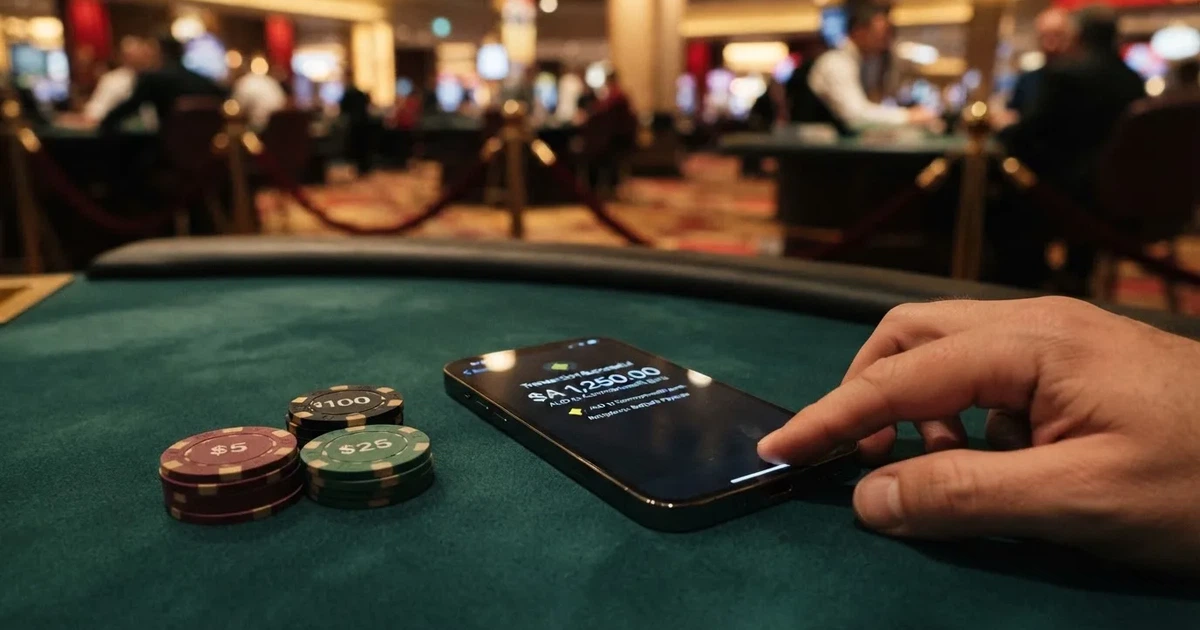
A player who searches for an instant bank transfer casino in Australia is usually trying to solve one puzzle: how quickly can money move from a bank account into an offshore casino cashier, and back out again. The puzzle has a clean answer in one direction and a much messier one in the other. Australia’s New Payments Platform can settle a transfer in under a minute. The Interactive Gambling Act 2001 makes it an offence to offer online casino games and pokies to a person physically in Australia, and the ACMA has spent the years since 2017 turning that offence into blocked websites, formal warnings and disappeared services. Speed of payment and standing of the payee are two separate questions, and a player who only checks the first one can lose the second without noticing.
This page works through both. It starts with what an instant bank transfer actually is in Australia, then explains the legal frame around any casino offering that route to an Australian account, then the responsible‑gambling dimensions that fall out of a direct transfer, then the payments picture, then the eleven operators the ACMA itself has put on notice. The angle is cost: what every step in this chain actually costs the person paying for it.
What an instant bank transfer actually moves
An “instant” bank transfer in Australia is an Osko payment. Osko sits on the New Payments Platform, a public infrastructure that went live on 13 February 2018 and is owned by New Payments Platform Australia Ltd, a not‑for‑profit whose thirteen shareholders include the Reserve Bank of Australia and the country’s major banks. With Osko, a transfer between participating banks arrives in under a minute, around the clock including weekends, and the money can be addressed either to a BSB and account number or to a PayID. By April 2025 more than 25 million PayIDs had been registered against the platform, and the service now reaches over a hundred Australian institutions. Paying to a PayID shows the name on the destination account before the transfer is sent, which is a small but useful guardrail against misdirected deposits.

None of that infrastructure is owned by a casino. A casino cashier that accepts a “bank transfer” is simply accepting a domestic transfer routed through this public platform. The settlement speed is the bank’s, not the casino’s. What the casino adds is its own transaction review, and that part does not move at network speed. A deposit that has cleared between banks in forty seconds can sit in a casino’s pending queue for hours while anti‑fraud and identity checks run. The instant leg is real; the instant casino leg is not, and treating the two as one is the most common mistake on this whole subject.
Why this matters for the reader: an offshore casino advertising an “instant” bank deposit is describing the network, not the cashier. A player who funds an account expecting to play within a minute of leaving the banking app may find the play balance still says zero ten minutes later, and may discover the issue is not the transfer but the queue behind it. The honest comparison is deposit‑rail speed versus playable‑balance speed, and only one of those is genuinely under the player’s control.
The mechanics behind the cashier screen
A bank transfer deposit at a casino cashier is a normal domestic transfer, neither more nor less. The casino provides a destination account — usually a BSB and account number, sometimes a PayID — and the player pushes funds to it from their own bank. The cashier credits the play balance when it sees the funds land, which the casino reconciles against its own ledger.

That reconciliation is the bottleneck. Card deposits pre‑authorise against the card network, which the casino can read in near real time. Wire deposits have no equivalent signal — the casino has to wait for its bank to confirm receipt and match the payment to the right player account. The infrastructure that makes Osko fast is therefore only the first half of the deposit; the second half is whatever the casino’s back office does with the receipt, and that varies from site to site.
Three quiet implications follow. First, a bank transfer is harder to charge back than a card, because it does not run on a chargeback‑enabled network. Second, it leaves a clearer paper trail than a card or an e‑wallet, which is on balance a safeguard for the player who wants to see their own spend over time and a worry for the player who would rather not. Third, the casino sees the player’s real bank account details, because the transfer is a direct push from that account — unlike a card deposit, where the casino only sees the card number, and unlike an e‑wallet deposit, where the casino only sees the wallet’s identifier.
Why some operators steer players to a transfer
Cards can be declined by the card issuer rather than the casino. The major Australian banks now run gambling blocks at card level. Westpac’s block refuses authorisation on transactions registered under the merchant category code for betting and casino gambling. ANZ’s block, activated in the ANZ app, covers transactions made through a digital wallet such as Apple Pay on an eligible card, not only on the physical card, and removing the block once it is on carries a 48‑hour waiting period. Commonwealth Bank offers a comparable lock via its app. Apple Pay and Google Pay together made up around 45% of card payments in Australia by number at the end of 2025, so a card decline that looks like a casino refusal may actually be a gambling‑block refusal that the player chose.
A direct transfer defeats most of those blocks because the block sits at the card layer. The merchant category code the banks filter on is the card network’s code, not a transfer’s code. A bank transfer to a BSB and account number is just a transfer; it goes through the same rails as a transfer to a household bill. That is why some offshore casinos recommend a bank deposit to Australian players whose cards keep coming back declined.
The reader’s position: a deposit route the bank cannot categorise as gambling is not safer for that reason. It is simply less visible to the bank’s own controls. A player who has turned on a gambling block to limit their own play has, by design, made a card deposit impossible; a transfer deposit under the same conditions is not blocked because the controls have no label to match. The mechanism that protects a player from themselves is the same mechanism that an offshore cashier routes around.
The legal frame around an offshore bank‑transfer casino
The product is prohibited. The Interactive Gambling Act 2001, strengthened by the Interactive Gambling Amendment Act 2017, makes it an offence for anyone to provide online casino games or online pokies to a person in Australia. No state or territory licenses online casino games. What is licensable — wagering on races and sporting events placed before the event, lotteries, keno — is in practice administered by the Northern Territory Racing and Wagering Commission, which regulates 52 online bookmakers including Sportsbet, Bet365 and Ladbrokes. The commission has no full‑time staff and meets once a month in Darwin.
The individual player is not prosecuted under the IGA. The Act targets the provider. That distinction is real, but it should not be read as a green light to play. An offshore site gives no Australian consumer protection, no complaints body, no recourse if a withdrawal is refused, and no obligation to honour a published bonus term if it chooses not to. The IGA’s effect on the player side is the absence of every safeguard an Australian‑licensed wagering service is required to provide.
The Interactive Gambling Amendment (Gambling Reform) Bill 2026 passed Parliament on 19 August 2026. Its advertising and inducement measures commence 1 January 2027, so on a page read in 2026 the law is in place but the new measures are not yet in force. The package tightens inducements around licensed wagering; it does not legalise online casino games. Nothing in the 2026 reform changes the underlying prohibition, and a reader who came across the announcement looking for a relaxation should adjust that expectation.
What the ACMA has actually done since 2017
The Australian Communications and Media Authority investigates, issues formal warnings, and directs Australian internet service providers to block illegal sites. According to the ACMA as reported in June 2026, a total of 1,751 illegal gambling and affiliate marketing websites had been blocked since the first blocking request in November 2019, and more than 230 unlicensed gambling services had left the Australian market since enforcement was strengthened in 2017. In the round reported on 26 June 2026 alone, the ACMA asked ISPs to block 12 more sites: 7Signs, ChromaBet, Donbet, Duospin, Freshbet, Slots Gem, Jacks Club, Lucky Start, Pointsbetz, Spinrise, Vinyl Casino and Wildsino.
A useful way to read that growth is to put a rate on it. The first blocking request went out in November 2019; by June 2026 the count of blocked sites stood at 1,751; the elapsed window is roughly 79 months. The blocking rate therefore sits in a band of roughly 21 to 23 sites a month as an average, which is the cleanest measure of how steadily the ACMA is using the power. Two things follow. The first is that the monthly cadence has not slowed: a player who assumes enforcement will fade should adjust that picture. The second is that a blocked list of this length is what the regulator describes as the floor of what it has identified, and the floor has not dropped — the floor has only risen.
A formal warning is a different thing from a block. It is an open letter from the ACMA naming an operator and a brand and referring to a specific provision of the IGA. Once a warning is published, the ACMA’s next step is generally a referral to ISPs for blocking and a referral to the Australian Federal Police where the conduct continues. The bulk of the operators reviewed on this page are brands the ACMA has already warned.
How a player should read an offshore “licence”
An offshore casino carries a licence from somewhere. Curacao, the Kahnawake Gaming Commission, the Malta Gaming Authority, and the Government of Curaçao through the Curaçao Gaming Control Board are common holders. None of these licences authorises the operator to take a bet from a person in Australia; an Australian‑facing offer is precisely what those licences do not cover. The licence a casino displays is a licence to operate in some other jurisdiction, not a licence to operate in Australia.
Two practical consequences. A player lodging a complaint against an offshore operator with an Australian consumer body will be told the body has no jurisdiction. A player taking a complaint to the offshore licence holder is asking the holder to enforce against a brand whose revenue comes from exactly the markets it should not be serving. The complaint structure is the complaint structure of a market the operator has already decided to serve outside the rules. Some complaints are honoured; nothing in the design compels them to be.
The reader’s position: the question is not whether the offshore licence exists. It almost always does. The question is what recourse the licence gives an Australian player when the casino refuses a withdrawal, voids a bonus, or disappears, and the honest answer in most cases is none.
What a bank transfer does to a player’s own safeguards
| Feature | Instant Bank Transfer | Card Deposit |
|---|---|---|
| Visibility on bank statement | Merchant name shown | Varies by merchant |
| Paper trail | Direct record of spend | Card statement entry |
| Banking blocks | Generally passes | Can be filtered |
| Chargeback availability | No | Yes |
A direct bank transfer is unusual among payment methods in that the casino sees the player’s real account details. The deposit is a push from the player’s account to the casino’s account; the player sees the casino’s destination, the casino sees the player’s source. This is the opposite of how a card or e‑wallet deposit works, where the merchant only sees the card number or the wallet identifier.
That observation has three sides. The first side is hygiene. A bank transfer is a poor choice for a player who wants to keep gambling spend segregated from their household accounts, because the spend shows up on the bank statement with the merchant’s name. The second side is proof. A bank transfer is an excellent choice for a player who wants a clear record of how much they have deposited, where, and on what date — the bank holds that record in the player’s own statement, not in a wallet’s history. The third side is the side that does the regulatory work. A transfer is the only common payment method that creates a paper trail the player, the bank, and the regulator can all read, and that paper trail is exactly what a player who later wants to dispute a withdrawal or prove a problem is doing without would need.
Where the responsible‑gambling register sits, and where it does not
BetStop, the National Self‑Exclusion Register, has been live since August 2023. It binds every Australian‑licensed online and phone wagering service to honour an exclusion registered by a named individual. The register’s logic is that the player registers once and every licensee on the list enforces it.
An offshore casino is not on that list. BetStop’s exclusion does not propagate to a brand sitting on a Curaçao or Anjouan licence, because the brand is not under the obligation in the first place. A player who self‑excludes on BetStop and then opens an account at an offshore casino has self‑excluded from licensed Australian wagering only; the offshore side of their play continues without the register knowing it exists. The National Gambling Helpline — 1800 858 858, free, 24/7, with chat via Gambling Help Online — is the right next contact for a player who has set up an exclusion and feels they need a second layer, but the second layer reaches licensed services only.
A bank transfer gives the player a tool the register does not. Most Australian banks now offer some form of gambling block or merchant block. Westpac’s block works at the merchant category code level on eligible cards; ANZ’s block covers digital wallet transactions on eligible cards and carries a 48‑hour removal cooling‑off; Commonwealth Bank offers a comparable lock via its app. The blocks are imperfect — the banks themselves warn that not every gambling transaction will be caught and some non‑gambling ones may be wrongly blocked — but they are independent of any register and any site. A player who keeps an offshore casino on a bank that runs a gambling block on cards should expect the card deposit to be declined and the bank transfer deposit to go through, because the bank’s controls target the card layer.
Practical mechanics for a player who wants the paper trail without the harm
A short, practical sequence for a player who has decided to play somewhere offshore and wants to keep their own bookkeeping clean: open a dedicated transaction account with a separate BSB, fund it from the main account by transfer only in amounts the player has decided in advance to lose, and route casino deposits out of that account so the household statement is unaffected. The same account holds the withdrawals, and the bank statement becomes the ledger. This does not solve the legal or consumer‑protection problem; it does solve the bookkeeping problem, which is the only one of the three sides of a bank transfer deposit the player actually controls.
The payments picture: which rails are open and which are closed
A bank transfer is one of several deposit rails an offshore casino will offer an Australian account, and the differences between them matter more than the marketing copy suggests. Cards are the next most common route, and the credit‑card ban inside the licensed market is worth understanding before any card deposit is attempted.
Cards, credit, and the 2024 rule
Under the Interactive Gambling Act 2001 as amended in 2023, Australian‑licensed online wagering services cannot accept payment by credit card or other credit‑related products, a restriction that took effect across licensed channels on 11 June 2024. Penalties run to A$247,500 for an operator that accepts a credit instrument in the licensed market. The same restriction works against linked digital wallets like Apple Pay, because the wallet honours the underlying credit instrument.
What that means for a player at an offshore casino is more nuanced. The ban applies to the licensed operator, not to the issuer side. An Australian card issuer will not decline a credit‑card transaction at an offshore casino because the IGA’s credit ban does not bind the issuer, but ANZ’s gambling block, Westpac’s card‑level block and Commonwealth Bank’s lock filter at the card layer regardless of the merchant’s location. Visa and Mastercard’s policies are their own. American Express sits outside the Reserve Bank’s July 2025 review of card surcharges — the review proposed removing surcharges only on eftpos, Mastercard and Visa, explicitly leaving Amex outside scope — which is interesting but not directly an acceptance question. Apple Pay’s own fees are zero on the consumer side; any surcharge at an Australian merchant comes from the merchant’s processing cost. Transaction limits and PIN requirements for Apple Pay are set by the issuer or the merchant, not by Apple.
The reader’s position: a credit card at an offshore casino in 2026 is closed by the issuer’s own rules at most Australian banks, and not because the IGA touched it there. A debit card is generally open, subject to the bank’s gambling block being off. A bank transfer is the most reliably open rail for Australian accounts precisely because it is not a card.
BPAY, Osko and PayID
BPAY is the bill‑payment service in online banking: a payer enters the Biller Code and a Customer Reference Number printed on the bill. It has operated in Australia since 18 November 1997, sits in the online banking of more than 140 institutions and is taken by over 95,000 businesses. It is run by Australian Payments Plus, the same operator as PayID and Osko, and is owned equally, via parent company Cardlink Services Limited, by ANZ, Commonwealth Bank, National Australia Bank and Westpac.
The structural difference between BPAY and an Osko transfer matters at a casino. BPAY is designed to clear bills to a biller; it expects a Biller Code and a CRN. A casino cashier that asked for a BPAY deposit would need a Biller Code and a CRN for every player, which is not how billers operate; in practice, offshore casinos asking for a BPAY deposit are asking the player to use a route that will mis‑classify the payment inside the bank’s records. Osko and PayID move between accounts in seconds. A domestic transfer routed through Osko reaches the casino’s account as a transfer, not as a bill payment, and reconciles against the BSB and account number or against the PayID.
Apple Pay, Google Pay and Samsung Pay together handled around 45% of card payments by number in Australia at the end of 2025. None of them is a bank transfer; all of them look like card payments to the issuing bank. A player weighing a deposit method is choosing between a route the bank can categorise as gambling (cards, with the bank able to block) and a route the bank cannot categorise (a transfer, where the bank’s gambling block has nothing to match).
AUSTRAC and the reporting thresholds
AUSTRAC’s threshold‑transaction‑report rule requires reports for cash transfers of A$10,000 or more; ordinary electronic bank transfers are not subject to that per‑transaction reporting requirement, regardless of the amount sent. The reporting framework that touches cash in this country does not transfer to electronic transfers, including to an offshore casino. A bank may still file a suspicious‑matter report on its own initiative regardless of size, and banks do.
The practical implication for a deposit at an offshore casino is straightforward. A single large transfer does not, by size alone, generate an automatic report. A pattern of frequent or unusual transfers may. The reader’s position is not about whether a report is filed; it is about whether the player wants a record on their own statement. A direct transfer always creates one.
Operators the ACMA has put on notice
| Brand | ACMA action and date | Operator named by the ACMA | Subject support |
|---|---|---|---|
| RocketPlay | Formal warning, March 2026 | Pulsup Ltd | No-data |
| Level Up Casino | Formal warning, May 2022 | Dama N.V. | Listings-only |
| Woo Casino | Formal warning, March 2025 | Dama N.V. | No-data |
| Spirit Casino | Formal warning, May 2025 | Dama N.V. | No-data |
| National Casino | Formal warning, July 2025 | Consolutetish S.R.L. | Listings-only |
| Bizzo Casino | Formal warning, July 2025 | Consolutetish S.R.L. | No-data |
| Ignition Casino | Formal warning, July 2025 | Bamboo Media | No-data |
| Instant Casino | Formal warning, February 2025 | EOD Code SRL | Listings-only |
| Jackbit | Formal warning, April 2026 | Ryker B.V. | No-data |
| Casino Intense | Formal warning, April 2025 | Sterplay Holding Ltd | Listings-only |
| Sky Crown | Formal warning, September 2022 | Hollycorn N.V. | No-data |
What follows is not a ranking. Online casino games and online pokies cannot be licensed anywhere in Australia, and the eleven operators below are listed because the ACMA itself issued a formal warning to the company behind each one for offering prohibited services to Australians. The site, the date and the operator are the ACMA’s, and the consistency across the eleven is the absence of an Australian licence.
RocketPlay
The ACMA issued a formal warning under the Interactive Gambling Act 2001 to Pulsup Ltd over Rocketplay in March 2026. An earlier Dama N.V. warning from May 2022 also covered this brand. The provider carries no Australian licence for online casino games, whatever licence the site displays elsewhere. The relevant question for a player is not what the site claims to be licensed for but what an Australian consumer can do if a withdrawal stalls, and the answer there is whatever the offshore complaint process produces.
Level Up Casino
The ACMA issued a formal warning to Dama N.V. over Level Up Casino in May 2022, as part of the same May 2022 round that covered Bambet, Dazard, Rocketplay, Wild Tornado and Cobra Casinos. Westpac’s published comparison materials mention the brand in passing. The historical status within the ACMA’s records does not age out; the warning stands, and a 2022 warning is still the operator’s record on the IGA side of things.
Woo Casino
The ACMA issued a formal warning to Dama N.V. over Woo Casino in March 2025, then again over Spirit Casino in May 2025. Two warnings to the same operator in fourteen months is the ACMA’s way of saying the first one did not stick. A player who would otherwise have treated the March 2025 warning as a settled matter now sees a May 2025 warning behind it, and the running‑total of warnings against Dama N.V. over this two‑year window is the cleanest summary of the operator’s posture on Australian customers.
Spirit Casino
The ACMA issued a formal warning to Dama N.V. over Spirit Casino in May 2025. The pattern is the same as for Woo Casino: a 2025 warning after a 2022 round that already named the operator. A reader who looked only at the most recent warning would miss the earlier one; both are on the ACMA’s record.
National Casino
The ACMA issued a formal warning to Consolutetish S.R.L. over National Casino in July 2025. AUSTRAC’s published materials and the broader background that turn up on searches for the brand show what a player looking for some basic information about the operator runs into — a missing Australian presence and a complaint structure that has to be pursued through the operator’s own channels. The substantive complaint a player would have against any offshore casino — a withdrawal that does not arrive, a bonus that is voided in play, an account that is closed with a balance on it — is the same complaint, and the recourse route is the same in any case.
Bizzo Casino
The ACMA issued a formal warning to Consolutetish S.R.L. over Bizzo Casino in July 2025. Bizzo had already been the subject of a 2022 formal warning to TechSolutions (CY) Group Limited and TechSolutions Group N.V. Two separate operators, two separate warnings, one brand. The 2025 warning is not a first contact; it is a re‑contact under a different company structure. For a player, the corporate history matters because a complaint lodged with the operator named on the 2022 licence may not be honoured by the operator named on the 2025 licence, and vice versa.
Ignition Casino
The ACMA issued a formal warning to Bamboo Media over Ignition Casino in July 2025. The warning is the ACMA’s only public entry on this brand in the round reviewed for this page. A player looking for a single, named entry within the regulator’s database finds the July 2025 record and the operator behind it; the surrounding enforcement record is otherwise thin compared with the operators that have accumulated multiple warnings across multiple brands.
Instant Casino
The ACMA issued a formal warning to EOD Code SRL over Instant Casino in February 2025. Material published by ecoPayz and PayID’s own pages turn up in listings searches for the brand, which is one of the few signals in the offline references a reader can verify, though a signal is not the same as a clean record. The warning is on the ACMA’s side and pre‑dates most of the 2025 round.
Jackbit
The ACMA issued a formal warning to Ryker B.V. over Jackbit in April 2026, the same warning also naming CasinOK. The 2026 date puts this at the freshest end of the warnings reviewed here, and a player comparing operators against the ACMA’s register finds Jackbit on the most recent page of the record.
Casino Intense
The ACMA issued a formal warning to Sterplay Holding Ltd over Casino Intense in April 2025. Listings for the brand touch AUSTRAC’s published materials, an IT News piece and a NAB gambling‑block page — the last of those describes what the player’s own bank would do at the card layer if asked to authorise a deposit there, which is a more useful piece of information for a player than the operator’s marketing.
Sky Crown
The ACMA issued a formal warning to Hollycorn N.V. over Sky Crown and Blue Leo, with the warning publication dated September 2022. Hollycorn’s record spans both brands; the warning remains in the ACMA’s database and not aged out, and the 2022 date puts it among the older formal warnings still standing on the published list.
Where the eleven leave the reader
Every one of these operators is named in a formal warning under the Interactive Gambling Act 2001 for offering prohibited online casino services to people in Australia. There is no brand among the eleven whose position under Australian law is more favourable than another’s. The differences across the eleven are in date, in operator, in the number of prior warnings, and in the offshore complaint structure a player would have to use. None of those differences change the underlying legal position.
H2 Gambling Capital’s 2025 report estimates that Australians lose about A$3.9 billion a year to illegal gambling sites, and that the share of gambling going through legal channels fell from 74% in 2021 to 64%. The 1,751 blocked sites sit on top of an annual loss figure that has grown as the legal share has fallen. The two numbers together describe the same market from two ends: more blockings, more spend on what is being blocked, and a regulator running the blocking programme at a steady monthly cadence of roughly 21 to 23 sites a month averaged over 79 months. A reader looking for the ACMA to slow down should be told the rate has not slowed; a reader looking for the ACMA to have caught up should be told the floor keeps rising.
Frequently asked questions
Is it legal for an online casino to accept a direct bank transfer from a player in Australia?
No online casino may lawfully offer online casino games or pokies to a person in Australia under the Interactive Gambling Act 2001, and the ACMA has named every operator reviewed on this page in a formal warning for doing so. The deposit method does not change the legal standing on the operator side. An Australian player is not personally prosecuted under the IGA, but the offshore operator carries no Australian consumer protection, no complaints body and no obligation to honour its own terms.
How does a bank transfer deposit at an offshore casino differ from a card deposit?
A bank transfer is a direct push from the player’s account to the casino’s account, clearing through Osko in under a minute on the network layer and then through the casino’s own reconciliation queue on the cashier layer. A card deposit runs through the card network, can be declined by the card issuer, and is invisible to the bank’s gambling block when the casino is reached by a non‑card rail. The deeper difference is that a transfer exposes the player’s real account to the casino and produces a clear statement entry on the player’s bank record, while a card deposit exposes only the card number and produces a card‑statement entry with the casino’s merchant descriptor.
Does a bank transfer leave a clearer paper trail than a card or e‑wallet deposit?
Yes, and that is the only meaningful sense in which it is the safer of the three for a player who wants to see what they have spent. A direct transfer lands on the player’s own bank statement with the merchant’s name, the date and the amount, and a year of those entries is a year of gambling spend the player can audit. A card deposit lands on the card statement with a merchant descriptor that may or may not read clearly, and an e‑wallet deposit is recorded inside the wallet’s own app. The paper trail is not a safety measure against the casino; it is a safety measure against the player’s own hindsight.
How long does an instant bank transfer usually take to actually clear at a casino site?
The bank leg, between the player’s bank and the casino’s bank, usually clears in under a minute during Australian business hours and at weekends through Osko. The casino leg, between the cashier seeing the funds and the play balance updating, depends on the operator’s own reconciliation queue and is generally slower. Players expecting a card‑like credit will sometimes wait hours; players expecting a wire‑like delay of a day or more generally do not. The honest description is that the transfer arrives quickly and the balance updates when the casino gets around to it.
Can a bank flag or block a transfer sent to an offshore casino site?
Australian banks run gambling blocks at the card layer, not at the transfer layer, so a direct transfer to a BSB and account number or to a PayID generally passes the bank’s automated controls. The bank can still file a suspicious‑matter report on its own initiative, and a player whose pattern of transfers draws attention will hear from the bank regardless of how the transfer is routed. The gambling block that protects a player from themselves is the card block; a transfer is the route the player takes when the card block has done its job and the player still wants to deposit.
What information does a casino site need to accept a direct bank transfer deposit?
A cashier asking for a bank transfer needs a destination — a BSB and account number, or a PayID — and tells the player which one to use. The player supplies nothing to the casino beyond what the cashier asks for; the transfer is initiated by the player from their own banking app, addressed to that destination. Some casinos ask for a reference code so the cashier can match the incoming funds to the right player account, and a missing or wrong reference is one of the cleanest ways a deposit is delayed or uncredited. The information flow runs from the player to the casino only at sign‑up; the money flows from the player’s bank to the casino’s bank without the casino seeing the player’s account details on the card‑scheme side.