
new australian online pokies in 2026 — what the legal landscape actually leaves on the table
Currency and licence register verified as of 8 November 2026 against the ACMA’s published formal warning list and the Interactive Gambling Act 2001.
The simplest way to put it: there is no licensed Australian online pokies market, and there is not going to be one in 2026. The Interactive Gambling Act 2001, in the shape it took after the 2017 amendments, makes it an offence to provide online casino games — which is the legal category online pokies fall into — to anyone who is physically in Australia. No state or territory issues a licence for it. The Northern Territory Racing and Wagering Commission regulates 52 online bookmakers, including Sportsbet, Bet365 and Ladbrokes, but those are wagering services licensed for tax reasons, not online casinos. The commission has no full-time staff and meets once a month in Darwin.
So when a reader types “new Australian online pokies” into a search bar, the honest page is one that names the gap, walks through what the ACMA has been doing about it over the last few years, points to the legal alternatives, and stops. A shortlist of offshore casinos accepting Australian players would not be honest — it would be a list of services the ACMA has been actively warning and blocking. The eleven names later in this page are exactly that: the ACMA itself issued a formal warning over each one. They appear here because a reader searching for them needs to know what happened, not because any of them is a recommendation.
What an Australian reader in 2026 actually has, laid out plainly: licensed pokies in clubs, pubs and casinos, state by state; licensed online wagering on races and sport, placed before the event; lotteries and keno; and BetStop, the National Self-Exclusion Register, which binds every Australian-licensed wagering service. The rest of this page works through what that means in practice.
Table of Contents
- The legal frame: how Australia ended up prohibiting online pokies
- How the ACMA has moved against individual brands
- The offshore services the ACMA has acted against
- The paytable and the catalogue: what “new” actually means in pokies
- How money moves on a licensed wagering site — and how it does not on an offshore casino
- BetStop, self-exclusion, and the help that is actually available
- What an Australian reader comparing options in 2026 is actually comparing
- The arithmetic of the blocking regime
- Frequently asked questions
The legal frame: how Australia ended up prohibiting online pokies
The Interactive Gambling Act 2001 is the federal statute that does the work, and the Interactive Gambling Amendment Act 2017 is what tightened it. Under the current law, providing online casino games — online pokies, online blackjack, online baccarat, online roulette — to a person who is in Australia is an offence. So is in-play betting on a sporting event. What remains licensable is wagering on races and sporting events placed before the event starts, lotteries and keno. The minimum age across every Australian jurisdiction is 18.
The 2026 reform sits next to that frame. The Interactive Gambling Amendment (Gambling Reform) Bill 2026 passed Parliament on 19 August 2026, and its advertising and inducement measures commence on 1 January 2027. That is law with a start date — it exists, but it is not yet in force on a page dated 2026. A reader who sees an inducement advertised in 2026 is being marketed to under rules that are about to change, and the change is six months away.
State and territory regulators handle the land-based machines — the actual poker machines in clubs and pubs, and the table games in the casinos. Each jurisdiction sets its own minimum return-to-player. New South Wales, the Northern Territory, Queensland and most of Victoria sit at 85 per cent, with Crown Melbourne at 87 per cent. The Australian Capital Territory and Tasmania are at 87 per cent, South Australia at 87.5 per cent, and Western Australia at 90 per cent. Those minimums apply only to the machines physically located in the relevant jurisdiction. An offshore site with a Curacao or Anjouan licence does not run on those minimums — it runs on whatever the operator decides to publish, with no Australian regulator checking.
What the ACMA has actually done
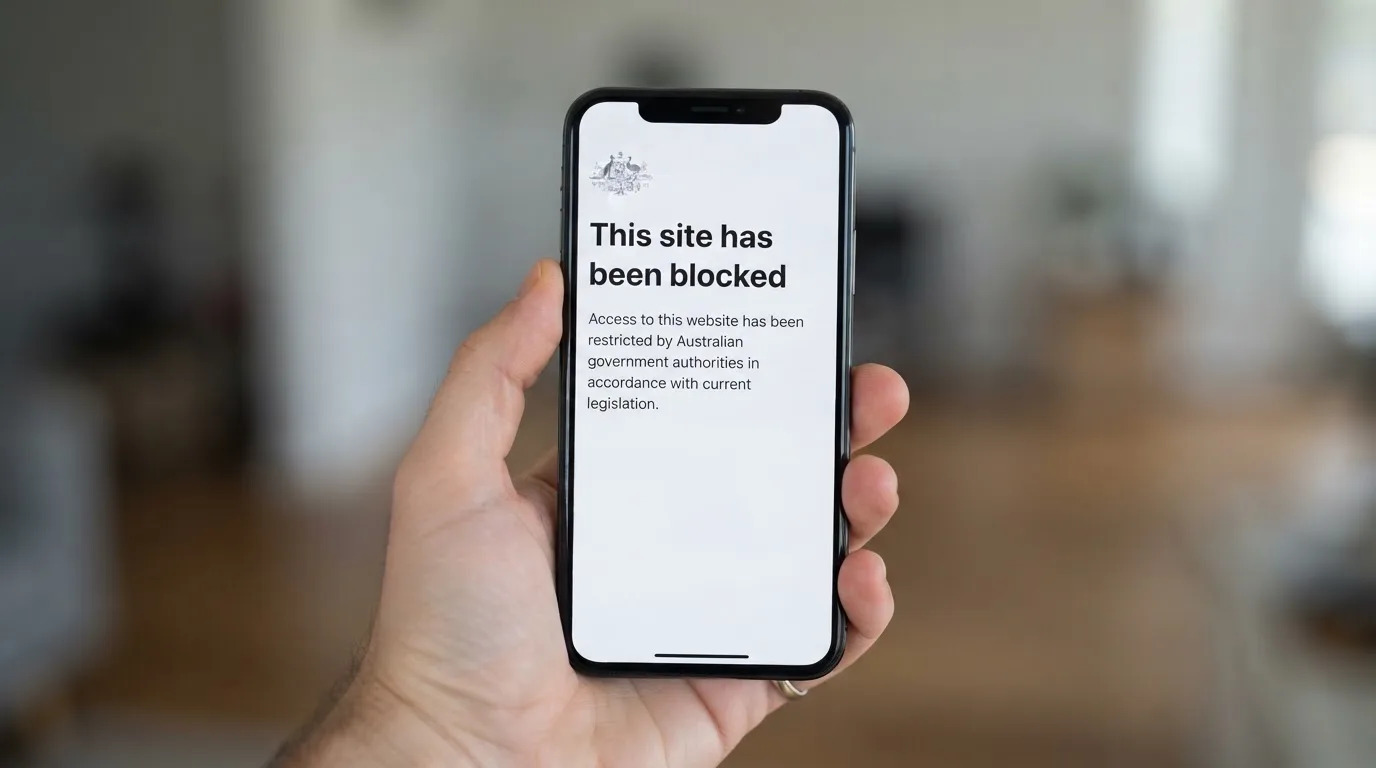
The Australian Communications and Media Authority enforces the prohibition on the provider side. Two tools do most of the work: formal warnings, which the ACMA publishes on its own website, and blocking requests, which direct Australian internet service providers to make a domain unreachable from inside the country.

As reported in June 2026, the ACMA had asked ISPs to block 1,751 illegal gambling and affiliate marketing websites since the first blocking request in November 2019, and more than 230 unlicensed gambling services had left the Australian market since enforcement was strengthened in 2017. The blocking count is cumulative, not annual — it is the running total from a regime that started with one request and now sits in the thousands. A round reported on 26 June 2026 alone added twelve more domains to that list: 7Signs, ChromaBet, Donbet, Duospin, Freshbet, Slots Gem, Jacks Club, Lucky Start, Pointsbetz, Spinrise, Vinyl Casino and Wildsino.
That volume matters for a reader comparing options. It is not a single bad operator being chased: it is an ongoing round that has been running since 2017, and the ACMA’s stated approach is that blocking requests continue as new illegal services come online. The service that gets blocked in 2026 is not the same service that was blocked three years ago.
Where the player sits in this
The IGA does not prosecute the player. It targets the provider. An Australian who opens an account at an offshore casino commits no offence under the Act. The cost is what the player gives up by being outside the Australian regime.
An offshore casino gives no Australian consumer protection: no complaints body to take a dispute to, no local recourse if a withdrawal is refused, and no guarantee that the balance sitting on the site at the moment the ACMA asks an ISP to block the domain is recoverable. A site can be blocked with money still on it. The same offshore casino is not connected to BetStop, so a self-exclusion registered there binds only Australian-licensed wagering services. And the payment rails are different — credit cards, credit-related products and digital currency are banned as payment for licensed online wagering in Australia since 11 June 2024, with penalties up to A$247,500 for operators who breach that rule. Legal deposit routes for licensed wagering are debit card, bank transfer, PayID/Osko and BPAY. An offshore casino asking for a credit card or a crypto deposit is operating outside the Australian rules; the reader does not get the protections those rules were written to provide.
The tax position is the one piece of clean news for the recreational player. Gambling winnings are not assessable income under section 6-5 of the ITAA 1997, and losses are not deductible — unless the person carries on a business of gambling. That is a model answer, not advice: anyone with a serious question about their own position checks with the ATO.
How the ACMA has moved against individual brands
The formal warning list is the ACMA’s public record of providers it has put on notice under the Interactive Gambling Act. The brand may keep operating elsewhere in the world, and may keep accepting Australian customers for a while after the warning; the ACMA’s next step in a serious case is a blocking request to Australian ISPs. Each entry below pairs the brand with the operator named in the ACMA’s published warning and the date the warning was issued. The list comes from the ACMA’s own site, and an operator or date that research did not turn up does not appear.
The picture across these eleven warnings is not eleven independent events. Dama N.V. has been warned repeatedly, in May 2022 over six brands, in March 2025 over Woo Casino, and in May 2025 over Spirit Casino. Consolutetish S.R.L. was warned in July 2025 over both National Casino and Bizzo Casino, with Bizzo having already been the subject of a 2022 warning to TechSolutions. Different operators, the same recurring structure: a Curaçao or similar corporate seat, an Australian-facing brand, a formal warning, and either a quiet withdrawal from the Australian market or a continuation under a different domain. The repetition is the point. A reader who has never heard of Dama N.V. has almost certainly been offered one of its brands at some point.
A reader asking why any of these are still worth describing is asking the right question. The reason is that the search traffic exists regardless, and the ACMA’s published warnings are the right source of truth about what each brand actually is. None of them is recommended here. None of them is presented as a place to play. Each is presented because the ACMA itself named it.
The offshore services the ACMA has acted against
| Brand | ACMA action and date | Operator named by the ACMA | Subject support |
|---|---|---|---|
| RocketPlay | March 2026 / May 2022 | Pulsup Ltd / Dama N.V. | No-data |
| Level Up Casino | May 2022 | Dama N.V. | Listings-only |
| Woo Casino | March 2025 | Dama N.V. | No-data |
| Spirit Casino | May 2025 | Dama N.V. | No-data |
| National Casino | July 2025 | Consolutetish S.R.L. | Listings-only |
| Bizzo Casino | July 2025 / 2022 | Consolutetish S.R.L. / TechSolutions | No-data |
| Ignition Casino | July 2025 | Bamboo Media | No-data |
| Instant Casino | February 2025 | EOD Code SRL | No-data |
| Jackbit | April 2026 | Ryker B.V. | No-data |
| Casino Intense | April 2025 | Sterplay Holding Ltd | Listings-only |
| Sky Crown | September 2022 | Hollycorn N.V. | No-data |
RocketPlay — Pulsup Ltd, March 2026
The ACMA’s formal warning over Rocketplay went to Pulsup Ltd in March 2026, and an earlier warning over the same brand had gone to Dama N.V. in May 2022 as part of the six-brand batch that also covered Bambet, Dazard, Level Up, Wild Tornado and Cobra Casinos. The brand changed corporate seat between those two warnings without changing what it offered Australian customers. Research did not turn up bonus terms from a source independent of affiliate marketing pages, so the page does not print them.
The verdict: a brand with two ACMA warnings six years apart and a corporate seat that moved in between. Whatever bonus headline the site carries, the regulatory position is the same both times.
Level Up Casino — Dama N.V., May 2022
Level Up Casino sat inside Dama N.V.’s six-brand batch in May 2022, alongside Bambet, Dazard, Rocketplay, Wild Tornado and Cobra Casinos. The brand appears in listings on game-provider sites such as bgaming as a venue carrying their catalogue. That is a listings mention, not an endorsement: it is what the provider’s own site reports about distribution, not a claim about what Level Up offers the player.
The verdict: a brand whose Australian-facing status changed nothing when the ACMA warning landed — the game catalogue continued, the corporate seat stayed put, and the warning sits on the public record.
Woo Casino — Dama N.V., March 2025
The ACMA issued a formal warning to Dama N.V. over Woo Casino in March 2025. It is the second Dama N.V. warning on this page, and it sits inside the pattern: one operator, multiple brands, recurring enforcement. Research did not surface a working bonus figure, and what affiliate pages carry for Woo Casino is not used here.
The verdict: a brand whose operator the ACMA has now warned twice in three years. The economics of any welcome offer the site advertises do not change the regulatory position.
Spirit Casino — Dama N.V., May 2025
Two months after the Woo Casino warning, in May 2025, the ACMA issued another formal warning to Dama N.V., this time over Spirit Casino. The brand is newer in the public record than Woo Casino, and the warning is the first formal action named against it. The same constraint applies as elsewhere on this page: no bonus terms are printed from affiliate sources.
The verdict: a brand whose first published ACMA action arrived in mid-2025. The reader who finds the site through a search result is finding a service the ACMA has just put on notice, and that is information worth having before any deposit.
National Casino — Consolutetish S.R.L., July 2025
The ACMA’s July 2025 warning to Consolutetish S.R.L. covered both National Casino and Bizzo Casino. National Casino appears in third-party listings as a venue carrying a familiar catalogue of slots and table games; that is what the listing reports, and the page does not push it further.
The verdict: a brand named in the same ACMA action as Bizzo Casino. The pairing matters — two brands, one operator, one warning — because it tells a reader comparing them that the corporate structure behind the marketing is shared.
Bizzo Casino — Consolutetish S.R.L., July 2025; TechSolutions, 2022
Bizzo Casino had already been the subject of a 2022 formal warning to TechSolutions (CY) Group Limited and TechSolutions Group N.V., and the ACMA came back in July 2025 with another warning, this time to Consolutetish S.R.L. Two operators, two warnings, the same Australian-facing brand.
The verdict: a brand with two ACMA warnings from two different operators across three years. The reader looking at any bonus headline on the site is reading marketing from a service the regulator has put on notice twice.
Ignition Casino — Bamboo Media, July 2025
In the same July 2025 round, the ACMA issued a separate formal warning to Bamboo Media over Ignition Casino. Ignition is one of the more recognisable names on the offshore market and the subject of a parallel enforcement action, not a continuation of a previous warning.
The verdict: a brand whose first named ACMA action landed in mid-2025. The brand’s familiarity on the offshore market is not the same as regulatory familiarity in Australia.
Instant Casino — EOD Code SRL, February 2025
The ACMA issued a formal warning to EOD Code SRL over Instant Casino in February 2025. The brand had not appeared in earlier warning rounds. Research did not surface an RTP, a volatility profile or a bonus figure from an independent source for this brand, so the page leaves those columns blank.
The verdict: a brand whose first ACMA action arrived in early 2025, and whose bonus mechanics the page cannot quote from a source that is not an affiliate marketing page.
Jackbit — Ryker B.V., April 2026
The ACMA issued a formal warning to Ryker B.V. in April 2026, naming both Jackbit and CasinOK. April 2026 is recent — within the current reporting cycle for this page. The brand sits inside a fresh batch, not a recurrence of an older case.
The verdict: a brand whose ACMA warning is months old, not years. The freshness is the point: this is what the regulator’s current caseload looks like.
Casino Intense — Sterplay Holding Ltd, April 2025
The ACMA’s April 2025 warning over Casino Intense went to Sterplay Holding Ltd. The brand appears in third-party reporting on Australian-facing casino marketing, alongside coverage of Australian-licensed venues and regulator decisions. That reporting context is the source for the listing mention; the page does not extend it into an endorsement.
The verdict: a brand inside a 2025 batch, named in published coverage alongside the Australian-licensed venues the reader can actually use.
Sky Crown — Hollycorn N.V., September 2022
The ACMA issued a formal warning to Hollycorn N.V. over its Sky Crown and Blue Leo casino services in September 2022. That is the earliest warning on this page and the one with the longest gap to a current reading. The corporate seat has not changed since, and the warning sits on the public record.
The verdict: a brand whose ACMA warning is several years old, with no second action recorded in the intervening time. The reader weighing Sky Crown against a brand with a 2026 warning is comparing one regulatory history to a different one — and that comparison is what the dates are for.
The paytable and the catalogue: what “new” actually means in pokies
A reader searching for “new Australian online pokies” is usually asking one of three questions, and they are different questions. The first is what counts as a new release versus an established title. The second is whether the bonus structure on a new title is the same as the bonus structure on an older one. The third is what the paytable actually says.
A “new” pokie is, in industry terms, a title released within roughly the last six to twelve months by a provider such as Pragmatic Play, NetEnt, Microgaming, Play’n GO or BGaming. The label moves with the calendar — a title launched in 2026-1 is no longer “new” by the time 2026 is half over. The provider’s own catalogue is where the label lives, and it is the provider who decides when a title drops off the “new” page and into the main library. There is no Australian regulator that defines “new” for online pokies, because there is no Australian regulator for online pokies. State regulators licence land-based machines, and the titles on those machines are tested under each jurisdiction’s own rules — New South Wales through Liquor & Gaming NSW, Victoria through the VGCCC, Queensland through the Office of Liquor and Gaming Regulation. The state regulators publish approved game lists, and a title moves onto a club or pub floor only after that approval.
What a reader can check on a new online pokie, where the data exists, is the paytable: the symbol values, the payline structure, the bonus feature triggers, the return-to-player percentage the provider publishes, and the volatility class. RTP is the long-run theoretical return to player, expressed as a percentage of stake. Volatility is the shape of the distribution around that return — high volatility means fewer wins and bigger swings, low volatility means more wins and smaller swings. Both are statistical properties of the game, not promises about the next spin. A title at 96 per cent RTP and high volatility is a different experience from the same RTP at low volatility, and the difference shows up over hundreds of spins, not the first dozen.
The bonus features on a new title are usually the marketing hook: free spin rounds, hold-and-spin mechanics, multiplier trails, pick bonuses, and the increasingly common bonus-buy button, which lets a player pay a fixed multiple of stake to trigger the feature directly. Bonus-buy changes the math of the title because the player is no longer waiting for the feature to land — the cost of entry is known upfront, and the variance of the session collapses onto the bonus round itself. Where a provider publishes a bonus-buy RTP, it is usually lower than the base-game RTP, because the feature is priced into the entry fee.
Table games a reader will run into on the same sites
The same offshore catalogues that carry new pokies also carry table games, and a few of them are worth naming because the house edge is published and stable. Baccarat, on the Banker bet, has a house edge of 1.06 per cent; on the Player bet, 1.24 per cent; on the Tie, 14.36 per cent. Punto banco, the variant most played today, was developed in Havana in the 1940s, and the casino banks the game at all times. Chemin de fer, the two-player variant, emerged in the late 19th century and is named for being quicker to play than the original. Under section 66 of the NSW Casino Control Act 1992, no baccarat game is played in a NSW casino unless the rules are approved by the regulator and a copy is available on request. That rule covers Crown Sydney; it does not cover an offshore site.
Blackjack, played with optimal strategy, has a house edge of about 0.28 per cent under liberal Las Vegas Strip rules — dealer stands on soft 17, double on any two, double after split, resplit aces, late surrender — and about 0.43 per cent under Atlantic City rules. The game descends from the English vingt-un and the Spanish veintiuno that Cervantes described around 1601–1602. The modern name “blackjack” dates from around 1899. Number cards count at face value, jack/queen/king at 10, and an ace at 1 or 11; a starting two-card total of 21 is the strongest hand. Variants a reader will see on an offshore lobby include Spanish 21, played without 10s; Double Exposure, where both dealer cards are face-up; Blackjack Switch, where the player can swap cards between two hands; and Super Fun 21, allowing up to four splits. Each variant changes the house edge, and most push it up from the baseline.
The house edge, plainly
Every game on every site has a house edge. That is the difference between what the player stakes and what the game returns over the long run, and it is the operator’s gross margin before costs. For pokies, the house edge is 100 per cent minus the RTP, so a 96 per cent RTP title carries a 4 per cent house edge — for every A$100 staked across enough spins to converge, the game returns A$96. For blackjack under liberal rules, the house edge is 0.28 per cent — A$100 staked returns A$99.72. For baccarat on the Banker bet, the house edge is 1.06 per cent. Those are long-run averages; they say nothing about the next hand or the next session, and they are not promises. They are the reason the same games, with the same rules, can be marketed a hundred different ways and still leave the operator ahead over time.
How money moves on a licensed wagering site — and how it does not on an offshore casino
The payment rails on a site tell the reader a lot about which regime the site is running under. For licensed Australian wagering, the rules tightened in June 2024: credit cards, credit-related products and digital currency cannot be used as payment. Penalties for operators who breach that rule run up to A$247,500. The legal deposit routes are debit card, bank transfer, PayID/Osko and BPAY.
PayID sits inside the New Payments Platform, and Osko is the same-platform settlement service that makes PayID transfers arrive in near-real time — typically within a minute or two, including weekends and outside banking hours. PayID works by linking a bank account to a piece of identifying information: a mobile number, an email address, an ABN, or an organisation name. The user enters the PayID rather than a BSB and account number, and the money moves across the NPP to the linked account. For a licensed Australian wagering site, that means the deposit hits the operator’s account fast and the withdrawal back to the player’s account hits fast, because the same rail runs both directions.
The published settlement speed on a licensed wagering site is usually minutes for the PayID leg, plus whatever processing time the operator adds before the withdrawal is approved. That is not the same as the operator’s stated payout time, which often bundles the approval queue and the internal review into the headline figure. A PayID withdrawal approved in seconds will still sit in a queue for a few hours if the operator processes withdrawals in batches. A licensed wagering site using PayID has no incentive to delay, because the player is protected by Australian consumer law and the operator is regulated by a state or territory body.
An offshore casino runs on different rails. The deposit methods are usually Visa or Mastercard (which the IGA regime does not govern for the offshore site, though the player’s own bank may decline the transaction), a series of e-wallets, and increasingly a cryptocurrency option. The settlement speed into the offshore casino is fast on the deposit side, because the operator wants it fast. The settlement speed on the withdrawal side is whatever the operator decides, and there is no Australian complaints body to take a dispute to if it does not arrive. A blocked site can have a balance on it that the player cannot withdraw, and the offshore operator is under no obligation to return it once the domain is unreachable from Australia.
That is the practical difference. A licensed wagering site is slow because the rules are designed to be slow on the withdrawal side, with checks that protect the player. An offshore casino is fast on the way in and slow on the way out, and the slowness on the way out has no recourse.
BetStop, self-exclusion, and the help that is actually available
BetStop, the National Self-Exclusion Register, has been live since August 2023. It binds every Australian-licensed online and phone wagering service. A person registers once, chooses an exclusion period, and the registered wagering services must not accept deposits or allow betting from that account. The minimum exclusion period is three months, and longer periods are available.
BetStop does not bind an offshore casino. A person who has registered with BetStop can still open an account at an offshore casino, deposit, and play, because the offshore operator is not connected to the register. That is the gap, and it is the gap the IGA was not designed to close — the Act targets the provider, and the offshore provider is outside the Act’s reach. A reader considering self-exclusion as a serious step is reading the wrong page for offshore gambling: the right step is to use BetStop for the licensed wagering side, and to seek help through the channels below for the rest.
The National Gambling Helpline is 1800 858 858 — free, 24 hours a day, with online chat at Gambling Help Online. The helpline is the right first call for a person who is concerned about their own or someone else’s play, regardless of whether the play is on a licensed Australian site, an offshore casino, a club pokie, or a race-day bet. Financial counsellors are also available, and they are the right contact for a person whose gambling has produced debt.
The fact that BetStop does not bind offshore casinos is one of the structural reasons the ACMA’s blocking programme matters. The other tools — formal warnings, blocking requests, the credit card ban — are pressure on the supply side. BetStop is the only tool that operates on the demand side for Australian-licensed services. An Australian reader weighing whether to play at an offshore casino should weigh that gap, too.
What an Australian reader comparing options in 2026 is actually comparing
A shortlist written for an Australian reader who has typed this search is, in honest terms, three options wide.
The first option is licensed pokies in clubs, pubs and casinos. The minimum RTP is set state by state, the regulator publishes approved game lists, the machine is in a venue the player can walk into, and the venue is subject to state gambling law. New South Wales had 87,298 gaming machines outside casinos across 2,195 venues in June 2023, with player losses of A$8.18 billion in 2022–23; Queensland had 21,122 machines in 351 venues in October 2023; Victoria had 26,380 outside Crown Casino in 488 venues in 2021–22, under a 30,000 statewide cap. Western Australia banned poker machines in pubs and clubs when Crown Perth opened in 1985, and Crown Perth’s own machine count has since grown from about 200 in 1985 to roughly 2,500.
The second option is licensed online wagering on races and sport, placed before the event. The Northern Territory Racing and Wagering Commission regulates 52 online bookmakers, including the three large names. The deposit routes are debit card, bank transfer, PayID/Osko and BPAY; credit cards and crypto are banned. The consumer protection is real: complaints go to the state or territory regulator, the operator is bound by Australian law, and BetStop applies.
The third option is an offshore casino offering online pokies. Every brand on this page is in this category. The bonus headlines are large; the catalogue is wide; the deposit routes usually include credit cards and crypto, which a licensed Australian wagering site cannot accept. The ACMA has issued a formal warning over every brand listed. A withdrawal can stall. A balance can sit on a site that the ACMA has asked ISPs to block. BetStop does not apply.
The reader choosing between those three is choosing between a regulated market that does not include online pokies and an unregulated market that does. The second is what the search results will surface; the third is what the ACMA’s enforcement record addresses. Neither makes online pokies legal in Australia. Only the first two are legal at all.
The arithmetic of the blocking regime
Two numbers from the ACMA’s own reporting give a reader a sense of the scale. The first is the running total of blocked sites: 1,751 illegal gambling and affiliate marketing websites blocked since the first blocking request in November 2019, as reported in June 2026. The second is the number of unlicensed gambling services that have left the Australian market since 2017: more than 230.
Between November 2019 and June 2026 is about six years and seven months, or roughly 79 months. Over that period, the ACMA’s blocking requests took out an average of about 22 sites per month — 1,751 divided by 79 is 22.16 — and pulled just under three operators per month out of the Australian-facing market on a cumulative basis since 2017 — 230 divided by the elapsed months of strengthened enforcement gives a smaller number, because the 2017 starting point is earlier than 2019.
Those are averages across an uneven series, not a forecast. Some months the ACMA asks ISPs to block a dozen domains in a single round — the 26 June 2026 round added twelve; some months the formal warning list moves faster than the blocking list. The relevant reading is not the per-month figure but the shape: the regime is a long-running, ongoing programme, not a single enforcement action that has wound down. A service that appeared after the most recent published round is in the same regulatory frame as the services that came before it.
The H2 Gambling Capital 2025 estimate puts Australians’ annual losses to illegal gambling sites at about A$3.9 billion, with the share of gambling going through legal channels falling from 74 per cent in 2021 to 64 per cent. The legal-channel share falling is the number to watch: the offshore market is not just large, it is growing as a share of total gambling spend. That is what the ACMA’s blocking regime is responding to.
Frequently asked questions
How much do Australians lose on gaming machines in an average year?
In 2020–21 Australians bet almost A$150 billion through gaming machines and lost A$12.18 billion on them — that is land-based pokies in clubs, pubs and casinos, not online. Online pokies are prohibited in Australia, so losses to them are not separately captured in the same dataset. The H2 Gambling Capital 2025 estimate for losses to illegal online gambling sites is about A$3.9 billion a year.
What counts as a new pokies release versus an established one?
A “new” pokie is, in industry usage, a title released within the last six to twelve months by a provider such as Pragmatic Play, NetEnt, Microgaming, Play’n GO or BGaming. The provider decides when the title moves off the “new” page and into the main library. State regulators publish approved game lists for land-based machines, and a title moves onto a club or pub floor only after that approval — that process has its own timeline, which is separate from the provider’s release date.
Is it legal for an online casino to offer new pokies titles to Australians?
No. Under the Interactive Gambling Act 2001, in the form it took after the 2017 amendments, providing online casino games — including online pokies — to a person who is in Australia is an offence. No state or territory issues a licence for it. The player is not prosecuted; the provider is. The ACMA enforces on the provider side, through formal warnings and blocking requests to Australian ISPs.
Can a new pokies bonus be claimed through a PayID deposit?
Only on a licensed Australian wagering site, and that site cannot offer online pokies, because online pokies are prohibited. PayID is one of the four legal deposit routes for licensed wagering in Australia (alongside debit card, bank transfer and BPAY); credit cards and crypto are banned for that purpose since 11 June 2024. An offshore casino accepting PayID is unusual, and an offshore casino accepting a credit card or crypto is operating outside the Australian rules but is not, for that reason alone, illegal — it is just unregulated.
Are new pokies titles tested before they appear on licensed club or pub floors?
Yes, under each state and territory’s own regime. New South Wales approves games through Liquor & Gaming NSW; Victoria through the VGCCC; Queensland through the Office of Liquor and Gaming Regulation. Each jurisdiction publishes an approved game list. The minimum return-to-player for land-based machines is set state by state — 85 per cent in NSW, the NT, Queensland and most of Victoria (87 per cent at Crown Melbourne), 87 per cent in the ACT and Tasmania, 87.5 per cent in South Australia, 90 per cent in Western Australia.
Why does Australia have such a large share of the world’s poker machines?
Australia has about 3 per cent of the world’s pub and club poker machines with 0.3 per cent of the global population. Registered clubs operated Australia’s first legal poker machines from 1956, in New South Wales, and the legal regime expanded state by state from there. Tasmania granted the Federal Group a monopoly over all of the state’s poker machines in 1968, and legislation passed in November 2021 ended that monopoly, moving oversight to the Tasmanian Liquor and Gaming Commission. The high machine count is a function of seven decades of state-by-state expansion under permissive licensing regimes, not a single federal decision.