
Best RTP slots in Australia — what that figure really means and where you actually find one
The phrase “best RTP slots” promises something it cannot deliver in this market. A return-to-player percentage describes how a slot machine is set up to behave across millions of spins, and that setup is disclosed in two places in Australia: on the help screen of electronic gaming machines in licensed venues, and in independent testing certificates held by the companies that design the games. It is not disclosed by the offshore casino sites that use the phrase “high RTP” as a marketing handle, because those sites are not licensed to offer their product to anyone in Australia at all. A player chasing the figure on the page and finding it on a website is being walked past the regulator, not towards a better game.
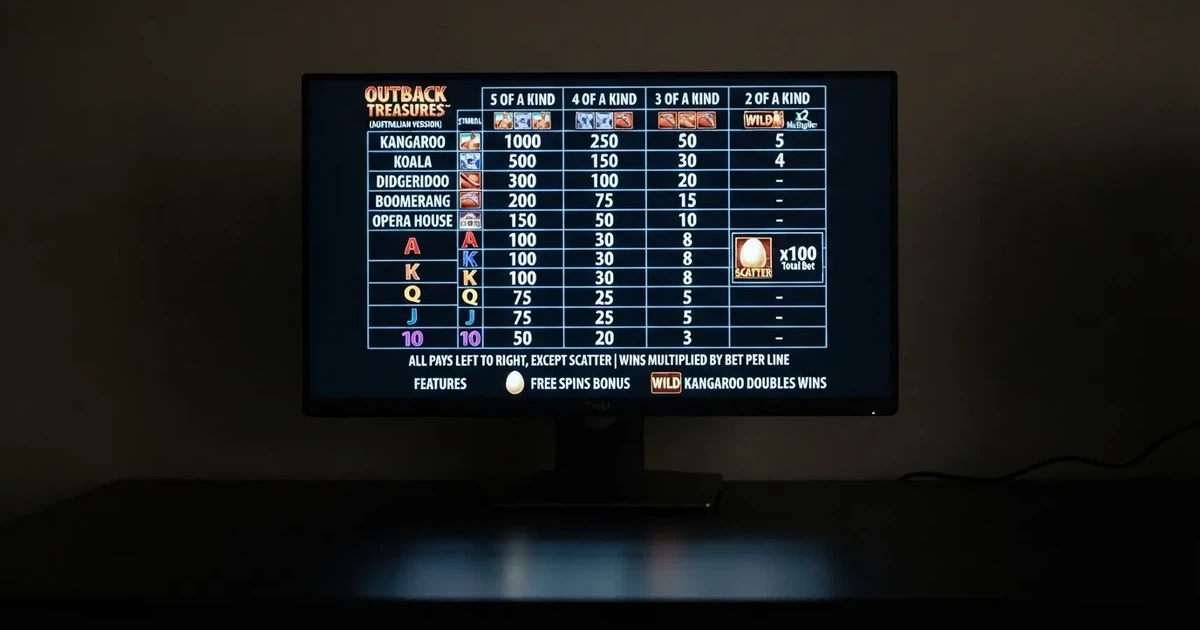
This guide explains the nature of RTP, how it is calculated, and why games with high figures are typically found in licensed venues rather than online. It also examines the brands the ACMA has targeted for offering prohibited services to Australians and details the legal framework behind those warnings. By the end, a reader should understand how to interpret a paytable, grasp what an RTP figure actually promises, and recognise why “best” is a problematic marketing term in this regulated market.
Current as of 8 November 2026. Licence claims, ACMA enforcement data, and EGMs counts verified against the ACMA’s published warnings and the relevant state regulator returns.
Table of Contents
- How a slot’s return-to-player percentage actually works
- The Australian landscape: onshore EGMs versus offshore online slots
- The legal frame: what the Interactive Gambling Act actually prohibits
- Responsible gambling: what is actually available to a player
- The high-RTP slot catalogue: what the figure looks like in practice
- How the ACMA’s enforcement record shapes what an Australian can actually reach
- What the operator warnings look like up close
- The mechanics behind the marketing: how “best RTP” gets sold
- What a player in Australia can do today
- What the offshore RTP claim is worth
- The wider gambling landscape in Australia
- Frequently asked questions
How a slot’s return-to-player percentage actually works
Return-to-player is one number trying to do two jobs. In its strict sense it is the share of every dollar a slot takes in that the machine is set, over the long run, to return as winnings. A slot configured at 96% RTP will, across enough spins to smooth out variance, return A$96 of every A$100 wagered. The remaining A$4 is the house edge, expressed differently. The two figures are arithmetic twins: 100% minus the RTP equals the house edge, and whichever way a venue chooses to print it, the other number is the complement.

The figure is theoretical in a specific way. It is not a forecast for any session a player runs; it is the asymptotic result of an enormous number of spins. A player sitting down for half an hour sees variance, not RTP. A bonus round hits on the third spin or it does not hit for two thousand spins, and either outcome says nothing about whether the game’s published figure is honest. The figure describes the design of the machine; the actual session is one sample drawn from the distribution that design produces.
It is also a figure set by the designer, not negotiated at the table. Modern video slots run on a random number generator (RNG) that produces outcomes independently of one another, and the symbol weights and reel layouts are set before the game is released. Independent testing laboratories then run the RNG through billions of simulated spins to confirm that the long-run return matches the stated figure. New South Wales, Victoria and the other states do not run that test themselves; they accept the certificates from approved testing houses and rely on them as the basis for approving a machine.
RTP does not exist outside that contract. A slot that publishes no figure has no tested return; a slot whose figure is only on a marketing page has no independent verification behind it. The clubs and pubs that hold electronic gaming machines in NSW are required to display the RTP figure on the machine’s help screen, and that figure is the one tied to the testing certificate. Offshore websites quoting RTP figures are quoting the game designer’s certificate, not their own — and the only thing that certificate tells you is what the game would do if it ran for long enough anywhere.
The arithmetic behind the figure
The mathematics is straightforward in shape, even if the working is opaque. Take a simplified three-reel slot with ten symbols on each reel and a single payline. With ten symbols on each of three reels there are 1,000 possible three-symbol combinations. If one of those combinations is the top prize and pays 100 coins for a 1-coin wager, while every other combination pays nothing, the expected return per spin is 100 coins × (1/1,000) = 0.10 coins. The bet is 1 coin. The RTP is therefore 10/100 = 10%. That is an absurd slot, but the shape of the calculation is the same for any real game: list every winning combination, multiply each by its payout and its probability, sum the products, divide by the cost of a spin.
A modern video slot with five reels and fifty symbols per reel has a different order of magnitude entirely. The total combinations climb past 300 million, and the paytable runs to dozens of symbol combinations, scatters, wilds, free-spin triggers and bonus rounds. The arithmetic still works the same way; the engineering just moves into computer simulation. The testing laboratories feed the paytable into a simulator and run billions of spins to confirm that the realised return converges on the stated RTP. That convergence is what the certificate vouches for.
What RTP does and does not promise
It promises a long-run average, not a short-run outcome. A player running ten spins on a 96% RTP slot has done nothing statistically meaningful — the standard deviation of any short session is wide enough that a 96% slot can pay out nothing or can pay out several times the wagered amount on ten spins. The figure answers the question “if a million people played this for a million spins each, what would the average return look like?” It does not answer the question “what happens if I play tonight.”
It also does not promise that one 96% slot feels like another. Volatility — sometimes called variance — is the second axis of slot design, and it describes how the winnings are distributed across spins. A low-volatility 96% slot pays small amounts often. A high-volatility 96% slot pays nothing for a long stretch and then occasionally returns a large prize. The RTP is identical, but the player’s experience of the game is entirely different. Marketing material that flatters a game by quoting its RTP alone is hiding this.
It does not survive a change in design. A slot released with one set of symbol weights at 96.5% can be re-released at a lower figure by the same developer, and many games do run in multiple RTP variants depending on the operator’s configuration. A figure quoted by an offshore site is the figure that site is running, not necessarily the figure another site runs on the same title. The player has no way to verify which version is loaded.
The Australian landscape: onshore EGMs versus offshore online slots
Australia runs one of the densest electronic gaming machine networks in the world.
| State | Pokies-style machines (outside casinos) | Date |
|---|---|---|
| New South Wales | 87,298 | June 2023 |
| Victoria | 26,380 | 2021–22 |
| Queensland | 21,122 | October 2023 |
| South Australia | 11,672 | September 2023 |
| ACT | 3,587 | November 2023 |
| ACT | 3,587 | November 2023 |
These machines are the legal home of RTP disclosure in Australia. Under each state’s gaming machine approval framework, the game’s RTP figure appears on the help screen and the paytable, and it ties back to the testing certificate lodged with the state regulator. A punter in a NSW pub can ask the machine for its RTP and read the answer. The certificate behind that figure is held by Liquor & Gaming NSW, the Victorian Gambling and Casino Control Commission, or the equivalent body in whichever jurisdiction approved the machine.
The online product is a different country. The Interactive Gambling Act 2001, tightened by the Interactive Gambling Amendment Act 2017, makes it an offence to provide online casino games — including online pokies — to a person physically in Australia. No state or territory issues a licence for the product. What is licensed is wagering on races and sport, lotteries and keno; in practice online bookmakers are licensed in the Northern Territory, where the Northern Territory Racing and Wagering Commission regulates 52 wagering operators including Sportsbet, Bet365 and Ladbrokes. The commission has no full-time staff and meets once a month in Darwin.
That split is the structural reason the term sits awkwardly. The high-RTP slot market in Australia is a physical-machine market in clubs, pubs and casinos. The sites that show up in search results for the phrase are unlicensed offshore operators offering the prohibited product. The marketing is one thing; the regulatory status is another; and the two do not line up.
How licensed Australian EGMs are tested and approved
Each state runs its own approval process for a gaming machine, but the underlying mechanism is shared. The game designer — Aristocrat, Ainsworth, IGT and a handful of others — submits the game, its math document and its RNG specification to a state-approved testing house. The testing house runs the game through billions of simulated spins and certifies that the long-run return matches the figure stated by the designer. The certificate is filed with the state regulator, and the game is added to the approved list. A venue that installs the machine displays the help screen and the paytable.
The help screen on a NSW EGM is not decorative. It is the legal disclosure of the game’s RTP and the rules of any bonus features. The figure printed there is the figure the certificate vouches for, and a player who wants to see the certificate can ask the venue operator. None of this survives the move online. An offshore site does not file the certificate with an Australian regulator; it does not display the help screen; and the figure on its marketing page is the designer’s certificate, quoted at a distance and not bound to the configuration the player is actually loading.
The 2026 reform picture adds another layer. The Interactive Gambling Amendment (Gambling Reform) Bill 2026 passed Parliament on 19 August 2026, and its advertising and inducement measures commence on 1 January 2027. The law exists with a start date and is not yet in force on this page. What is in force is the 2017 framework, as documented in the authority’s register of formal warnings.
Where RTP disclosure rules diverge from the United States
The Australian regime is more demanding on disclosure than most US state regimes. Nevada requires slot machines to return at least 75% of wagers, Mississippi at least 80%, New Jersey at least 83%. These are floors, not the figures any given machine runs at. Australian EGMs typically run in a much narrower band above their respective state minimums, and the exact figure is published on the machine. A punter in a NSW pub reading the help screen is reading a number the regulator has signed off on; a player at a Las Vegas slot reading nothing is reading the law’s silence.
The US comparison is useful because it shows what RTP disclosure looks like when it is voluntary rather than required. The Australian EGM market treats the figure as a piece of consumer information the venue owes the player. The US slot market treats the figure as a piece of compliance information the venue owes the regulator. The two are not the same disclosure.
The legal frame: what the Interactive Gambling Act actually prohibits
The Interactive Gambling Act 2001 prohibits the supply of “interactive gambling services” to customers physically in Australia. The 2017 amendment closed the loophole that had allowed offshore operators to advertise and accept Australian customers under licences issued elsewhere, and it broadened the definition of a prohibited service to cover online casino games, online pokies and in-play betting. A site that offers any of those products to a person who is in Australia is breaking the law, regardless of where the site is incorporated or what other licences it holds.
The Act targets the provider, not the customer. A player in Australia who opens an account with an offshore casino is not personally committing an offence under the IGA. The site that accepts the account is. That asymmetry is the reason ACMA enforcement focuses on the operator side — formal warnings, civil penalty proceedings, and requests to Australian internet service providers to block offending domains. The player gets a closed tab, a frozen balance, and no Australian complaints body to take the case to.
What is licensed, in practice, is wagering on sporting events and races placed before the event, lotteries and keno. Sportsbet, Bet365 and Ladbrokes operate from Northern Territory licences and offer a product that is genuinely licensed for Australian customers. Their terms, their complaints process and their responsible-gambling obligations are Australian, and a customer of those brands can use BetStop and the National Gambling Helpline in the way those services are designed to be used. None of that carries over to an offshore casino.
The credit-card ban and what it tells you about a site
Since 11 June 2024 licensed Australian wagering operators have been prohibited from accepting credit cards, credit-related products and digital currency as payment. The penalties are substantial — up to A$247,500 for an operator that accepts a prohibited payment. Legal deposit routes for licensed wagering are debit card, bank transfer, PayID/Osko and BPAY. A site asking an Australian customer for a credit card or a crypto deposit is, by that single fact, operating outside the Australian framework. The payment screen is the simplest test of whether a site is licensed for Australian customers, and the answer is almost always no for any site offering online pokies.
That test does not catch every unlicensed site. Some offshore operators accept debit cards and PayID and still offer a prohibited product. The payment method is a signal, not a verdict. But a credit-card or crypto request on an Australian-facing site is a near-certain signal that the operator is outside the regime, because no licensed Australian operator can legally take that payment for the product it is offering.
What the ACMA actually does when it acts
The ACMA’s enforcement ladder runs from investigation through formal warning to blocking requests directed at Australian ISPs. A formal warning is a written notice that names the operator, the offending service and the section of the IGA being breached, and it is published on the ACMA’s website. A blocking request is a direction to licensed Australian ISPs to make the offending domains unreachable from Australian IP addresses. Both are provider-facing actions; neither involves a customer.
The blocking total reported in June 2026 is the most current public measure of how many sites the ACMA has acted against. Since the first blocking request in November 2019 the ACMA had asked ISPs to block 1,751 illegal gambling and affiliate marketing websites, and more than 230 unlicensed gambling services had left the Australian market entirely since enforcement was strengthened in 2017. In the round reported on 26 June 2026 the ACMA asked ISPs to block another twelve domains: 7Signs, ChromaBet, Donbet, Duospin, Freshbet, Slots Gem, Jacks Club, Lucky Start, Pointsbetz, Spinrise, Vinyl Casino and Wildsino.
The pattern is consistent. Offshore operators cycle through new brands and new domains, and the ACMA plays a long game of formal warnings and blocking requests against each generation. The customer on the Australian side sees a site appear, accept deposits and disappear when the blocking request lands. The balances in accounts at the moment of blocking are not protected by any Australian regime; the offshore operator’s own terms govern.
Responsible gambling: what is actually available to a player
The Australian responsible-gambling framework is built around licensed wagering. BetStop, the National Self-Exclusion Register, has been live since August 2023 and lets a person register once and be excluded from every Australian-licensed online and phone wagering service. The exclusion periods run from a minimum of three months up to a lifetime exclusion, and a registered person cannot open new accounts with any of the bound operators during the period. BetStop is the strongest tool available to an Australian who wants to stop gambling with licensed operators.
The limitation matters here: BetStop binds only Australian-licensed online and phone wagering services. An offshore casino is not connected to the register. A person who has registered with BetStop and then opens an account with an offshore casino is not in breach of their exclusion — the offshore site has no mechanism to check the register — but they have also not used the strongest available safeguard. The exclusion only works for the services the register can see.
The National Gambling Helpline on 1800 858 858 is free, runs 24 hours a day, and connects callers to Gambling Help Online for web chat and email support. State-level services sit behind the national line — Victorian, NSW, Queensland and other jurisdictions run their own counselling and financial-counselling programs. None of these services turn a customer away because they have used an offshore site. The clinical question is the gambling, not the channel.
State-level self-exclusion schemes for physical venues are separate again. A person excluded from a NSW pub or club under the state’s venue self-exclusion arrangements cannot be readmitted to participating venues for the exclusion period. The same person can still walk into Crown Melbourne, because the venue exclusion schemes are state-specific. The Australian framework is a federation of programs, not a single national register, and the right program depends on which product and which jurisdiction the player is using.
The offshore gap and what it means in practice
A player using an offshore casino is outside every layer of the Australian framework. There is no BetStop binding the site. There is no Australian complaints body if a withdrawal is refused. There is no requirement on the operator to display its RTP figure or to honour its advertised bonus terms. The site’s own terms govern, and those terms are drafted under the law of whichever jurisdiction the operator has incorporated in — Curaçao, Anjouan, Costa Rica — not under Australian consumer law.
The ACMA’s own communications make this point plainly. A formal warning names the operator and the offending service; it does not address the customer. A blocking request makes the site unreachable from Australian IPs; it does not return money already deposited. The enforcement tools are provider-facing and prospective, not customer-facing and retrospective. A player who has lost money to an offshore site has, in practice, no Australian recourse.
This is the gap the marketing around “best RTP slots” sits inside. The phrase is designed to attract the player; the gap is what the player lands in.
The high-RTP slot catalogue: what the figure looks like in practice
The phrase “high RTP” has no single agreed floor. Different operators and different designers use the term loosely, and the marketing has bled the term of precision. As a working rule the games that get called “high RTP” tend to publish figures at or above 96%, and the games marketed as the “highest RTP” tend to publish figures at or above 97%. Those are conventions rather than definitions, and the figure printed on the help screen of a licensed EGM is the one that matters when the game is played in a venue.
The catalogue of high-RTP titles is dominated by a small set of developers and a long tail of reskins. Aristocrat and Ainsworth carry a deep Australian library because their games dominate the local EGM market. IGT and a handful of European studios contribute titles that appear more often in the offshore catalogue than in the local venues. The same title can run at different RTP figures in different markets, because the configuration is set at the operator level rather than at the game level. A punter at a NSW pub playing the Aristocrat title Lightning Link is playing a 96.3% version of that title under the NSW regulator’s approval; a player at an offshore site playing “Lightning Link” may be playing a different configuration of the same mathematics.
The offshore sites that rank “best RTP slots” rarely disclose the configuration. They quote the designer’s headline figure and present it as the figure that applies to the version the player loads. Independent verification of the live configuration is not available to the player. The testing certificate the designer filed is for the original configuration; the configuration in production on the offshore site is whatever the operator has set, and the player has no audit trail.
Game design mechanics that lift the headline RTP
A small set of design choices moves a slot from a 94% baseline into the 96–97% range that the marketing calls “high.” Reducing the symbol weights on the lower-paying combinations, removing some of the smaller bonus features, and tightening the free-spin retrigger rules are the most common levers. The trade-off is visible in volatility: a slot that has lifted its headline RTP by trimming the small wins will tend to have a longer dry stretch between payouts and a sharper peak when the bonus lands.
Megaways-style games, where the number of symbols per reel varies from spin to spin, sit in a separate category. Their published RTPs tend to be lower than the non-Megaways equivalent because the variable reel structure adds a layer of volatility that the headline figure absorbs. A Megaways title at 96% feels different from a non-Megaways title at 96%, and the player experience reflects the structure rather than the number.
Bonus buy features, where a player pays a multiple of the stake to trigger the bonus round directly, also move the calculation. A bonus buy at 100× the stake that triggers a bonus round with an internal RTP of, say, 85% returns an average of 85 coins per 100 coins paid for the buy. The headline RTP of the slot is the weighted average of base-game spins and bonus buys, and it depends on how often the player triggers the bonus normally versus through the buy. The figure is honest as a long-run average; the player experience of buying a bonus at 85% internal RTP is not the same as the headline figure suggests.
What a player can and cannot verify
A player in a NSW pub can verify the game’s RTP by reading the help screen. The certificate behind that figure is held by the state regulator and can be requested through the venue operator. A player at an offshore casino can read whatever figure the site publishes on the game page; the underlying configuration is not independently verified, and the testing certificate the site references is the designer’s certificate, not the operator’s.
The verification asymmetry is the core of the trust problem. Two slots, both quoted at 96.5%, can be very different products depending on whether the figure is regulator-vetted or marketer-claimed. The onshore EGM carries the regulator’s sign-off; the offshore slot carries the designer’s sign-off quoted at a distance. The first is auditable. The second is not.
How the ACMA’s enforcement record shapes what an Australian can actually reach
The ACMA’s published enforcement record is the most concrete measure of which offshore operators have been formally warned for offering this product to Australians. The list below summarises the brands that have been the subject of formal warnings, with the operator named in the warning and the date the warning was issued. None of these brands are licensed to offer online casino games or online pokies to Australian customers, whatever other licences they hold in other jurisdictions. The table is not a ranking and not a recommendation; it is the ACMA’s own record of action.
| Brand | ACMA action and date | Operator named by the ACMA | Subject support |
|---|---|---|---|
| RocketPlay | Formal warning, March 2026 | Pulsup Ltd | — |
| Level Up Casino | Formal warning, May 2022 | Dama N.V. | Listings only |
| Woo Casino | Formal warning, March 2025 | Dama N.V. | — |
| Spirit Casino | Formal warning, May 2025 | Dama N.V. | — |
| National Casino | Formal warning, July 2025 | Consolutetish S.R.L. | Listings only |
| Bizzo Casino | Formal warning, July 2025 (earlier 2022) | Consolutetish S.R.L. (earlier TechSolutions) | — |
| Ignition Casino | Formal warning, July 2025 | Bamboo Media | — |
| Instant Casino | Formal warning, February 2025 | EOD Code SRL | — |
| Jackbit | Formal warning, April 2026 | Ryker B.V. | — |
| Casino Intense | Formal warning, April 2025 | Sterplay Holding Ltd | Listings only |
| Sky Crown | Formal warning, September 2022 | Hollycorn N.V. | — |
The pattern across the list is structural. The same operator entity appears under several brand names — Dama N.V. is named for Level Up Casino, Woo Casino, Spirit Casino and an earlier round covering RocketPlay, Bambet, Dazard, Wild Tornado and Cobra Casinos. Consolutetish S.R.L. is named for National Casino and Bizzo Casino; TechSolutions was named for Bizzo Casino in the 2022 round. The offshore market consists of a small number of operating companies running many consumer-facing brands, as detailed in the authority’s public enforcement register.
How to read the table
The ACMA action column records the most recent formal warning over the brand, with earlier warnings noted where they exist. The operator column records the corporate entity named in the ACMA’s publication, which is the legal counterparty the warning is addressed to rather than the consumer-facing brand. The subject support column records whether the operator’s own materials confirm the connection to this product category (high-RTP slot content), drawing on the listings or background research; where that column is blank, the operator’s own materials do not confirm the connection and the brand is described here on the ACMA record alone.
No brand on this list is licensed to offer online casino games to Australian customers. The offshore licence the operator may display on its website is issued in another jurisdiction and does not authorise the supply of a prohibited interactive gambling service to a person in Australia. A player opening an account with any of these brands from an Australian IP address is using an unlicensed service, and the protections of the Australian framework do not apply.
The rate at which the ACMA is blocking sites
The arithmetic the ACMA’s own record supports is straightforward. From the first blocking request in November 2019 to the June 2026 round, 1,751 illegal gambling and affiliate marketing websites had been blocked. That is the running total across roughly six and a half years of enforcement. Worked as a band, the blocking rate sits between roughly 240 and 290 sites per year across the period — closer to 270 per year if the total is spread evenly, and running higher in the more recent rounds where the ACMA has moved from monthly blocking requests to multi-domain actions. The June 2026 round alone added twelve domains in a single action. The blocking rate is not a fixed pace; it is a function of how many new offshore brands enter the Australian market and how quickly the ACMA can build the evidentiary record for each one.
The implication is that a single offshore brand’s window of operation before a blocking request can be measured in months, not years. A player who opens an account with one of these sites and deposits money is operating on a clock that the ACMA, not the player, controls. The site may be unreachable from Australian IPs before the player has tried to withdraw.
What the operator warnings look like up close
The following sections examine the brands on the ACMA’s record. Each section details the ACMA action as published, the operator entity named in the warning, and what the brand’s materials reveal about the product category this guide covers. The pages describe operators; they do not recommend them as places to play. A player reading the descriptions should weigh them against the legal frame above and the regulator’s history.
RocketPlay
The ACMA issued a formal warning to Pulsup Ltd over Rocketplay in March 2026, and an earlier round in May 2022 named Dama N.V. over a group that included Rocketplay. The brand does not confirm any connection to a high-RTP slot product on its own materials. A player who can read the brand’s own game lobby will see online pokies; the ACMA has confirmed that what is being offered from Australia is a prohibited interactive gambling service. The duplication of warnings across two operator entities — Pulsup Ltd in 2026, Dama N.V. in 2022 — is a familiar pattern where brands change corporate hands frequently.
Level Up Casino
The May 2022 warning to Dama N.V. covered Level Up Casino along with Bambet, Dazard, Rocketplay, Wild Tornado and Cobra Casinos. The brand’s listings on third-party developer sites describe it as carrying games from BGaming and a roster of other studios; that is the listings-only evidence in the subject support column. The figure the player sees on the site’s marketing pages for any given game’s RTP is the designer’s certificate at a distance, not an Australian regulator’s sign-off.
Woo Casino
The ACMA issued a formal warning to Dama N.V. over Woo Casino in March 2025, one of two Dama N.V. warnings that year alongside Spirit Casino in May. The brand’s own materials do not provide specific confirmation of high-RTP slot products. Woo Casino is one of several Dama N.V. brands on the ACMA’s record; the same operator entity is responsible for Level Up Casino, Spirit Casino and the earlier round of warnings.
Spirit Casino
The May 2025 warning to Dama N.V. over Spirit Casino is the most recent Dama N.V. warning on the record. Spirit Casino’s own pages do not explicitly connect it to high-RTP slot products. The pattern across the three Dama N.V. brands on this list — Woo Casino, Spirit Casino, Level Up Casino — is consistent with the ACMA’s broader enforcement findings: one operator, several brands, warnings issued as the authority’s process reaches each in turn.
National Casino
The July 2025 warning to Consolutetish S.R.L. covered National Casino along with Bizzo Casino. The brand’s listings on Wikipedia and similar aggregator sites describe the games available, which is the listings-only evidence recorded here. National Casino and Bizzo Casino share an operator entity, and Bizzo Casino was also the subject of an earlier 2022 warning to TechSolutions (CY) Group Limited and TechSolutions Group N.V. The chain of operator entities is itself a signal: the brand has changed corporate hands at least once since the first ACMA action, and the current corporate counterparty is a different entity than the one named in 2022.
Bizzo Casino
The July 2025 warning to Consolutetish S.R.L. over Bizzo Casino is the most recent; the earlier 2022 warning to TechSolutions (CY) Group Limited and TechSolutions Group N.V. over the same brand sits behind it. Bizzo Casino’s platform similarly lacks explicit claims regarding high-RTP slot products. Two warnings, two operator entities, one consumer-facing brand: the offshore market’s habit of reincorporating under a new parent while keeping the brand alive explains the growth of the enforcement list.
Ignition Casino
The July 2025 warning to Bamboo Media over Ignition Casino is the only ACMA action on the brand. This operator does not mention high-RTP slots in its promotional materials. Ignition Casino has been visible in the Australian market for several years; the ACMA’s action in 2025 is the formal entry of that visibility onto the enforcement register.
Instant Casino
The February 2025 warning to EOD Code SRL over Instant Casino is the action on record. The operator lacks any claims regarding high-RTP slot performance. The 2025 warning is the first formal action the ACMA has published over the brand, and it sits within the same enforcement cycle that produced the Woo Casino and Spirit Casino warnings later in the year.
Jackbit
The April 2026 warning to Ryker B.V. over Jackbit covers the brand along with CasinOK, which the ACMA treats as a parallel offering from the same operator. This site’s documentation makes no specific high-RTP slot assertions. The April 2026 action is the most recent ACMA formal warning on this page and illustrates how the enforcement record grows as new offshore brands enter the Australian market.
Casino Intense
The April 2025 warning to Sterplay Holding Ltd over Casino Intense is the ACMA action on record. The brand’s own materials do confirm some connection to the Australian context via listings on Australian media sites, and the subject support column reads as listings-only. Casino Intense is one of the smaller brands on the ACMA’s record by market presence, and the warning is part of the ACMA’s broader 2025 enforcement round that also covered Ignition Casino, National Casino, Bizzo Casino and the Dama N.V. brands.
Sky Crown
The September 2022 warning to Hollycorn N.V. covered Sky Crown and Blue Leo casino services. Public documentation for these services includes no specific claims about high-RTP slots. Sky Crown is one of the older entries on the record in this set; the 2022 warning predates the 2025 and 2026 actions.
The mechanics behind the marketing: how “best RTP” gets sold
The marketing around “best RTP slots” runs through three moves. The first is to quote the designer’s certificate figure as if it were the figure for the configuration the player will load. The second is to rank games by headline RTP without showing volatility, hit frequency, or the configuration the operator is running. The third is to bundle the ranking with a welcome bonus offer that ties the player’s bankroll to wagering requirements that effectively double the turnover the bonus has to clear before it can be withdrawn.
The third move is the one that costs the player most. A welcome bonus that pays, say, A$500 on a A$50 deposit carries a wagering requirement that the player has to clear before any of the bonus balance becomes withdrawable. The requirement is expressed as a multiple — 40×, 50×, sometimes higher — applied to the bonus, the deposit, or the combined total depending on the terms. At 40× on a A$500 bonus, the player has to wager A$20,000 before the bonus converts to withdrawable cash. The RTP of the underlying game determines the expected loss on that A$20,000 of turnover; at 96% RTP, the expected loss is roughly A$800, which is more than the bonus itself. The “free” bonus is, statistically, an A$800 cost to the player.
The arithmetic holds for any RTP figure and any wagering multiple. The expected loss on the turnover is turnover × (1 − RTP). At a 40× wagering multiple on a A$500 bonus and a 96% RTP game, expected loss = A$20,000 × 4% = A$800. At a 50× multiple on a A$1,000 bonus and a 94% RTP game, expected loss = A$50,000 × 6% = A$3,000. The marketing frame is “free money”; the arithmetic is “expected cost.” The gap between the two is the operator’s margin on the bonus.
Volatility as the hidden variable
Two slots at the same headline RTP can feel entirely different. A low-volatility 96% slot pays small amounts frequently; the player’s bankroll moves in small steps and the session ends close to where it started, with the house edge taken in a slow bleed. A high-volatility 96% slot pays nothing for a long stretch and occasionally returns a large prize; the player’s bankroll swings widely and the session can end well above or well below the starting point, with the house edge taken in occasional large hits.
The marketing around “best RTP” rarely discloses volatility. A list of top-ten slots sorted by headline RTP will include both high-volatility and low-volatility titles side by side, and the reader cannot tell which is which from the ranking. The information needed to read the ranking is held back, and the ranking reads cleaner without it.
A player who wants to compare two 96% slots fairly needs three figures: the RTP, the volatility class, and the hit frequency (how often any winning combination lands). The first is published on licensed EGMs and quoted at a distance offshore. The second is sometimes published as a label (low, medium, high) and sometimes only implied by the game’s design. The third is rarely published at all.
What a player in Australia can do today
A player in Australia who wants a high-RTP slot experience has three honest options. The first is to play electronic gaming machines in licensed clubs, pubs and casinos. The RTP figure on the help screen is regulator-approved, the certificate behind it is auditable, and the venue operates under Australian law. The second is to play wagering products — sports betting, racing, lotteries — through a Northern Territory-licensed operator like Sportsbet, Bet365 or Ladbrokes. The third is to not play at all, and to use BetStop, the National Gambling Helpline on 1800 858 858, or a state-level counselling service if the urge to play has become a problem.
A player who wants to use an offshore casino despite the legal frame should know three things. The first is that the ACMA may block the site from Australian IPs at any time, and a blocked site will not return balances. The second is that the site’s own terms govern disputes, and the terms are drafted under the law of a jurisdiction the player has no practical access to. The third is that no Australian responsible-gambling tool — BetStop, the National Gambling Helpline, state-level self-exclusion — binds the offshore site, because the offshore site is not connected to any of those programs.
A player who is comparing two offshore sites should look past the headline RTP and ask three questions. What configuration of the game is the site actually running? What is the volatility of the game? What are the wagering requirements on the welcome bonus? The first two questions usually have no answer the player can verify. The third has an answer, and the answer usually tells the player that the “free” bonus is the most expensive part of the offer.
What the offshore RTP claim is worth
The honest reading of the offshore RTP claim is that the figure is real but the application is not. The game designer filed a testing certificate for a configuration of the game at a stated RTP figure, and that certificate is genuine. The offshore operator loaded a configuration of the game and published the designer’s certificate as the figure that applies to the version the player is loading. The two are not the same claim. The first is what the game would do if it ran at the designer’s configuration. The second is what the game would do at the operator’s configuration, which the player cannot verify.
A player who treats the offshore RTP claim as if it were the on-machine figure is paying for the difference. The on-machine figure is regulator-vetted; the offshore figure is marketer-claimed. The first costs the player the house edge. The second costs the player the house edge plus the marketing premium plus the loss of any Australian recourse if the site disappears.
The wider gambling landscape in Australia
The H2 Gambling Capital 2025 report estimates that Australians lose about A$3.9 billion a year to illegal gambling sites, and that the share of gambling going through legal channels fell from 74% in 2021 to 64%. The decline in the legal share is the size of the offshore market’s growth in Australia over four years. The ACMA’s enforcement record is the regulator’s response to that growth; the 1,751 blocked sites and 230 services that have left the market are the measurable output.
The legal channel for wagering runs through the Northern Territory. The Northern Territory Racing and Wagering Commission regulates 52 online bookmakers, including Sportsbet, Bet365 and Ladbrokes, and the commission’s operating model is unusual in its scale relative to its footprint — no full-time staff, monthly meetings in Darwin. The bookmakers are licensed in the Territory for tax reasons rather than because their customers are concentrated there; the customer base is national.
The legal channel for gaming machines runs through the states. NSW operates the largest EGM network outside casinos, with 87,298 machines as of June 2023. Victoria, Queensland, South Australia and the ACT run networks of varying size, each under their own state regulator’s approval framework. The total machine count outside casinos alone is over 150,000 across the five jurisdictions. Inside the casinos, Crown Melbourne operates baccarat variants approved by the Victorian Gambling and Casino Control Commission, and Crown’s blackjack variants have had approved rule changes logged publicly by the VGCCC, including a December 2024 renaming of the “Perfect Pairs” side bet to “Crown Pairs” and a March 2024 introduction of a “Free Bet” option with a “Pot of Gold” side bet.
The comparison with offshore online casinos is the comparison of a regulated industry with an unregulated one. The regulated industry publishes RTP figures, displays help screens, operates complaints bodies, and is bound by Australian responsible-gambling tools. The unregulated industry publishes marketing figures, displays bonus terms, operates its own disputes process, and is not bound by any Australian tool. The two are not equivalent products, and a player who treats them as equivalent is paying for the difference.
Frequently asked questions
How is a slot’s RTP percentage calculated over the long run?
The figure is the sum, across every winning combination on the slot, of each combination’s payout multiplied by its probability, divided by the cost of a single spin. For a simple three-reel, ten-symbol slot with one paying combination the calculation is direct; for a modern video slot with hundreds of combinations, scatters, wilds and bonus rounds, the calculation moves into computer simulation. The testing laboratory runs billions of spins to confirm that the realised return converges on the stated figure, and the certificate filed with the regulator is the audit trail.
Does a slot’s RTP figure guarantee any result over a single session?
No. The figure is an asymptotic average across an enormous number of spins; a single session of a few hundred spins is one sample drawn from the distribution that figure describes, and the sample can land anywhere from a substantial loss to a large payout. A 96% slot can pay out nothing for two hundred spins in a row or hit a bonus that returns ten times the wager in a single spin. The RTP describes the design; the session is variance. A player who treats the figure as a forecast for the next hour of play is misreading it.
Are RTP figures independently tested before a slot is released?
Yes, for slots that reach the Australian EGM market or any other regulator’s approved list. The game designer submits the math, the RNG specification and the paytable to a state-approved testing house, which runs the simulation and certifies the long-run return. The certificate is filed with the state regulator and forms the basis for the game’s approval. For slots offered on offshore sites, the testing certificate is the designer’s, not the operator’s; the configuration the player loads at an offshore site is not independently verified, and the player has no audit trail.
How many licensed gaming machines operate outside casinos in Queensland compared with New South Wales?
NSW operated 87,298 pokies-style machines outside casinos as of June 2023. Queensland operated 21,122 as of October 2023. The NSW count is roughly four times the Queensland count. The gap reflects NSW’s earlier legalisation of slot machines (1956), Queensland’s later and tighter regime, and the different venue types each state has approved for machine installation.
Why do two slots with the same theme sometimes carry different RTP figures?
The figure is set at the configuration level, and a designer can release the same game at multiple configurations for different markets or different operator preferences. A 96.3% Lightning Link on a NSW EGM is the configuration the NSW regulator has approved; a 94.5% Lightning Link on an offshore site is a different configuration of the same mathematics. The game name does not determine the figure; the configuration does, and the player has no way to verify which configuration is loaded on a given site.
Can a player request the RTP figure for a specific licensed pokies machine in Australia?
Yes, on the machine itself. Licensed EGMs in NSW, Victoria and the other states display the RTP figure on the help screen, and the testing certificate behind that figure is held by the state regulator. A player who wants to see the certificate can ask the venue operator or the regulator directly. The figure on the help screen is regulator-vetted and is the figure that applies to the machine as installed.