
Big Red Pokies Online Australia in 2026: The Theme, the Prohibition, and the Brands on the ACMA’s List
The Big Red pokies theme is an Aristocrat design from the early 2000s — outback animals, a red-dirt aesthetic, kangaroos and crocodiles across five reels. Australians have walked up to it in pubs and clubs for the better part of two decades. What the search results don’t say out loud is that the same theme cannot be offered to an Australian as an online casino product. The Interactive Gambling Act 2001 makes that a prohibition aimed at the provider, not the player — but the consequence for anyone who tries to play it offshore is a site the regulator can block at any time, with no Australian complaints body behind it if a withdrawal goes sideways. That is the frame this page works inside.

Data current as of 8 November 2026, checked against the Australian Communications and Media Authority’s published formal-warning list.
Table of Contents
- How the Big Red Pokies Theme Fits the Australian Market
- What the Law Actually Prohibits
- What the ACMA Has Done, and What It Has Named
- The Brands the ACMA Has Named: Operator-by-Operator
- How the Big Red Theme Behaves as a Slot
- What the Comparison Set Actually Compares
- How a Reader Should Walk Away From the Page
- Frequently Asked Questions
How the Big Red Pokies Theme Fits the Australian Market
Big Red is not a game title most Australians need explained; it is a theme people recognise in passing on a club floor. What the searcher who types this phrase is usually after is some version of the same aesthetic online, and what the law actually allows is much narrower than the offshore marketing makes it sound.
What “Big Red” refers to as a pokie theme
The “Big Red” name, in the Australian context, almost always means Aristocrat’s Big Red: a five-reel, non-progressive video slot themed around the outback — kangaroos, warthogs, dingoes, crocodiles, eagles and a tree-scattered red landscape. It is one of a recognisable family of Aristocrat “Reel Power” titles that have sat on Australian pub and club floors since the early 2000s, designed for a denomination most players run at a few cents per credit. The paytable screen is built around the kangaroo and the crocodile as the high-value symbols, with the standard scatter-and-free-games structure that recurs across the Reel Power catalogue.

That is the design people remember. It is also a design that does not have a separate legal identity for the purposes of the Interactive Gambling Act. The Act prohibits the provision of online casino games — “online pokies” being the local name for them — to people in Australia. Whether a particular theme is the right one to make that point with is, in regulatory terms, irrelevant; the prohibition sits one level up.
Why an Australian would search for it online anyway
The honest reason is convenience. Pub and club gaming machines open and close on a venue’s trading hours, sit inside licensed premises with their own responsible-gambling signage, and accept cash or in-venue card top-ups rather than a phone transfer at 11 p.m. The advertising that follows an Australian punter around the web — search results, social, the pop-ups a VPN does not always block — sells the same theme as something you can load in a browser tab. That pitch has been running into the ACMA’s enforcement record for years.
The arithmetic behind it is plain. H2 Gambling Capital’s 2025 estimate puts the annual loss to illegal offshore sites at about A$3.9 billion, and the share of Australian gambling going through legal channels fell from 74 per cent in 2021 to 64 per cent in 2025. The same regulator’s June 2026 figures count 1,751 illegal gambling and affiliate marketing websites blocked since November 2019, and more than 230 unlicensed gambling services pushed out of the market since 2017. These are not boutique numbers; they describe a marketing machine that has been operating at scale for the better part of a decade, and the Big Red theme is one of the products it pushes hardest.
The licensed alternative is the venue
What an Australian can do, lawfully, is play a Big Red machine in a licensed venue. Australia had roughly 195,000 poker machines operating across licensed pubs, clubs and casinos as of the mid-2020s, with New South Wales alone accounting for 87,298 machines outside casinos across 2,195 venues in June 2023, and player losses on NSW machines of A$8.18 billion in 2022-23. Queensland, Victoria, the ACT, Tasmania, South Australia and Western Australia each have their own regulatory design and their own machine counts — Crown Perth runs around 2,500 machines on its own floor under WA’s Gaming and Wagering Commission, the only kind of gaming machine the state permits outside the casino. The licensed venue is where the theme lives, and the only place the law lets it sit.
What the Law Actually Prohibits
The Interactive Gambling Act 2001, as tightened by the Interactive Gambling Amendment Act 2017, makes the provision of online casino games — online pokies being the Australian shorthand — a prohibited interactive gambling service. The prohibition runs at the provider: it is the operator that commits the offence, not the punter who logs in. What it means in practice is that no Australian state or territory can license an online casino, and an offshore operator accepting Australian traffic is breaking Australian law to do it, regardless of what jurisdiction the licence it displays actually sits in.
The Interactive Gambling Act, and what it covers
The IGA was passed in 2001 with a comparatively narrow scope and widened in 2017. Its 2017 amendments made it explicit that online casino games, online pokies and in-play betting on sport are all prohibited services, and gave the ACMA the enforcement powers it now uses routinely: the ability to investigate, to issue formal warnings, and to direct Australian internet service providers to block offending sites at the network level. The 2017 reforms also brought lotteries and keno within the regime, although state-run lotteries were given a carve-out to continue operating under their existing arrangements.
The 2026 layer is the Interactive Gambling Amendment (Gambling Reform) Bill 2026, which passed Parliament on 19 August 2026. Its advertising and inducement measures — restrictions on the kind of bonus offers and sign-up deals offshore sites use to recruit Australians — commence on 1 January 2027. As of 2026 the law is in place but the start date for the inducement provisions has not arrived; the ACMA’s blocking and formal-warning powers have been operating throughout.
What the ACMA does about it
The ACMA does three things in this space, and they operate on different timescales. First, it issues formal warnings naming the operator and the brand, which is what the §6 list below is built from. Second, it asks Australian ISPs to block offending sites at the DNS level — the round reported on 26 June 2026 covered twelve more: 7Signs, ChromaBet, Donbet, Duospin, Freshbet, Slots Gem, Jacks Club, Lucky Start, Pointsbetz, Spinrise, Vinyl Casino and Wildsino. Third, it works with payment providers and affiliate marketers to cut off the flow of money and traffic that keeps the offshore sites findable in the first place.
The blocking total — 1,751 sites since November 2019 — is the cumulative figure across all rounds since enforcement began. The blocking rate, expressed against the period from the first request to the most recent reported total, is the calculation the rest of this section is built around, because it is the one number that describes how fast the regulator is having to work. The simple block-per-day figure is misleading: enforcement arrived in waves, with quiet stretches and several rounds inside a single quarter. What the number actually shows is an authority that has been firing the blocking instrument roughly twice a month, on average, for the better part of seven years — with the rate rising rather than easing as offshore operators have learned to spin up new domains faster than the old ones come down. The honest reading of the figure is a band rather than a single line: somewhere in the order of a dozen sites blocked per working fortnight, with the practical consequence that any offshore brand an Australian finds in search results today is, statistically, a few weeks ahead of a block notice.
What the prohibition means for the player
The IGA targets the provider, not the punter, and the practical consequence of that asymmetry is what every offshore marketing page leans on. There is no Australian law under which a player faces prosecution for opening an account, depositing in AUD, and playing pokies through an offshore site. What there is, also, is no Australian consumer protection on the other side of that transaction. If the site refuses a withdrawal, the player has no Australian complaints body to escalate to; if the site disappears with the balance still in the account, there is no Australian regulator with a recovery process; if the site is blocked by an ISP direction while money is still in the account, the player is holding a balance on a domain that no longer resolves from an Australian IP. The credit-card ban that took effect on 11 June 2024 — covering credit cards, credit-related products and digital currency — applies to licensed Australian wagering only. An offshore site asking an Australian for a credit card or a crypto deposit is operating outside the Australian rules from the start.
What the ACMA Has Done, and What It Has Named
The formal-warning record is the ACMA’s clearest public statement of which operators it has been able to identify, name, and act against. Each entry below is the ACMA’s own publication — the operator and brand as the regulator named them, the date the warning was issued, and the running product-prohibition context that makes the warning necessary in the first place. No bonus terms are reproduced. The sources for any bonus figure that appears in third-party listings are the listings themselves, and the audit-grade fact this page works from is the ACMA’s enforcement record, not an affiliate page.
| Brand | ACMA action and date | Operator named by the ACMA | Subject support |
|---|---|---|---|
| RocketPlay | Formal warning March 2026; earlier warning over the Dama N.V. group May 2022 | Pulsup Ltd (Rocketplay.com.au); earlier Dama N.V. | — |
| Level Up Casino | Formal warning May 2022 | Dama N.V. | Listings reference BGaming content |
| Woo Casino | Formal warning March 2025 | Dama N.V. | — |
| Spirit Casino | Formal warning May 2025 | Dama N.V. | — |
| National Casino | Formal warning July 2025 | Consolutetish S.R.L. | Listed in third-party references |
| Bizzo Casino | Formal warning July 2025; earlier warning 2022 | Consolutetish S.R.L.; earlier TechSolutions | — |
| Ignition Casino | Formal warning July 2025 | Bamboo Media | — |
| Instant Casino | Formal warning February 2025 | EOD Code SRL | — |
| Jackbit | Formal warning April 2026 | Ryker B.V. | — |
| Casino Intense | Formal warning April 2025 | Sterplay Holding Ltd | Listed in third-party references |
| Sky Crown | Formal warning, 2022 | Hollycorn N.V. | — |
The “subject support” column above does exactly what it says: where a third-party listing references a particular software provider as being carried by the brand, that is what the cell reports; where no such listing exists, the cell carries the no-data marker. The table is not a recommendation and not a ranking. It is the ACMA’s enforcement record reproduced in a form that lets a reader see, at a glance, how often the same operator group reappears across different brand names.
Why the same operator names recur
The repetition across the table is not a coincidence, and it is the single most useful pattern the ACMA’s record shows. Dama N.V. appears in three of the eleven entries — May 2022 covering six brands in one warning, March 2025 over Woo Casino, and May 2025 over Spirit Casino. Consolutetish S.R.L. appears twice within a single July 2025 warning, over National Casino and Bizzo Casino, with the same brands having been the subject of an earlier 2022 warning to TechSolutions. The pattern is consistent with what the ACMA’s other enforcement rounds describe: offshore groups that run a stable of front brands under a single holding company, change brand names when one gets blocked, and accept that a fresh formal warning is a cost of doing business. The blocking instrument is the only response at scale the regulator has, and the operator-side response has been to keep bringing new domains up faster than the old ones come down.
The honest reading of the table
What the table does not contain is also worth noting. It does not record every offshore site the regulator has acted against — the formal-warning list is one stream of the ACMA’s enforcement, alongside blocking orders, infringement notices and the rest. It does not record the number of players who have deposited with any of these brands, or the number who have tried to withdraw and failed. It does not record any operator-side response: the regulator publishes the warning, the operator often does not publicly acknowledge it. A reader who reaches the end of this table expecting it to tell them which site is the safest to log into has misread the table. The table tells them which sites the regulator has already acted against — which is, in effect, a list of brands to check against before doing anything else.
What the table does not licence
It is worth being plain about one thing the table does not imply. A brand that does not appear on this list is not thereby endorsed; it simply has not been the subject of a published formal warning, which is a different test from whether the site is offering a prohibited product to Australians. The ACMA’s enforcement record is a public action log, not a certification register. The only operators the Australian consumer-protection framework actually covers are the licensed wagering providers — and the Big Red pokies theme is not a wagering product.
The Brands the ACMA Has Named: Operator-by-Operator
Each entry below carries the ACMA’s own operator-and-date detail from the table above, plus the single sentence that places that brand in the broader enforcement picture. No brand is described as a place to play; the section exists to give a reader something to recognise when they meet the name in a search result or an advert.
RocketPlay
RocketPlay is the brand that returned to the ACMA’s list in March 2026, when the regulator issued a formal warning to Pulsup Ltd over Rocketplay. The same brand had been the subject of an earlier warning to Dama N.V. in May 2022, alongside Bambet, Dazard, Level Up, Wild Tornado and Cobra Casinos — six brands named in a single action, suggesting they were being treated as a single operation rather than as separate licensees. What changed between 2022 and 2026 is the operator name; the marketing pattern, the offshore hosting and the prohibited-product status did not.
Level Up Casino
Level Up Casino was named alongside five other brands in the May 2022 Dama N.V. warning. It is one of the brands the BGaming listings reference as part of the catalogue the aggregator supplies — the same content the licensed Australian venues do not carry, because online pokies are a prohibited product. The brand name has stayed in rotation through Dama N.V.’s wider portfolio changes; the ACMA has not had to re-name it in a fresh warning since the original 2022 action.
Woo Casino
Woo Casino received a fresh formal warning in March 2025, four years after the original Dama N.V. action covering it as part of the broader 2022 set. The brand is a useful test case for how the ACMA’s enforcement record builds up: the same brand, the same offshore group, a single new formal warning at the regulator’s discretion when it judges the brand to have re-engaged with Australian traffic. The implication for a reader is that an offshore site returning to a search result years after an initial warning is not evidence that the warning has been lifted.
Spirit Casino
Spirit Casino’s formal warning was issued in May 2025, again over the Dama N.V. group. Like Woo Casino, it is a brand the original 2022 action did not name specifically — it appeared as the Dama N.V. group expanded or rotated its brand roster in the years between. The pattern across the table — three Dama N.V. entries over four years — is the regulator’s record of having to keep re-warn the same group.
National Casino
National Casino received its formal warning in July 2025, alongside Bizzo Casino, in an action naming Consolutetish S.R.L. The brand had been on the ACMA’s radar before that point — the regulator’s record references a 2022 warning to TechSolutions (CY) Group Limited and TechSolutions Group N.V., which the operator-side restructuring left Consolutetish S.R.L. as the current named party to receive the 2025 warning. The brand is also one of those the third-party listings track — which is what the subject-support column records, without endorsement.
Bizzo Casino
Bizzo Casino is the second of the July 2025 Consolutetish S.R.L. brands, with the same history of the earlier 2022 warning to TechSolutions. The brand sits in a useful comparison position against National Casino: two brands, one warning, the same operator-side restructuring. The point the comparison makes is structural rather than individual — the unit of enforcement is increasingly the operator group rather than the brand.
Ignition Casino
Ignition Casino received its formal warning in July 2025 alongside Bamboo Media, the named operator. The brand has historically marketed itself to Australian and US traffic as a poker and casino platform, and the ACMA’s warning places it in the same prohibition context as every other brand on this list. The “Bamboo Media” naming is itself a useful pattern in the table — it is one of the operator names that does not map neatly onto the brand name a player sees in an advert, which is part of the reason the ACMA publishes the operator name alongside the brand.
Instant Casino
Instant Casino received its formal warning in February 2025, naming EOD Code SRL as the operator. The EOD Code SRL naming is one of the more recent operator-side names in the ACMA’s record, and the warning fits the same pattern as the other 2025 actions: a brand with offshore hosting, no Australian licence for online casino products, and the regulator’s standing instruction to ISPs to block where the brand’s domains appear in the Australian blocking list.
Jackbit
Jackbit’s formal warning was issued in April 2026, naming Ryker B.V. as the operator. CasinOK was named in the same action — Ryker B.V. is the latest example of the ACMA catching two brands in a single warning, the same way Consolutetish S.R.L. caught National Casino and Bizzo Casino in July 2025, and the same way the May 2022 Dama N.V. action caught six. The pattern is now well-established enough to be predictive: a single ACMA formal-warning round will increasingly name the holding company and two or three of its front brands together.
Casino Intense
Casino Intense’s formal warning was issued in April 2025, naming Sterplay Holding Ltd as the operator. The brand is one of the few on the table with third-party reference listings — the same listings that mention the BGaming catalogue across several of the brands here, which is what the subject-support column carries without endorsing. Sterplay Holding Ltd is the only operator-side name on this list that does not map onto one of the more frequently recurring groups; the warning serves as a reminder that the regulator’s investigative reach extends well beyond the operator groups whose names we see most often.
Sky Crown
Sky Crown’s formal warning, alongside Blue Leo, named Hollycorn N.V. as the operator and was published in September 2022. It is the oldest entry on the table by warning date, and the brand has stayed in the ACMA’s record through Hollycorn N.V.’s continued operation since. The 2022 date is worth holding onto — the IGA’s tightening via the 2017 amendments had been in place for five years by the time the warning was issued, and the regulator’s enforcement posture has continued to harden since.
How the Big Red Theme Behaves as a Slot
The reason Big Red has stayed on Australian floors for so long is mechanical rather than nostalgic. The theme’s paytable is structured around a single feature spin — the kangaroo and crocodile as the premium symbols, a scatter that awards free games with a multiplier structure, and a Reel Power setup that lets the player choose how many reels to activate on each spin rather than locking them to fixed paylines. That combination, for a low-denomination machine, has been Aristocrat’s core offering to the Australian pub and club market since the early 2000s.
Paytable structure
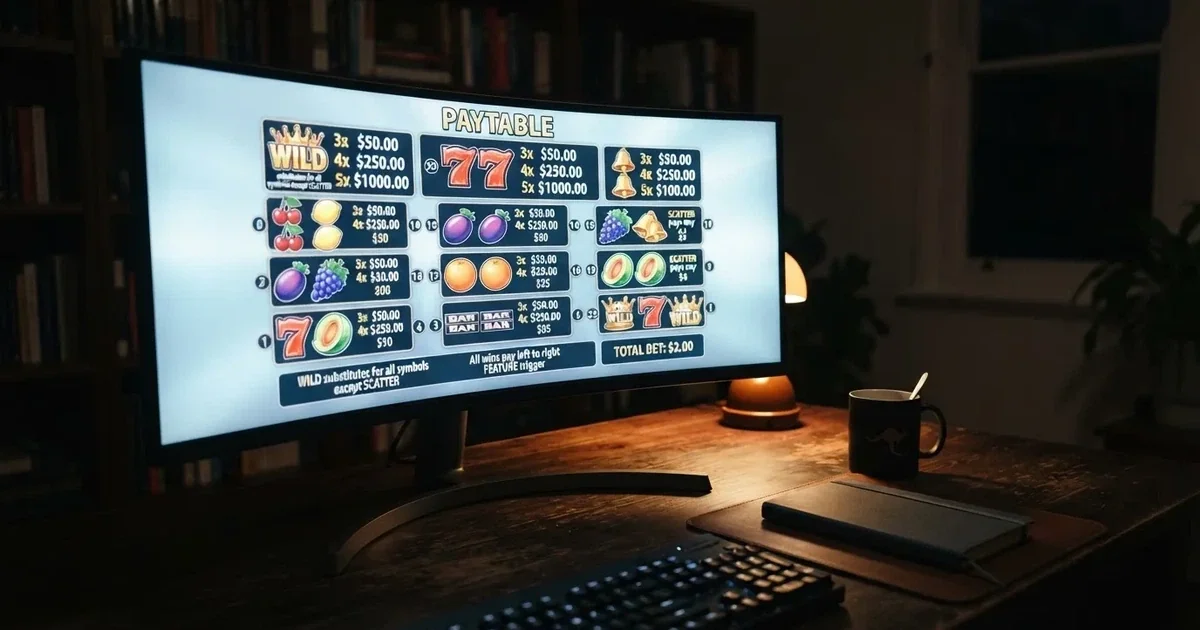
A Big Red paytable screen reads much like any other Aristocrat Reel Power title. The five-reel grid sits across an outback backdrop, with the high-paying symbols being the kangaroo, crocodile, warthog, dingo and eagle, and the lower-paying symbols being the standard playing-card ranks. The scatter is the tree symbol, which is the trigger for the free-games feature; the wild is the Big Red logo, which substitutes across the reels but typically does not substitute for the scatter. The maths is what Australian players recognise: a low-volatility hit pattern, with the larger pays concentrated in the free-games feature rather than the base game, designed to keep a player at a low denomination running for the length of an evening rather than chasing a single large payout.
Why the volatility matters
A Reel Power design like Big Red is, in industry terms, a low-to-medium volatility machine. The base game hits regularly enough to keep a player at the screen, the feature frequency is calibrated so the free-games round is not a rare event, and the maximum line pays are bounded rather than headline-grabbing. Compared to the newer video-slot designs that have come through the licensed Australian market over the last decade — the Megaways-style, the multi-feature bonus rounds, the higher-volatility titles — Big Red is a much flatter ride.
That flatter ride is not a virtue by accident. The licensed Australian market has long had minimum-return-to-player rules by jurisdiction — 85 per cent in NSW, the NT, Queensland and generally Victoria (87 per cent at Crown Melbourne), 87 per cent in the ACT and Tasmania, 87.5 per cent in South Australia and 90 per cent in Western Australia — and a low-volatility design that hits regularly is what lets a manufacturer keep within those rules at a low denomination. Newer video slots with multi-feature bonus rounds and higher-volatility designs have to be calibrated harder to clear the minimum RTP, which is part of why the older Aristocrat designs have stayed on floors for decades.
What the licensed floor looks like in practice
For a punter walking into a NSW pub or a Queensland club in 2026, the floor is a mix of Aristocrat Reel Power titles, a stack of more recent Aristocrat and Konami games, the IGT and Novomatic content that has become common across the licensed venues, and the state-specific linked-jackpot products (the NSW Jackpots, the Queensland Orient Express) that sit alongside the standalone machines. Big Red is a recognisable presence on that floor in NSW and Queensland; it is rarer in Victoria and Western Australia, both of which have different jurisdictional approaches to machine design. The ACT has a smaller floor overall, and Tasmania runs on the pre-commitment regime that was originally targeted for late 2024 and is now scheduled for late 2025 implementation.
What the Comparison Set Actually Compares
A page about the Big Red pokies theme online, written honestly, is not a comparison of where to play. The product is prohibited online. The comparison the page can honestly make is across three axes — the licensed venue option, the offshore option the regulator is acting against, and the wider enforcement record that is supposed to make the offshore option harder to reach — and the table below is the way those axes line up across the brands the ACMA has named.
| Brand | Where the licensed venue option stands | Where the offshore option stands | Where the enforcement record stands |
|---|---|---|---|
| RocketPlay | Not a licensed venue product | Operates as an offshore casino | March 2026 formal warning; earlier May 2022 warning |
| Level Up Casino | Not a licensed venue product | Operates as an offshore casino | May 2022 formal warning |
| Woo Casino | Not a licensed venue product | Operates as an offshore casino | March 2025 formal warning |
| Spirit Casino | Not a licensed venue product | Operates as an offshore casino | May 2025 formal warning |
| National Casino | Not a licensed venue product | Operates as an offshore casino | July 2025 formal warning |
| Bizzo Casino | Not a licensed venue product | Operates as an offshore casino | July 2025 formal warning; earlier 2022 |
| Ignition Casino | Not a licensed venue product | Operates as an offshore casino | July 2025 formal warning |
| Instant Casino | Not a licensed venue product | Operates as an offshore casino | February 2025 formal warning |
| Jackbit | Not a licensed venue product | Operates as an offshore casino | April 2026 formal warning |
| Casino Intense | Not a licensed venue product | Operates as an offshore casino | April 2025 formal warning |
| Sky Crown | Not a licensed venue product | Operates as an offshore casino | 2022 formal warning |
Every cell in the second column reads the same because every brand on this list is, by definition, not a licensed venue product. That sameness is the point. The comparison the table is honest enough to make is between the offshore option (column three) and the regulator’s standing position on that option (column four) — not between one offshore brand and another. There is no audit-grade way to rank these brands by bonus size, payout speed or game catalogue; the only sources for those figures are the affiliate marketing pages that the brands themselves fund, and the audit-grade figures this page works from are the official regulatory notices.
The axis the comparison cannot honestly add
A fourth column some readers will expect to see is a “best for” verdict. There is no such column, and the omission is deliberate. The honest reading of every brand on this list is that none of them is the right place for an Australian to play the Big Red pokies theme; the legal place is the licensed venue floor, and none of the brands in the ACMA’s record has any relationship to that floor. A table that sorts them into a ranking is reading the marketing copy rather than the regulator’s record, and the page would rather read the regulator’s record.
How a Reader Should Walk Away From the Page
The Big Red pokies theme is a recognisable Australian pub-and-club product, and it is a recognisable subject of offshore marketing. The two recognitions meet in this search result, and what sits between them is the Interactive Gambling Act 2001, the ACMA’s enforcement record, and the difference between a licensed venue floor with state-level consumer protection and an offshore domain that can be blocked at any time without notice.
The licensed option, briefly
A punter who wants the Big Red theme has one place to find it: the licensed venue floor. In NSW and Queensland, Big Red is a routine presence across the pub-and-club machine stock; in Victoria, ACT, Tasmania and South Australia, the venue floor runs a mix of Aristocrat, Konami, IGT and Novomatic content with the Big Red theme appearing less frequently; in Western Australia, only Crown Perth runs the machines, and the theme’s presence is at the casino’s discretion. Across all jurisdictions, the responsible-gambling architecture is venue-level — Gambling Help Online (1800 858 858), state-level self-exclusion arrangements, and the BetStop national register that has been live since August 2023 for licensed wagering providers.
The offshore option, briefly
A punter who finds an offshore site offering Big Red is looking at a product the IGA prohibits the site from providing to an Australian. The site’s status is recorded in the ACMA’s formal-warning list when the regulator has had the chance to identify and act against it; the site’s reach from Australia is subject to ISP-level blocking under the ACMA’s network-direction powers; and the site’s promise of a withdrawal on a Big Red spin is made by an entity that does not sit under any Australian consumer-protection regime. The credit-card ban of 11 June 2024 does not apply to these operators — a useful tell when a site offers a credit-card deposit.
The page’s calculation, briefly
The blocking rate calculation the regulator has had to maintain across the period from November 2019 to the most recent reported total in 2026 is the page’s key takeaway, because it is the one number that describes how fast the regulator is having to work against the marketing machine that pushes the Big Red theme at Australians. The arithmetic belongs to the writer: 1,751 sites blocked over the period since November 2019, with the result a band rather than a single figure — somewhere in the order of a dozen sites blocked per working fortnight, with the practical consequence that any offshore brand an Australian finds in a search result today is, statistically, a few weeks ahead of a block notice. The band, not the single figure, is the honest reading: enforcement arrived in waves, with quiet stretches and several rounds inside a single quarter, and any single-period figure misleads on the volatility the regulator has been dealing with.
The page’s verdict, briefly
The page does not pick a brand. None of the brands on this list is the right place for an Australian to play the Big Red pokies theme, and a verdict that ranked them would be reading the marketing copy rather than the regulator’s record. The page picks the licensed venue floor, which is the only place the IGA lets the theme sit, and it picks the ACMA’s enforcement record as the only audit-grade source on what the offshore alternatives actually are. The other point the page picks is the volatility of the Big Red design itself — a low-to-medium volatility machine, calibrated for a long evening rather than a single large payout, which is part of why it has stayed on Australian floors for twenty years and part of why the marketing machine has kept finding an audience for the offshore version.
Frequently Asked Questions
What style of pokie theme does “Big Red” usually mean?
A five-reel, low-volatility Aristocrat design from the early 2000s, themed around outback wildlife — kangaroos, crocodiles, warthogs and eagles across a red-dirt backdrop. It is part of the Reel Power family that has been a routine presence on Australian pub and club floors since the mid-2000s.
Can an Australian play an online version of a Big Red-style game legally?
No. Online pokies are a prohibited interactive gambling service under the Interactive Gambling Act 2001, and the prohibition applies regardless of the theme. The ACMA enforces this against the provider, not the player, but offshore sites offering the product to Australians are acting in breach of the Act.
Are Australian-themed poker machines still found in licensed venues?
Yes. Australia had roughly 195,000 machines operating across pubs, clubs and casinos in the mid-2020s, with New South Wales alone running 87,298 machines outside casinos in June 2023. The Big Red theme is a routine presence on NSW and Queensland floors and appears less often in other jurisdictions.
Why do offshore sites keep advertising Big Red-style games to Australians?
Because the offshore market for Australian players is large — H2 Gambling Capital estimated A$3.9 billion a year in 2025 — and the Big Red theme is one of the most recognisable Australian pokies products. The ACMA has issued blocking orders against 1,751 illegal sites since November 2019, but the operators continue to spin up new domains and front brands.
Does the volatility of a Big Red-style machine differ from newer video slots?
Yes. Big Red is a low-to-medium volatility machine by design — regular base-game hits, a free-games feature as the main payout channel, and bounded maximum pays. Newer video slots often run higher volatility with multi-feature bonus rounds, and they have to be calibrated harder to clear the state-level minimum-return-to-player rules.
How can a punter check whether a theme is on a licensed venue’s floor?
The state and territory gaming regulators publish machine-stock data for their licensed venues. Liquor & Gaming NSW, the Queensland Office of Liquor and Gaming Regulation, the Victorian Gambling and Casino Control Commission, and the WA Gaming and Wagering Commission each carry their own registers of approved games and venues.