
Mines in Australia in 2026: the grid, the IGA, and what it costs a player to play
Anyone searching for a real-money Mines casino game in Australia in 2026 runs straight into the same wall. The Interactive Gambling Act 2001 prohibits the supply of online casino games to a person physically in Australia — Mines sits inside that prohibition in exactly the way pokies, blackjack and roulette do. Offshore sites that take AUD deposits anyway do so unlicensed for the Australian market, and most of the brands a reader will encounter by name have already been the subject of a formal warning from the ACMA. This page works through the mechanics the grid actually has, the legal frame that surrounds it, and the cost a player pays once an offer is opened and accepted.
Currency stamp: data current as of 8 November 2026, verified against the ACMA’s formal warnings and blocking notices.
Table of Contents
- What the Mines casino game actually is
- Legality in Australia: why the offer does not exist lawfully
- Responsible play: the one mechanic that decides the round
- Payments and payout speed: the offshore side of the deposit
- Bonuses and free spins: the arithmetic behind the offer
- Specific games, providers and what the operator is actually hosting
- How this page ranks the brands
- Operator write-ups: the ACMA formal warnings on file
- Reading the regulator’s record
- What it costs to play anyway
- Frequently asked questions
What the Mines casino game actually is
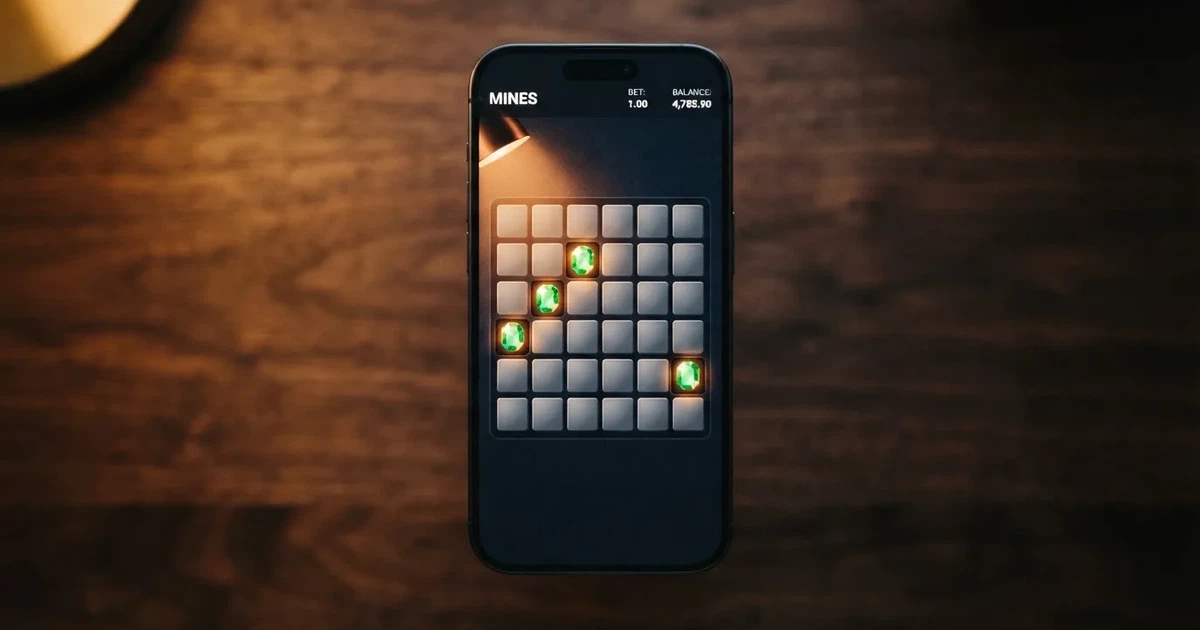
Mines is a staked adaptation of the tile-revealing Minesweeper puzzle. A grid is laid out, a fixed number of hidden mines are placed under it, and the player uncovers tiles one at a time hoping to avoid them. Each safe tile revealed raises a running multiplier; the round ends the moment a mine is uncovered, and the player takes whatever the multiplier stood at, or loses the stake from the spot they chose to cash out late.
The grid, the tiles, and the multiplier
A round opens with a stake and a chosen grid size, then a chosen number of mines — usually between one and roughly a quarter of the available tiles, depending on the operator. Every safe tile the player reveals multiplies the payout further; one mine picked ends the round and forfeits whatever has been staked but not yet cashed out. The deeper the player goes, the larger the multiplier grows, but the fewer safe tiles remain on the board.
The pattern that defines the game is the trade between the rising multiplier and the rising probability that the next click will be a mine. A one-mine, twenty-five-tile grid offers small, frequent wins for players who cash out after one or two reveals; a five-mine, five-tile grid pays dramatically more on a clean sweep but offers almost no room for error. The grid size and the mine count chosen at the start of the round fix that trade for the entire session.
Where the format comes from
The Minesweeper format dates to Ian Andrew’s 1983 puzzle game Mined-Out and Tom Anderson’s 1987 SunOS title Mines. Microsoft’s own Minesweeper, written by Robert Donner and Curt Johnson, appeared in the Windows Entertainment Pack in 1990 and shipped as a standard Windows feature until Windows 8 dropped it in 2012. The casino version keeps the reveal mechanic and adds a stake. The hidden information is identical to the puzzle’s; what changed is that someone now loses real money when a mine is uncovered.
Spribe, the studio behind the casino version of Mines that most operators host, was founded in 2018 and is best known for its earlier crash-style title Aviator, which launched in January 2019. The Mines title sits inside that same single-game, single-round format family — a stake in, a multiplier building, a player-controlled exit. The UK Gambling Commission’s public register lists Spribe OÜ under Gambling Software Remote licence 057302-R-333085-003, active since 8 December 2020, with a separate Game Host (Casino) Remote licence shown as in progress at the time of writing. On 30 October 2025 the UK Gambling Commission suspended Spribe OÜ’s remote gambling software licence on suitability grounds, after finding that the company had been hosting casino games without the separate remote casino game host licence its business model required. The Australian position does not turn on any of that — the Interactive Gambling Act 2001 does not require a casino game to be licensed overseas for it to be prohibited here — but it does matter to anyone trying to read a licence line in an operator’s footer.
Legality in Australia: why the offer does not exist lawfully
Online casino games are prohibited in Australia. The Interactive Gambling Act 2001, strengthened by the Interactive Gambling Amendment Act 2017, makes it an offence for a provider to supply online casino games, online pokies or in-play betting to a person physically in Australia. No state or territory licenses online casino games. What can be licensed is wagering on races and sport placed before the event, lotteries and keno — in practice licensed by the Northern Territory Racing and Wagering Commission.
What is and is not licensed
A wagering service that offers pre-event sports or race betting to Australians, licensed in the Northern Territory, is operating inside the law. A site that offers online pokies, online blackjack, online roulette, or online Mines to an Australian resident is not. The licence it displays is an overseas licence; it does not authorise supply into Australia under the IGA, and no amount of offshore regulation makes the supply lawful here.
The minimum age for licensed wagering is 18. The IGA targets the provider, not the individual player — Australians are not prosecuted for opening an account — but the practical consequences fall on the punter anyway. An offshore site gives no Australian consumer protection, no complaints body, and no recourse if a withdrawal is refused. The site can be blocked overnight while a balance remains on the account.
Enforcement: formal warnings and site blocking
The ACMA investigates complaints, issues formal warnings to operators it considers to be supplying prohibited services, and can ask Australian internet service providers to block offending websites. The register of those actions is the practical measure of how the prohibition is being enforced.
According to the ACMA, as reported in June 2026, a total of 1,751 illegal gambling and affiliate marketing websites had been blocked since the first blocking request in November 2019, and more than 230 unlicensed gambling services had left the Australian market since enforcement was strengthened in 2017. In the round reported on 26 June 2026 alone, the ACMA asked Australian ISPs to block 7Signs, ChromaBet, Donbet, Duospin, Freshbet, Slots Gem, Jacks Club, Lucky Start, Pointsbetz, Spinrise, Vinyl Casino and Wildsino.
What an ACMA formal warning actually changes
A formal warning is a published notice that names an operator and the brand it considers to be in breach of the IGA, and asks the provider to take steps to stop supplying prohibited services to Australians. It is not a fine, and it is not a court order; it sits at the enforcement end of the ACMA’s toolkit before site blocking. A site that has been formally warned and continues to accept Australian players is operating openly against the regulator’s stated position, not as an oversight.
The other side of enforcement is the market figure that sits behind the warning: H2 Gambling Capital’s 2025 report estimates that Australians lose about A$3.9 billion a year to illegal gambling sites, and that the share of gambling going through legal channels fell from 74% in 2021 to 64%. The supply is not a marginal leak — it is the dominant channel for online casino play in Australia.
Responsible play: the one mechanic that decides the round
Mines rewards a decision the player makes before the round starts. The tile-by-tile format lets a player keep going after every safe reveal feels lucky, and the multiplier climbs visibly as a result; that is exactly the mechanic the responsible-gambling guidance is built around. A stop point set before the stake is placed — a target number of safe tiles to cash out at, or a multiplier floor — is the only rule that constrains the round from inside.
Set the exit before the stake
The point of deciding in advance is not strategy in the puzzle sense. It is the recognition that, after two or three safe tiles, the player’s own estimate of how safe the next tile is will be biased upward, and the multiplier that the screen is showing will feel earned. Cashing out at a preset point is the only mechanism the game offers to act against that bias, and the only thing that turns a session from a chase into a series of bounded rounds.
Where Australian help is, and what it covers
BetStop, the National Self-Exclusion Register, has been live since August 2023 and binds Australian-licensed online and phone wagering services. An offshore casino is not connected to it — a self-exclusion lodged with BetStop does not extend to a site the ACMA has blocked — so the register helps with the legal side of Australian wagering rather than the offshore side. The National Gambling Helpline is 1800 858 858, free, 24/7, with chat at Gambling Help Online for anyone whose play has moved past the preset exit point.
Payments and payout speed: the offshore side of the deposit
Payment rules for Australian-licensed wagering are narrow. Credit cards, credit-related products and digital currency have been banned as payment for licensed online wagering since 11 June 2024, with penalties of up to A$247,500 for operators. Legal deposit routes for licensed wagering are debit card, bank transfer, PayID/Osko and BPAY. A site asking an Australian customer for a credit card or a crypto deposit is operating outside the Australian rules — and an unlicensed casino is not bound by any of these routes.
The deposit the Australian rules do not reach
An unlicensed offshore casino accepts whatever payment method its operator decides to expose to an Australian IP. Crypto and a credit card are both routinely available, precisely because the site is not subject to the 11 June 2024 prohibition. That is a convenience for the punter and a separate problem: if the withdrawal stalls, the only complaint route is the operator’s own support, and the regulator that could compel a payout sits in another jurisdiction.
A no-deposit bonus does not change the frame
A Mines no-deposit bonus still runs through the same casino review process as any other bonus before real money can be withdrawn: a wagering multiple applies to the bonus amount, some games contribute less than the full stake to that requirement, and there is usually a maximum-cashout cap on what a no-deposit bonus can convert into. The bonus being free at the point of deposit does not exempt it from any of those terms, and on an unlicensed site the terms are also unenforceable from an Australian complaints body if they are broken.
Bonuses and free spins: the arithmetic behind the offer
The promo codes and bonus codes advertised for Mines usually apply the same wagering terms used across the site’s other games — they are usually a casino-wide bonus labelled with a game, not a game-specific deal. The shape that matters to the player is the same wherever the code is advertised: a bonus amount, a wagering multiple, a stake cap during the bonus, a contribution rate for the game, and a maximum cashout.
Read the offer by what it costs to clear
The cleanest way to read a bonus offer is the time it takes to clear it at the stake the bonus terms allow. Required turnover is the bonus amount multiplied by the wagering factor — a A$100 bonus with a 40x requirement on the bonus alone is A$4,000 of qualifying wagers. Divided by a typical bonus stake of A$1, that is 4,000 spins of the grid. At five seconds per click, that is roughly 5.6 hours of play just to convert the bonus into withdrawable funds.
A bonus that looks generous on the headline number becomes a multi-session grind once the wagering factor is applied to it. The promo code is the cheapest part of the offer to advertise; the wagering multiple is the part that decides what it actually costs to claim.
Why a “free” bonus is rarely free
A no-deposit bonus carries the same turnover requirement in a smaller envelope — typically A$10 to A$50 of bonus money with a 40x to 60x wagering multiple — and a maximum-cashout cap that converts the bonus into a hard ceiling rather than a withdrawal. The arithmetic looks small. The cap is what decides whether the bonus is worth the time spent clearing it; on many no-deposit offers the cap is low enough that a full clear produces a payout below the time it cost.
Specific games, providers and what the operator is actually hosting
The casino version of Mines that most offshore operators host is Spribe’s title of the same name, distinguished from the puzzle only by the stake and the multiplier display. There is no Australian-licensed Mines product — no state regulator approves a game for online supply if the supply itself is prohibited. The relevant distinction is therefore between operator types, not between game variants.
The licensed land-based alternative is a different game
Australia’s licensed casinos offer table games — blackjack, baccarat, craps, roulette — under state regulator approval, but none of them offer Mines. Crown Melbourne, for example, runs three baccarat variants under the Victorian Gambling and Casino Control Commission; the VGCCC maintains a public log of approved rule changes for those table games. None of those games is Mines, and none of them is offered online. The reader who searches for “Mines” and lands on an Australian licensed site has, by definition, searched for the wrong product.
The single-game hosted format
Spribe’s product is a single round at a time — a stake, a grid, a multiplier, an exit. The format is the same on every site that licenses it; what differs is the operator’s bonus terms, the deposit routes it offers, and the licence it claims in its footer. Two sites running the same Mines title can have entirely different profiles once those three fields are filled in.
How this page ranks the brands
The plan here is unusual, and it is worth saying so outright. There is no defensible ranking of Mines casino sites for an Australian reader, because every site a reader would consider ranking is operating against the Interactive Gambling Act 2001. The “comparison” below is a record of the ACMA’s formal warnings — operator by operator, brand by brand — rather than a league table.
The comparison that does exist
The table below is not a quality ranking. Each row is an ACMA formal warning: the date, the operator the regulator named, and the brand the warning was issued over. It is the public record of who has been told to stop supplying to Australians and when.
| Brand | ACMA action and date | Operator named by the ACMA | Subject support |
|---|---|---|---|
| RocketPlay | Formal warning, March 2026 | Pulsup Ltd | — |
| Level Up Casino | Formal warning, May 2022 | Dama N.V. | Listings reference only |
| Woo Casino | Formal warning, March 2025 | Dama N.V. | — |
| Spirit Casino | Formal warning, May 2025 | Dama N.V. | — |
| National Casino | Formal warning, July 2025 | Consolutetish S.R.L. | Listings reference only |
| Bizzo Casino | Formal warning, July 2025 (and 2022) | Consolutetish S.R.L. (and TechSolutions, 2022) | — |
| Ignition Casino | Formal warning, July 2025 | Bamboo Media | — |
| Instant Casino | Formal warning, February 2025 | EOD Code SRL | — |
| Jackbit | Formal warning, April 2026 | Ryker B.V. | — |
| Casino Intense | Formal warning, April 2025 | Sterplay Holding Ltd | Listings reference only |
| Sky Crown | Formal warning, September 2022 | Hollycorn N.V. | — |
The progression down the table is chronological by most recent action rather than ranked by severity — the ACMA issues formal warnings at a single level, and the regulator’s repeated naming of an operator across multiple brands (Dama N.V. across Level Up, Woo and Spirit; Consolutetish S.R.L. across National and Bizzo) is the most useful pattern the table exposes. A reader can see at a glance which operators the ACMA considers repeat offenders rather than single-brand cases.
The calculation this page offers
The arithmetic the table above does not show is the rate at which the ACMA has been blocking sites. The first blocking request under the IGA went out in November 2019; the running total reached 1,751 by the round reported in June 2026. That is roughly 263 sites blocked per year on average across the period, or about 22 per month. The headline figure understates the recent pace: enforcement was strengthened in 2017, the first block came in late 2019, and the running total includes affiliate sites as well as gambling services. The figure a reader can take from the calculation is that the regulator is acting at a measured, ongoing rate — not a single sweep that ended years ago.
Operator write-ups: the ACMA formal warnings on file
Each entry below is the public record of the ACMA’s action over the named brand. The fact that a brand has been formally warned does not, on its own, mean the operator has stopped supplying — many of these sites were still accessible at the time of writing — and a formal warning is not a criminal finding. What it is, by definition, is the Australian regulator telling an operator that the way it is supplying to Australians is not acceptable under the IGA.
RocketPlay
The ACMA issued a formal warning to Pulsup Ltd over RocketPlay in March 2026. The same brand was earlier the subject of a May 2022 formal warning to Dama N.V. covering six brands, which is the operator lineage the brand sits inside rather than an unrelated repeat offence. Online casino games cannot be licensed anywhere in Australia, whatever licence the site displays in its footer; that frame applies to RocketPlay the same way it applies to every other brand in this list. A reader drawn to the brand by a promo offer should treat the ACMA’s record as the operative fact about it, not the licence it advertises.
Level Up Casino
Level Up Casino was named in the May 2022 formal warning to Dama N.V. that covered six brands at once. Dama N.V. is one of the more frequently named operators in the ACMA’s record, surfacing again in March 2025 over Woo Casino and again in May 2025 over Spirit Casino. The repeated naming is the most useful signal a reader can take from the entry: Dama N.V. has been told more than once that what it is supplying to Australians is not acceptable, and the brand the reader is looking at sits inside that lineage.
Woo Casino
Woo Casino drew a fresh formal warning to Dama N.V. in March 2025. The brand had not appeared in the earlier 2022 batch; the 2025 warning is the regulator acting on the brand specifically rather than as part of a six-brand sweep. The same operator lineage — Dama N.V. — sits behind Level Up Casino and Spirit Casino, which is why the ACMA’s action over Woo reads less as a one-off than as another entry in an ongoing pattern.
Spirit Casino
Spirit Casino drew a formal warning to Dama N.V. in May 2025, two months after the Woo Casino warning. The pair of warnings, two months apart, to the same operator, is the clearest signal in the ACMA’s recent record that Dama N.V. was continuing to supply prohibited services across its brands despite the earlier action. A reader looking at Spirit Casino is looking at a brand the regulator acted against, twice in three months, on the same operator.
National Casino
The ACMA issued a formal warning to Consolutetish S.R.L. over National Casino in July 2025. The same operator was named in the same month over Bizzo Casino; the pair of warnings is the same pattern the Dama N.V. trio above sets — an operator acting across multiple brands and the regulator catching up with them one brand at a time. The frame for reading the entry is the same as for any other brand here: an Australian-licensed site running this game does not exist, and the offshore site offering it has been told the supply is not acceptable.
Bizzo Casino
Bizzo Casino draws a special line in the table: the ACMA issued a formal warning to Consolutetish S.R.L. in July 2025, and had already issued a 2022 formal warning to TechSolutions (CY) Group Limited and TechSolutions Group N.V. over the same brand. That is a second formal warning tied to Bizzo Casino since 2022 — three years apart, to two different operating entities, for the same brand and the same conduct. The regulator’s record on Bizzo is unusually long, and a reader who lands on the brand has more regulator history to weigh than the other rows in the table carry.
Ignition Casino
The ACMA issued a formal warning to Bamboo Media over Ignition Casino in July 2025. Bamboo Media is the named operator; Ignition is the brand. The warning sits in the same July 2025 batch as the Consolutetish S.R.L. entries, which makes the month the busiest single batch the ACMA has published in the period covered here. The conduct the regulator named was the same conduct: supplying prohibited online casino games to Australians.
Instant Casino
The ACMA issued a formal warning to EOD Code SRL over Instant Casino in February 2025. The brand and operator pair do not reappear in the entries below; the warning is a standalone entry in the regulator’s record. That does not make the conduct any less prohibited, and it does not give Instant Casino a different status under the IGA — the prohibition is on the activity, not on repeat offenders specifically.
Jackbit
The ACMA issued a formal warning to Ryker B.V. over Jackbit and CasinOK in April 2026. The warning named two brands at once, which is a tighter version of the multi-brand pattern other operators in this list have set. A reader looking at Jackbit is looking at an operator the regulator has named twice in the same breath — once over Jackbit, once over CasinOK — and the same prohibition applies.
Casino Intense
The ACMA issued a formal warning to Sterplay Holding Ltd over Casino Intense in April 2025. The brand and operator pair are a single entry in the regulator’s record, not part of a multi-brand batch, and the conduct the regulator named is the standard prohibited supply. Casino Intense is the same frame as the other brands in the list — unlicensed for the Australian market, formally warned, and offering Mines to Australian residents anyway.
Sky Crown
The ACMA issued a formal warning to Hollycorn N.V. over its Sky Crown and Blue Leo casino services. Hollycorn is the only operator in this list with two of its brands on the same warning rather than separate warnings: Sky Crown and Blue Leo were named together. The conduct is the same; the regulatory action covers two brands at once. A reader looking at either brand is looking at the same operator and the same warning.
Reading the regulator’s record
The eleven entries above are not eleven different stories; they are one story with eleven examples. The story is that the ACMA has been issuing formal warnings to operators of offshore casino brands for years, that some operators appear more than once, and that the regulator’s record is the closest thing to a public ranking of these brands that exists for an Australian reader.
What the ACMA record does not tell a reader
A formal warning is not a finding that the operator has done anything criminal. It is a regulatory notice that names conduct the ACMA considers prohibited under the IGA. The warning does not, on its own, tell a reader whether the operator has stopped supplying, whether the site has been blocked, whether the brand still accepts AUD, or whether the offer advertised this week is the same offer the regulator named. What the warning does tell a reader, conclusively, is that the regulator has stated its position on the brand.
What the record does tell a reader
The record tells a reader which operators the ACMA has named once, which it has named multiple times, and which it has named over more than one brand. Dama N.V. (Level Up, Woo, Spirit) and Consolutetish S.R.L. (National, Bizzo) are the clearest repeat entries; Hollycorn N.V. (Sky Crown and Blue Leo in the same warning) is the clearest multi-brand entry; Pulsup Ltd over RocketPlay is a fresh name on the March 2026 warning. None of these patterns changes the underlying prohibition. They sharpen the picture of how the offshore market has been responding to it.
What it costs to play anyway
The cost question is the one a reader most often skips, because the offer is the thing in front of them. The cost is what the offer takes to clear, and what the prohibition takes if the operator disappears with a balance on it.
The cost of the bonus
A bonus offer on an unlicensed site carries the same arithmetic as a bonus offer on a licensed one — turnover = bonus × multiple, spins = turnover ÷ stake-per-spin, time = spins × 5-second interval. The numbers that go into the calculation are the operator’s own; what differs from a licensed offer is the recourse a player has if the operator refuses to honour the terms. The arithmetic does not change; the protection around it does.
The cost of the operator
An offshore casino can be blocked overnight. The ACMA’s blocking rate — 1,751 sites blocked since November 2019 — is the public measure of how often that happens. A balance on a blocked site is not a balance a player can withdraw through any Australian complaints body, because the Australian complaints bodies have no jurisdiction over the operator. The cost the prohibition imposes is the cost of an operator that cannot be compelled to pay out from inside Australia.
The cost a player can avoid
A player who reads the regulator’s record before opening an account has done the only piece of due diligence the market allows. The ACMA’s formal warnings list is the public record of who has been told to stop, and the blocking notices are the public record of who has been blocked. Neither is hidden; both are searchable. The cost a reader can avoid is the one that comes from not checking.
Frequently asked questions
Is it legal to play the Mines casino game for real money in Australia?
No. The Interactive Gambling Act 2001 prohibits the supply of online casino games to a person in Australia, and Mines sits inside that prohibition. No state or territory licenses online casino games for real-money play to Australian residents. What can be licensed is wagering on races and sport placed before the event, lotteries and keno.
How does the payout on Mines increase as more safe tiles are revealed?
Each safe tile revealed multiplies the stake further, and the running multiplier is shown on the screen until the player cashes out or hits a mine. The exact multiplier at each step depends on the grid size and the number of mines set at the start of the round; the deeper a player goes, the higher the multiplier, but the fewer safe tiles remain.
What determines how many hidden mines are placed on a Mines grid?
The player chooses the number of mines at the start of the round, within the range the operator exposes (usually between one and roughly a quarter of the available tiles). The grid size and the mine count chosen fix the trade between the size of the multiplier and the probability the next click will be a mine for the entire session.
What conditions usually apply before a Mines no-deposit bonus can be withdrawn?
A wagering multiple applies to the bonus amount (commonly 40x to 60x), and the game contributes only part of the stake to clearing it. A maximum-cashout cap on what the no-deposit bonus can convert into is also standard. The bonus being free at deposit does not exempt it from any of those terms.
Is the Mines app a separate product from the browser-based version of the game?
No. The casino version of Mines is the same single-round, single-grid format whether it is opened in a mobile browser or through an app wrapper. The difference between routes is the deposit method and the bonus offer attached to it, not the underlying game. The prohibition under the Interactive Gambling Act 2001 covers both equally.
What is a sensible way to decide a stop point before starting a round of Mines?
Pick a target number of safe tiles to cash out at, or a multiplier floor, before the stake is placed, and treat it as the only exit condition for the round. The tile-by-tile format is built to make the player keep going after a run of safe reveals; a preset exit is the only mechanism the game offers to act against that. Australian help is at the National Gambling Helpline on 1800 858 858 and at Gambling Help Online.