
Best BGaming Online Casinos Australia 2026: What a Searcher Is Actually Standing In Front Of
This page is current as of 8 November 2026, and the licence claims and blocking figures below were checked against the Australian Communications and Media Authority’s public register.
A search for “best BGaming online casinos Australia” treats BGaming the way a reader treats a brand on a coffee bag: a mark of quality, a name worth seeking out. The trouble is what stands behind that mark when the reader is sitting in Australia. BGaming is a real studio with a real catalogue, but the sites that carry its games for real money to Australian players sit outside the law this country writes for itself. The rest of this page is what that gap actually contains — the studio, the regulator, the brands the regulator has named, and the arithmetic the marketing never puts on the page.
Table of Contents
- What BGaming Actually Is
- The Australian Rule on Online Casino Play
- How the ACMA Has Acted
- Where a Reader Should Look if Play Starts to Hurt
- How a Paytable Actually Works on a BGaming Slot
- What Bonuses Actually Cost
- The Mobile Side, Briefly
- The Operators Behind the BGaming Name
- What a Reader Should Carry Away (2)
- Frequently Asked Questions
What BGaming Actually Is
BGaming is not an operator. It is a game studio, run by Stable Games Ltd out of Valletta, Malta, and it supplies content to sites rather than running them. The team inside it has worked on games since 2012, though the BGaming brand itself only debuted in 2018. The catalogue now runs past 250 certified titles, spread across video slots, video poker, lottery, card, scratch, crash and casual games. It holds a Malta Gaming Authority Critical Gaming Supply Licence (MGA/B2B/785/2020), issued on 18 March 2021, which authorises Type 1 B2B gaming services out of Malta. BGaming says its games are used by more than 3,000 operators, and it names Blaze, Pin-Up and Gamdom as examples. None of that licence authority extends to Australia, because no Australian regulator licences BGaming’s customers, and the products BGaming makes are precisely the ones the Interactive Gambling Act 2001 prohibits.
Three of BGaming’s mechanics get mentioned often enough to be worth naming once. TRUEWAYS is a ways-to-win structure that can climb to 262,144 lines; MultiDice X is a dice-led mechanic; Merge UP combines adjacent symbols into higher-value ones. These are design choices, not regulatory ones — a way to differentiate a slot on a screen full of similar ones, with no bearing on whether a site carrying the title is allowed to take an Australian deposit.
The point of the paragraph is a small one. A reader who searched this term is looking past BGaming toward the sites, and the next sections take that step deliberately: what the law says, who enforces it, what enforcement has done, and which brands the regulator has put on the public record.
The Australian Rule on Online Casino Play
Under the Interactive Gambling Act 2001 — tightened by the Interactive Gambling Amendment Act 2017 — it is an offence to provide online casino games, online pokies or in-play betting to a person physically in Australia. No state or territory licences those products. What is licensable, in practice, is wagering on races and sport before the event, lotteries, and keno. The age floor across all of it is 18. The body that does the licensable work is largely the Northern Territory Racing and Wagering Commission (NTRWC), which regulates 52 of Australia’s online bookmakers — Sportsbet, Bet365 and Ladbrokes included — from a Darwin office that runs without full-time staff and meets once a month.
The interactive gambling rules target the provider, not the player. A punter who clicks through to an offshore site is not personally at risk of prosecution. What the punter loses is everything the local licence would have given: an Australian complaints body, consumer protection, recourse if a withdrawal is refused, and a guarantee that a balance still sitting in an account will be reachable when the regulator moves to block the site. Enforcement sits with the ACMA — investigations, formal warnings, and the power to direct Australian internet service providers to block illegal sites.
The 2026 reform sits in a particular state. The Interactive Gambling Amendment (Gambling Reform) Bill 2026 passed Parliament on 19 August 2026, but its advertising and inducement measures only commence on 1 January 2027. On a 2026 page, that is law on the books, not law in force, and the distinction matters when an inducement-heavy offshore ad lands in an inbox in October.
A practical note on payments, because it is where the offshore shelf is most often caught. Since 11 June 2024, credit cards, credit-related products and digital currency have been banned as a payment method for any licensed Australian online wagering service, with penalties of up to $247,500 for an operator who takes them. The legal deposit routes for licensed wagering are debit card, bank transfer, PayID/Osko and BPAY. An offshore site that asks for a credit card or a crypto wallet is doing so because it cannot meet the Australian rules — that single signal places it on the prohibited side of the line.
How the ACMA Has Acted
The ACMA’s enforcement record is what makes the brands on this page more than names pulled from a banner ad. As of the June 2026 reporting round, 1,751 illegal gambling and affiliate marketing websites had been blocked since the first blocking request in November 2019, and more than 230 unlicensed gambling services had been pushed out of the Australian market since the regime was strengthened in 2017. In that June 2026 round alone, the ACMA asked Australian ISPs to block 12 more: 7Signs, ChromaBet, Donbet, Duospin, Freshbet, Slots Gem, Jacks Club, Lucky Start, Pointsbetz, Spinrise, Vinyl Casino and Wildsino. A single round does the work of years elsewhere.
H2 Gambling Capital’s 2025 estimate put Australian losses to illegal gambling sites at around A$3.9 billion a year, with the share of gambling going through legal channels falling from 74% in 2021 to 64%. The trend is the regulator’s case for taking a harder line, and the numbers are the reader’s case for being careful where a deposit lands.
Brand-Level Formal Warnings
The warnings the ACMA publishes name the operator behind the brand, which is why a list of casino names is in fact a list of corporate names. The relevant run runs from 2022 onward and clusters around a small group of repeat operators:
- In May 2022, Dama N.V. was warned over six brands at once: Bambet, Dazard, Level Up, Rocketplay, Wild Tornado and Cobra Casinos.
- In March 2025, Dama N.V. was warned again over Woo Casino. In May 2025, the same operator was warned over Spirit Casino.
- In July 2025, Bamboo Media was warned over Ignition Casino, and Consolutetish S.R.L. was warned over National Casino and Bizzo Casino. Bizzo had already been the subject of a 2022 warning to TechSolutions (CY) Group Limited and TechSolutions Group N.V.
- In February 2025, EOD Code SRL was warned over Instant Casino.
- In April 2026, Ryker B.V. was warned over Jackbit and CasinOK.
- In April 2025, Sterplay Holding Ltd was warned over Casino Intense.
- In September 2022, Hollycorn N.V. was warned over Sky Crown and Blue Leo.
- In March 2026, Pulsup Ltd was warned over Rocketplay — a separate front from the older Dama N.V. Rocketplay, which makes the brand name a moving target rather than a single operator.
The repeated corporate names are the most useful tell. A new skin on the same operator is still the same operator.
What the Blocking Rate Looks Like Across a Run
The numbers above reduce to a single rate worth stating in plain prose. Between November 2019 and the June 2026 round, 1,751 sites were blocked across roughly 79 months, an average of about 22 sites a month, or roughly one site every 33 hours. That is the regulator’s pace, not the operator’s. The site that the reader meets today may well be on a blocking list next quarter; the deposit that goes in this evening may not be retrievable when the block lands. The condition that goes with that band: it is a smooth average across a regime that has sped up, and a single round in June 2026 alone took out 12 sites, so a reader who treats the average as the worst case is reading the wrong row of the table.
Where a Reader Should Look if Play Starts to Hurt
The Australian safety net has two ends, and a reader who has found their way to this page through an offshore ad may not know either of them.
The first is help, free and around the clock. Gambling Help Online runs the National Gambling Helpline on 1800 858 858, with chat available on the website. The service is confidential, it does not ask the caller to register, and it is run for the situation where a punter notices the gambling starting to chase them rather than the other way around.
The second is self-exclusion. BetStop, the National Self-Exclusion Register, has been live since August 2023. It binds every Australian-licensed online and phone wagering service, and a person on the register cannot open a new account with any of them while the exclusion is in force. The limit matters because BetStop does not bind offshore sites. A punter who excludes themselves through BetStop and then opens an account with an offshore operator has excluded themselves from the protection that would have done the work, and the offshore account sits outside the regime entirely.
Tax is the third point worth one sentence here. Gambling winnings of a recreational player are not assessable income (section 6-5 of the Income Tax Assessment Act 1997), and losses are not deductible. A punter who is carrying on a business of gambling is in a different position, and that is a question for the ATO rather than for this page.
How a Paytable Actually Works on a BGaming Slot
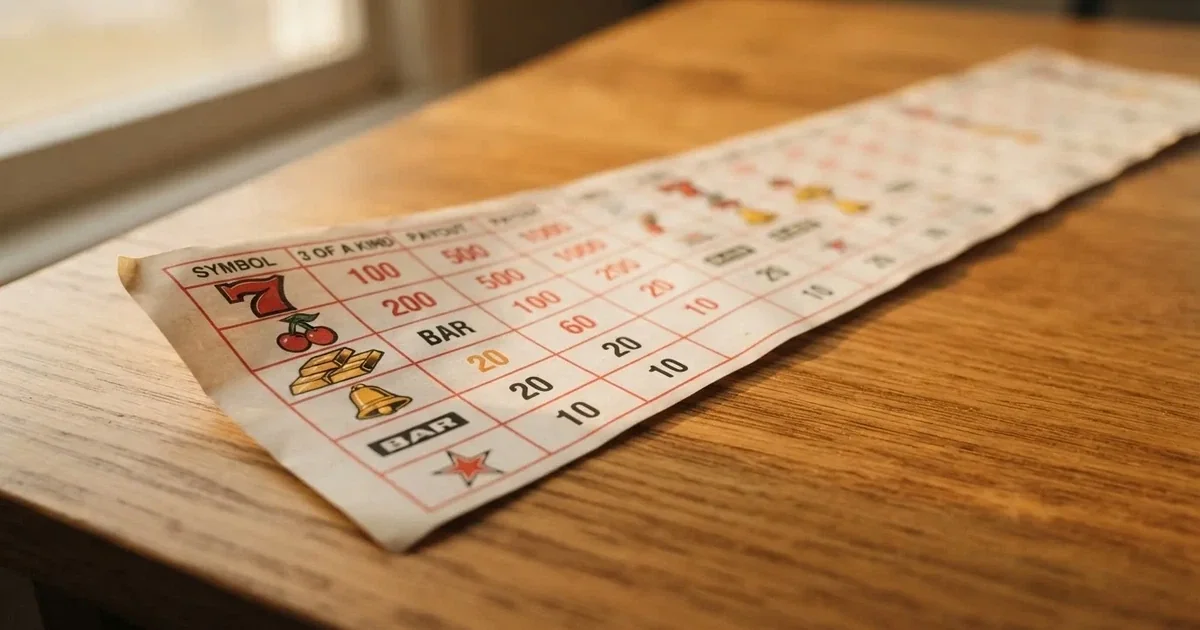
A paytable is the small reference card that sits inside every slot, and it is the most concrete thing the reader can hold onto without leaving the page. For a video slot, it lists the symbol values, the win lines, the special symbols (wild, scatter, bonus), the rules for any free-spins round, and the return-to-player percentage the studio publishes. A reader who knows how to read a paytable can read any studio’s slot; a reader who does not is reading the marketing.
The lines a reader should know how to find: the symbol values, usually expressed as multiples of the stake-per-line (so a five-of-a-kind on the top symbol paying 20× the line stake is paying 20× the stake on that line, not 20× the total spin cost); the wild, which substitutes for paying symbols; the scatter, which usually pays anywhere on the reels and triggers the bonus round; and the RTP, which is the long-run return across millions of spins and not a forecast for any session. A typical BGaming video slot runs 5 reels and 20 to 30 paylines; the studio publishes RTPs in the mid-90s, with volatility varying by title.
The mechanical edge is the house edge. If a slot has a published RTP of 96%, the house edge is 4%, and that 4% is the average cut the operator keeps on every dollar wagered over the long run. That figure does not promise anything for a single session, and it does not shrink when a bonus is in play. The arithmetic that turns a bonus into a cost lives in the next section.
What Bonuses Actually Cost
Bonuses are where the marketing does most of its work, and where the arithmetic does most of its undoing. The offer on the banner is the headline number: “100% up to A$500”, “200 free spins”, “no deposit required”. The cost of clearing that offer is what the small print holds, and the small print is built out of three things: a wagering requirement (the multiple of the bonus the player has to wager before any winnings can be withdrawn), a per-spin cap during clearing, and a maximum cashout from the bonus itself.
The Mechanics, in Plain Prose
A 100% match bonus of A$500 with a 40× wagering requirement needs A$20,000 of qualifying turnover before any winnings are withdrawable. At a typical slot stake of A$1 per spin, that is 20,000 spins. At 5 seconds per spin, that is roughly 27.8 hours of continuous play — not a session, but the better part of three working days at the machine. A 200-free-spins bonus with the same wagering on the winnings needs roughly 1,400 to 2,000 spins of clearance on top of the spins themselves, depending on what each spin returns.
The Real Cost
The expected loss on a bonus is what the wagering requirement costs the player on average. Take the same A$500 bonus with 40× wagering: A$20,000 of turnover at a 96% RTP produces an expected loss of A$800. The bonus was worth A$500; the act of clearing it costs A$800. That is the arithmetic, before any cap on cashout is applied. A cap that limits withdrawals from a “no deposit” bonus to, say, A$100 turns a lucky spin into a number that does not move.
What a Reader Should Carry Away
Bonuses on offshore sites tend to carry heavier conditions than their licensed-Australian equivalents: higher wagering multiples, tighter game weighting, shorter expiry windows. A reader who treats the bonus as a discount is being read by the bonus, not the other way around.
The Mobile Side, Briefly
A mobile casino is, in the main, a website running in a phone browser. The HTML5 build most studios use now runs the same catalogue as the desktop site, with the screen rearranged for a thumb. Native apps exist for some operators, but the offshore shelf tends to live on the web, which means a reader installs nothing and the operator ships no updates through an app store they could be removed from. The convenience is real; the absence of an app store review process is part of it.
The mobile-specific risks are the ones that come with playing on any device: an unsecured Wi-Fi connection exposes the session to anyone on the same network, a phone that is not locked lets a borrowed hand place a stake, and a session that runs out of battery mid-spin is not always recoverable. None of these are BGaming-specific, and none of them are unique to offshore sites. They are the things a reader should know regardless of where the catalogue comes from.
The Operators Behind the BGaming Name
The brands below are not recommendations. They are the brands the ACMA has named on its own formal warnings register for offering prohibited services to people in Australia. The list is drawn from §6 of the research pack and presented in the order the ACMA’s record places them; the corporate operator named by the ACMA is the line that matters, because a rebrand does not change who runs the site.
Each card carries the ACMA action and date, the corporate operator the regulator named, and a verdict that answers a different question from the one above it — what the regulator’s action implies for the reader who meets this brand today.
| Brand | ACMA action and date | Operator named by the ACMA | BGaming subject support |
|---|---|---|---|
| RocketPlay | Formal warning, March 2026 (Pulsup Ltd); earlier May 2022 (Dama N.V.) | Pulsup Ltd; earlier Dama N.V. | — |
| Level Up Casino | Formal warning, May 2022 | Dama N.V. | Listings only |
| Woo Casino | Formal warning, March 2025 | Dama N.V. | — |
| Spirit Casino | Formal warning, May 2025 | Dama N.V. | — |
| National Casino | Formal warning, July 2025 | Consolutetish S.R.L. | Listings only |
| Bizzo Casino | Formal warning, July 2025 (Consolutetish); earlier 2022 (TechSolutions) | Consolutetish S.R.L.; earlier TechSolutions (CY) Group Limited and TechSolutions Group N.V. | — |
| Ignition Casino | Formal warning, July 2025 | Bamboo Media | — |
| Instant Casino | Formal warning, February 2025 | EOD Code SRL | — |
| Jackbit | Formal warning, April 2026 | Ryker B.V. | — |
| Casino Intense | Formal warning, April 2025 | Sterplay Holding Ltd | Listings only |
| Sky Crown | Formal warning, September 2022 | Hollycorn N.V. | — |
RocketPlay
The RocketPlay name has been worn by two operators. Dama N.V. was warned in May 2022 over six brands at once, Rocketplay among them; Pulsup Ltd was warned in March 2026 over Rocketplay. A reader who arrives at a “Rocketplay” today is meeting whichever front the brand is currently running, and the regulator’s record is the only reliable source for which front is live. The verdict is on the name itself: it is a brand, not an operator, and the operator is the line the ACMA names.
Level Up Casino
Warned in May 2022 as part of the Dama N.V. cluster. Level Up is the kind of site a reader meets through a casino affiliate page, and the listing on the studio’s own directory describes it as carrying BGaming content. The regulator’s action and the studio’s listing are two different documents, and a reader who relies on the second without knowing about the first has read only the marketing.
Woo Casino
Dama N.V. was warned over Woo Casino in March 2025, having already been warned over the wider cluster three years earlier. A second action on the same operator tells a reader that the first action did not move the site out of the Australian market. The verdict here is one a reader can take forward: a formal warning does not move a site; a blocking request is what removes access, and the gap between the two is the working life of the brand.
Spirit Casino
Warned in May 2025, also over Dama N.V. The same operator, the same corporate front, a different skin. For a reader, the lesson is the same one the Woo card carries: a fresh brand name on the same operator is the same risk under a different label, and the ACMA’s record is the place to read who is actually behind the front.
National Casino
Warned in July 2025, with Consolutetish S.R.L. named as the operator. The site’s listing across several studio directories places it as a multi-studio site, which makes it a useful example of the wider pattern: a single brand carries games from many studios, and the ACMA’s action is over the site, not the studios whose content it hosts. The studios are licensable in other jurisdictions; the site is not licensable here.
Bizzo Casino
Two warnings on this one. The first was in 2022, addressed to TechSolutions (CY) Group Limited and TechSolutions Group N.V.; the second, in July 2025, addressed the same brand under Consolutetish S.R.L. A reader who assumed the first warning closed the brand has just met the second one. The verdict on a repeat name is the same as the verdict on a fresh name, with one more digit of caution: the operator has been told once already.
Ignition Casino
Warned in July 2025, with Bamboo Media named. Ignition is a brand that has run on the same bones under different operators over the years; the ACMA’s record is what pins it to Bamboo Media for the current run. A reader who knows the brand from a US-facing context is meeting a different corporate front than the one the Australian regulator names.
Instant Casino
Warned in February 2025, with EOD Code SRL named as the operator. The “Instant” branding is worth one sentence on its own: the word is doing the marketing work that the licence authority would normally do, and a reader who is reassured by the word has been read by the word.
Jackbit
Warned in April 2026 alongside CasinOK, both under Ryker B.V. The cluster is small — two sites, one operator — but it shows the same shape the rest of the table carries. A reader should treat the operator name as the unit of caution, not the brand name.
Casino Intense
Warned in April 2025, with Sterplay Holding Ltd named. The site is listed across multiple studio directories, including ones for BGaming content as a category rather than as a verified hosting claim. The verdict here is the same one the listings card carries: a listing is what the studio’s directory says, not what the operator can prove.
Sky Crown
The oldest of the warnings on this list. Hollycorn N.V. was warned in September 2022, with Sky Crown and Blue Leo named on the same notice. Hollycorn has been a prolific operator across the offshore shelf, and the warning here is one of several on its record. A reader meeting a Hollycorn site today is meeting an operator the regulator has already spoken to.
What a Reader Should Carry Away (2)
A search for “best BGaming online casinos Australia” runs into a single hard fact at the centre: the product category is prohibited. The studio is licensable in Malta; the products the studio makes are prohibited when provided to someone in Australia. The sites that ignore that prohibition are the ones the ACMA names on its public register, and the ACMA has been naming them at a rate of roughly 22 a month since November 2019.
Three practical points. The first is on deposits: a site that asks for a credit card or a crypto wallet is operating outside the Australian rules, and the asking is itself the tell. The second is on balances: an offshore account does not come with an Australian complaints body, and a blocking request can land while a balance is still inside. The third is on help: 1800 858 858 is free, around the clock, and confidential, and a punter who notices the gambling starting to chase them has not yet crossed the line they think they have.
Frequently Asked Questions
Is BGaming itself an operator, or just a game studio that supplies content to sites?
BGaming is a game studio, not an operator. It is run by Stable Games Ltd out of Valletta, Malta, and it supplies content to operators rather than running sites itself. Its Malta Gaming Authority licence (MGA/B2B/785/2020) authorises it as a B2B supplier of Type 1 gaming services, which is the supply-side half of the relationship.
Can BGaming titles be played for real money at any licensed Australian casino?
No. The Interactive Gambling Act 2001, as strengthened by the 2017 amendment, prohibits the provision of online casino games and online pokies to anyone in Australia. No state or territory licences them. Any site offering BGaming titles for real money to an Australian player is operating outside Australian law, regardless of the licence it displays from another jurisdiction.
How does a BGaming slot typically differ from other studios’ games in its paytable?
A BGaming video slot typically runs 5 reels and 20 to 30 paylines, with a published RTP in the mid-90s and volatility that varies by title. The studio’s proprietary mechanics include TRUEWAYS (which can climb to 262,144 ways to win), MultiDice X and Merge UP. These are design choices visible in the paytable, not regulatory ones that change where the slot can be offered.
Does BGaming operate its own casino, or license its games to other operators?
BGaming licenses its games to operators; it does not run its own casino. The studio states its games are used by more than 3,000 operators, with Blaze, Pin-Up and Gamdom named as examples. The site a reader meets that carries BGaming content is run by a separate operator, and it is the operator — not BGaming — that is named on the ACMA’s warnings register.
Why do offshore casinos highlight BGaming as a selling point to Australian visitors?
BGaming’s name signals a recognisable studio and a particular catalogue of mechanics (TRUEWAYS, MultiDice X, Merge UP), which gives the marketing something concrete to point at. For an Australian reader, the signal is also a tell: the sites that lean on the studio’s name are the sites operating outside Australian law, and the ACMA’s warnings register is where the names of those sites and the corporate operators behind them are kept.
Is it legal for a site to offer BGaming games for real money to people in Australia?
No. Under the Interactive Gambling Act 2001 it is an offence for a provider to offer online casino games, online pokies or in-play betting to a person in Australia. The IGA targets the provider, not the player, which is why enforcement has focused on blocking requests and formal warnings rather than on individual players. A reader who plays on such a site is outside Australian consumer protection, and the site’s balance is reachable only until the regulator moves to block it.